
/images/ppid_59c68470-image-178066257012497180.webp)

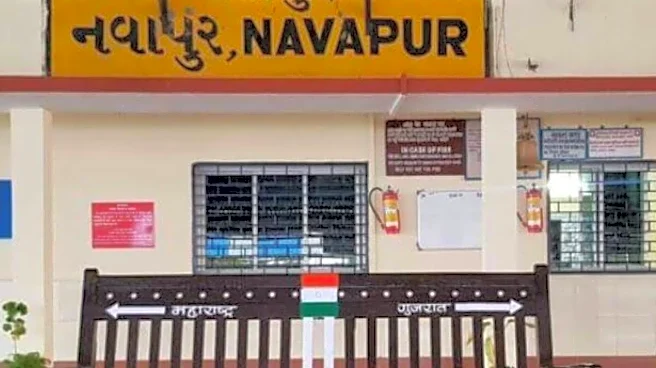
Most railway stations belong to one city, one district and one state. Navapur belongs to two. Located on the Maharashtra-Gujarat border, Navapur railway station is one of India’s strangest railway landmarks because the state boundary runs directly through the station itself.
According to Indian Railways records, the station is about 800 metres long, with roughly 500 metres lying in Gujarat and the remaining portion in Maharashtra.
The split creates wonderfully surreal situations.
A painted yellow line cuts across the station platform marking the interstate boundary. On one side, “Gujarat” is written. On the other, “Maharashtra.” Even a wooden bench at the station is divided exactly between the two states, turning it into a popular selfie point
where people joke about sitting in two states at once.
The station’s daily operations are equally unusual.
The ticket counter falls in Maharashtra while the station master’s office and some railway logistics infrastructure sit on the Gujarat side. Railway officials told the newspaper that even electricity bills arrive from two different states because of the station’s split location.
The multilingual atmosphere reflects the border identity too.
Announcements are reportedly made in four languages — Hindi, English, Marathi and Gujarati — because passengers from both states use the station constantly.
The station’s existence is partly an accident of history.
When the railway line was originally built during British rule, Maharashtra and Gujarat did not yet exist as separate states. Later, after the bifurcation of the old Bombay State in 1960, the newly created state border ended up slicing directly through Navapur station. Indian Railways simply continued operating it that way.
That strange geography produces real-world complications.
Jurisdiction disputes sometimes emerge during emergencies because police and administrative authority change depending on which side of the station an incident occurs. Railway officials described cases where authorities first called Gujarat police, only to later realise an accident technically fell on the Maharashtra side.
Different state laws also collide at the station.
One of the most fascinating examples involves alcohol. Gujarat follows strict prohibition laws, while alcohol remains legal in Maharashtra. Carrying a liquor bottle while standing on one side of the platform could technically make a person law-abiding, while standing a few feet away could place them in violation of Gujarat’s prohibition rules.
Locals have adapted naturally to the split identity.
Passengers move casually across the painted border line without much thought, while vendors, railway staff and commuters switch comfortably between Marathi, Gujarati and Hindi conversations throughout the day.
And perhaps that is what makes Navapur so fascinating.
In a country where state borders often carry strong political, linguistic and cultural significance, one ordinary railway station quietly allows people to cross into another state simply by changing seats on a bench.

/images/ppid_59c68470-image-178059752912058550.webp)



/images/ppid_a911dc6a-image-178065171192646070.webp)
