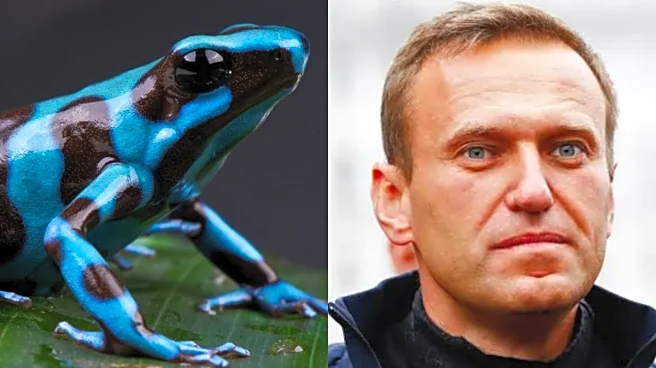



Five European countries have claimed that the Russian administration reportedly killed opposition leader Alexei Navalny using a rare poison derived from dart frog toxin.
In a joint statement, the foreign ministries of the UK, France, Germany, Sweden and the Netherlands said the Russian opposition leader was poisoned with a rare and lethal toxin found in the skin of poison dart frogs.
“We know the Russian state now used this lethal toxin to target Navalny in fear of his opposition,” the UK’s Foreign Office said in a statement.
The European countries said Russia had the means, motive and opportunity to use the poison, and added that they would report Moscow to the Organisation for the Prohibition of Chemical Weapons for violating the Chemical Weapons Convention.
His widow, Yulia Navalnaya, said on Saturday that her husband’s death in an Arctic prison in 2024 was “murder” and is now a “scientifically proven fact”.
What Is Dart Frog Toxin?
As per scientists, toxins found in poison dart frogs are being described as some of the most powerful natural poisons known to science. These small, brightly coloured amphibians inhabit the rainforests of Central and South America and carry potent chemical compounds in their skin as a defence against predators.
How It Works?
According to the Environmental Literacy Council, the poison linked to dart frogs is batrachotoxin, a steroid alkaloid that interferes with the communication between nerves and muscles. Under normal conditions, nerve cells transmit electrical signals by opening and closing specialised pathways known as voltage-gated sodium channels.
Batrachotoxin compels these channels to remain open, triggering a continuous flow of sodium ions into cells. This severe disruption can lead to paralysis, irregular heart rhythms and, in extreme cases, heart failure.
Research cited by ScienceDirect noted that batrachotoxin is among the deadliest natural poisons, capable of causing rapid and severe effects if it enters the human body.
Where The Toxin Comes From?
Poison dart frogs are not believed to produce these toxins themselves. According to researchers, these frogs likely accumulate toxic alkaloids through their diet, particularly from insects such as ants, beetles and mites.
Frogs raised in captivity on controlled diets do not develop the same level of toxicity, supporting the theory that their poison is diet-derived.
Another compound identified in some species is epibatidine, a chlorinated alkaloid also found in frog skin secretions. Scientists have studied epibatidine for its biological effects, including its powerful impact on the nervous system.