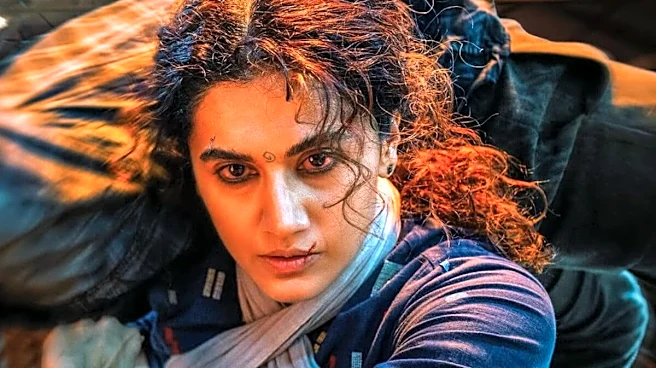



Taapsee Pannu’s recently released film Gandhari has become a talking point ever since it premiered on Netflix. The movie follows the story of a mother, Bani, whose daughter gets kidnapped at a railway station, and while trying to save her child, she loses her vision. She later trains herself and sets out on a mission to find her daughter, only to uncover a much larger child-trafficking network. But if Taapsee’s character is named Bani, why is the film called Gandhari? The answer lies in the film’s symbolic connection to the Indian mythological epic Mahabharata.
Is Gandhari an adaptation of the Mahabharata?
While the Taapsee Pannu-starrer is not a direct adaptation of the Mahabharata, its title draws inspiration from one of the epic’s most significant characters, Gandhari. She was the wife
of the blind King Dhritarashtra and famously chose to blindfold herself after their marriage, symbolically sharing her husband’s lack of sight. Gandhari was also portrayed as a grieving mother following the Kurukshetra war, after losing her 100 sons.
In the Kanika Dhillon-written film, Taapsee’s character Bani draws a symbolic parallel with Gandhari from the Indian epic. Like Gandhari, Bani is a grieving mother who finds herself without sight, although the circumstances surrounding their loss of vision are vastly different. This thematic connection between the two characters is what gives the film its title, Gandhari.
Kanika Dhillon wished to reinterpret Gandhari
Meanwhile, writer Kanika Dhillon has said she wanted to reinterpret Gandhari’s role as a woman who actively fights for her child, rather than remaining passive. Speaking about the character, Dhillon said, “Gandhari, in the Mahabharata, has been a mother who could never actively take a stand. This time I wanted to reinterpret that, see her actually making the right decision and getting into the battlefield and fighting that war.”
The film, therefore, uses Gandhari as a symbolic reference rather than directly retelling her story. Bani and Gandhari share similarities as mothers who experience the loss of sight, but their journeys are fundamentally different. Bani actively enters the battlefield herself to rescue her daughter, while Gandhari is predominantly remembered as a grieving mother who lost her 100 sons in the Kurukshetra war.
Ultimately, Gandhari uses the character from the Mahabharata as a thematic parallel to explore motherhood, loss, blindness and a woman’s determination to fight for her child.








/images/ppid_59c68470-image-178852755820280243.webp)
