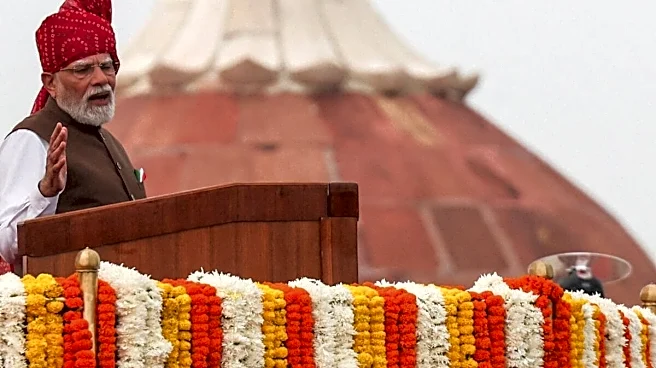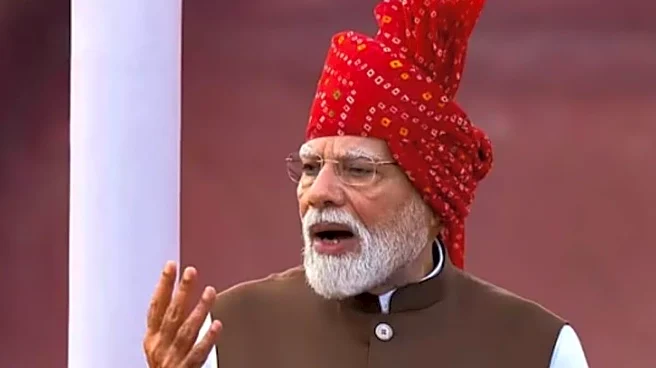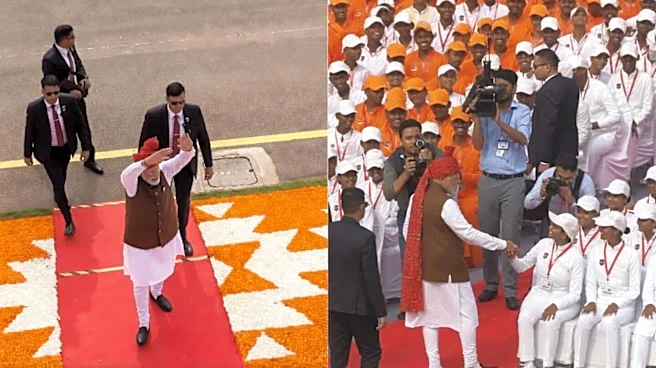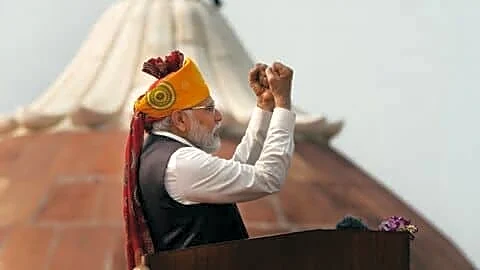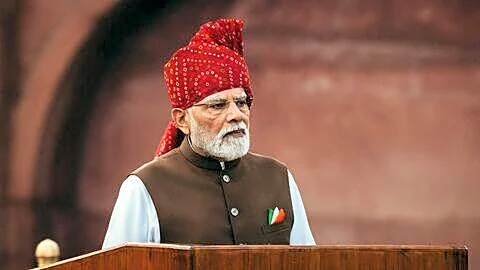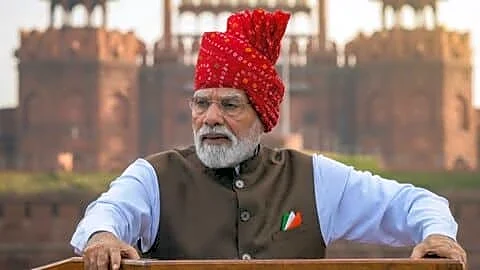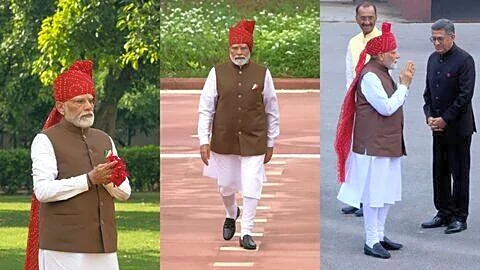

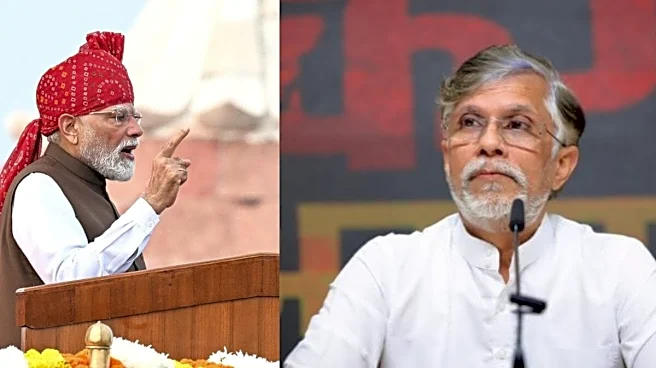
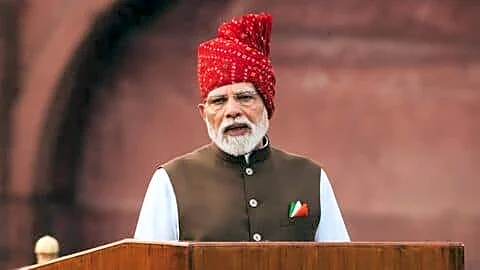
Since 2014, Narendra Modi has addressed the nation from the Red Fort thirteen times as the prime minister. Strung together, the speeches trace a shift — from cleanliness and financial inclusion in the early years, through security and surgical-strike assertiveness in the middle years, to an economy-and-youth-first pitch in 2025 and 2026.
The arc becomes visible once the speeches are read side by side rather than as standalone events each August. Early addresses were built around visible, everyday problems — toilets, bank accounts, manufacturing jobs. Later ones increasingly centred on India’s standing in the world — its economy, its military doctrine, its technological self-reliance.
The latest two speeches mark a further shift again, from defending
India’s position to actively building out its economic ambition.
How Did The Early Years (2014-2017) Set The Tone?
Modi’s first address in 2014 leaned heavily on sanitation and financial access — the Swachh Bharat Mission and Jan Dhan Yojana were the headline announcements, alongside an early manufacturing push aimed at youth employment.
By 2015, the emphasis had shifted to unity, with Modi warning against “casteism” and “communalism” while citing Jan Dhan’s early numbers — 17 crore accounts and ₹20,000 crore deposited.
The 2016 and 2017 speeches, delivered in the shadow of that September’s surgical strikes and demonetisation, pivoted toward security assertiveness and a cashless economy, with Modi crediting the strikes for changing how the world saw India’s military resolve, and pushing citizens toward digital transactions and Benami-property crackdowns.
What Changed In The GST And Healthcare Years (2018-2020)?
By 2018, GST — rolled out the previous year — had become a talking point of its own, framed as an economic “game-changer,” alongside the launch of Ayushman Bharat, then billed as the world’s largest government health cover scheme.
The 2019 speech, delivered soon after Article 370’s abrogation, dealt with Jammu and Kashmir directly, alongside the Jal Jeevan Mission for water access and a push against single-use plastic.
Then came 2020 — the Covid-19 pandemic reshaped the entire address, with Modi using the Red Fort platform to launch Atmanirbhar Bharat (self-reliant India), a framing that would recur in every subsequent speech through 2025.
What Did The ‘Panch Pran’ Era (2021-2023) Add?
As India marked 75 years of independence, Modi used the 2021 and 2022 addresses to introduce longer-horizon framing: the Gati Shakti infrastructure push worth ₹100 lakh crore, and then the “Panch Pran” (five pledges) in 2022 — developed-nation status by 2047, shedding a “colonial mindset,” pride in heritage, unity, and civic duty.
By 2023, the speech leaned into economic positioning, with Modi noting India’s rise from the world’s 10th-largest economy in 2014 to fifth-largest, alongside an appeal for peace during unrest in Manipur.
How Does 2025 Mark A Turn Toward Security Assertiveness?
The 2025 address was arguably the most security-heavy of the run. Delivered months after Operation Sindoor, it centred on defence self-reliance — indigenous fighter jet engines, a new Sudarshan Chakra Mission targeting a security shield by 2035, and the suspension of the Indus Waters Treaty.
Even the economic content that year — semiconductor plants, nuclear energy targets, critical minerals — was framed through a self-reliance lens rather than growth or opportunity.
What Makes 2026 A Distinct Chapter?
This year’s address pulls back from security framing almost entirely, replacing it with an economy-and-youth pitch.
Modi opened by invoking Vande Mataram’s first-ever rendition at the Red Fort, then pivoted to India’s journey from the “Fragile Five” in 2014 to the world’s fastest-growing major economy over 12 years.
His central announcement, “Sapta Dhara” — seven streams of strength — deliberately echoes the historical “Sapta Sindhu” era rather than continuing 2025’s defence-driven “self-reliance” language.
Youth announcements followed a similar shift: AI training for a crore young Indians, free online coaching, and a personal appeal for youth to volunteer time toward the ongoing census — asks that are civic and economic rather than defensive.
Conclusion
Two things have stayed constant across all thirteen speeches: the 2047 “Viksit Bharat” deadline, present in some form since at least 2022, and Modi’s habit of pairing at least one large infrastructure or technology number with a direct appeal to the country’s youth.
What’s shifted is the register — from cleanliness and access, to security and assertiveness, to what now looks like an attempt to convert twelve years of stated self-reliance into visible global standing.