
/images/ppid_a911dc6a-image-177072016638512152.webp)
/images/ppid_a911dc6a-image-177072012220392505.webp)
/images/ppid_59c68470-image-177072004423273525.webp)
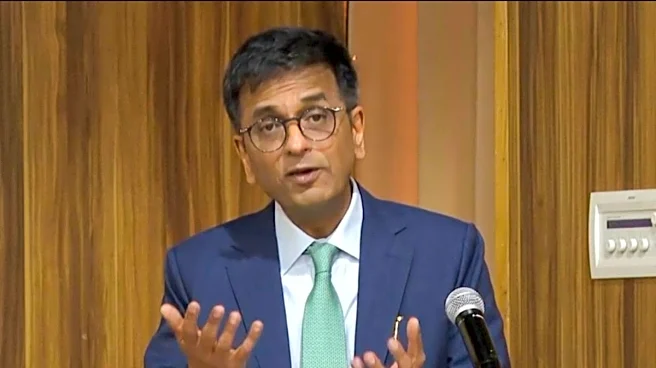
Former Chief Justice of India DY Chandrachud on Sunday remarked that bail before conviction should be a matter of right, but noted that it is a court’s duty in depth where national security is involved.
He made the remarks at the ongoing Jaipur Literature Festival in response to a question from a journalist, who raised the issue of the Supreme Court recently denying the bail plea of activists Umar Khalid and Sharjeel Imam in the 2020 Delhi riots conspiracy case.
The top court on January 5 observed that they were involved in the “planning, mobilisation and strategic direction” of the northeast Delhi riots and said a delay in trial does not operate as a “trump card” which automatically displaces statutory safeguards.
During a session titled ‘Ideas
of Justice’, Justice Chandrachud (retd) said, “Bail before conviction should be a matter of right. Our law is based on a presumption, and that presumption is that everyone is innocent until proven guilty. Because, if someone remains an undertrial prisoner for five or seven years and is finally proven innocent, how will you compensate for the time lost?”
He said bail can be denied if there is a possibility of the accused returning to society and committing the crime again, tampering with evidence, or using the benefit of bail to escape the clutches of the law. “I think that where national security is involved, it is the court’s duty to examine the case in depth. Otherwise, what is happening is that people remain imprisoned for years,” he said.
The former CJI called the denial of bail by sessions and district courts a matter of concern and said judges fear that their integrity might be questioned. “This is the reason why bail cases reach the Supreme Court,” he said.
Highlighting concerns over the slow pace of case disposal in the Indian criminal justice system, Justice Chandrachud emphasised that the Constitution is the supreme law, allowing no exceptions. “If there is a delay in a speedy trial, the accused is entitled to bail,” he added.
The 2020 Northeast Delhi riots broke out on February 24, 2020 during protests against the Citizenship (Amendment Act) (CAA) and NRC. The violence lasted several days, resulting in at least 53 deaths and over 700 injuries. The Delhi Police Special Cell filed multiple FIRs, including one under UAPA (Unlawful Activities Prevention Act, 1967) and IPC provisions alleging a “larger conspiracy” behind the violence.
(with inputs from PTI)