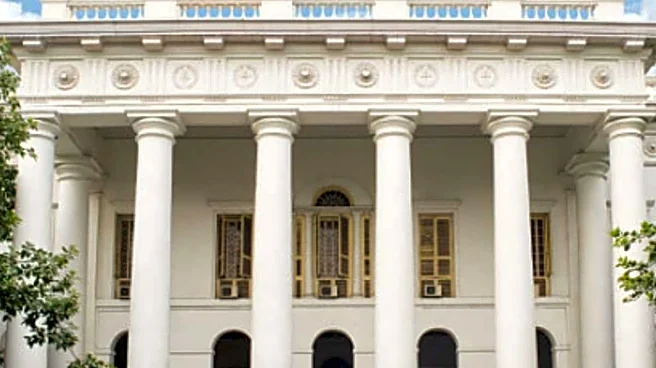

India has been home to globally known centres of learning for thousands of years. When we speak of ancient education, Nalanda and Takshashila immediately come to mind. But when the discussion shifts to modern
universities, the timeline changes. The modern phase of university education in India began in the year 1857. Many recall this year for the First War of Independence, but 1857 holds another important milestone, the establishment of India’s first modern university in Calcutta.
The University of Calcutta was founded on 24 January 1857. In that same year, two more universities came up, one in Bombay and another in Madras. Together, these three institutions laid the foundation of the modern higher education system in India, built on the British model.
How Calcutta University Was Conceived
The roots of Calcutta University trace back to the Wood’s Dispatch of 1854. It was a detailed policy document that recommended bringing modern educational reforms to India. Charles Wood, who authored the policy, argued that India could not progress unless education from the primary level to the university level was properly organised and supported. This dispatch is often called the “Magna Carta of Indian Education.”
Among its major recommendations was the creation of universities in three key presidencies: Calcutta, Bombay and Madras. That recommendation became reality within three years.
Modelled On The University Of London
When Calcutta University began, its structure was based on the University of London. It was the first university in Asia to operate simultaneously in three domains: undergraduate teaching, postgraduate study and academic research.
In its early years, Calcutta University functioned mainly as an examining body. Over time, it expanded into a full-fledged teaching and research institution, contributing significantly to India’s intellectual landscape.
Four Nobel Laureates Associated With Calcutta University
Very few institutions in Asia boast the distinction that Calcutta University holds. Over its long history, four Nobel Prize winners have been linked to this university either as students, teachers or through affiliated colleges.
Rabindranath Tagore: He served as the Ramtanu Lahiri Professor of Bengali at Calcutta University between 1932 and 1933.
C.V. Raman: He held the position of Palit Professor of Physics at the university from 1917 to 1934 and conducted much of his pioneering research during this period.
Amartya Sen: He studied Economics (Honours) at Presidency College in Calcutta, which was then affiliated with Calcutta University.
Abhijit Vinayak Banerjee: He too completed his Economics (Honours) degree from Presidency College in Calcutta, marking the beginning of his academic journey.
Distinguished Alumni
The university’s alumni list includes prominent thinkers, leaders and scholars who shaped modern India. Among them are:
- Bankimchandra Chattopadhyay, novelist and writer of ‘Vande Mataram’
- Prafulla Chandra Ray, noted chemist
- Swami Vivekananda, philosopher and spiritual leader
- Jadunath Sarkar, historian
- Dr Rajendra Prasad, the first President of India
- Each contributed to the intellectual and social journey of modern India.
Even after more than 165 years, Calcutta University remains a symbol of India’s transition from ancient learning traditions to a modern university system. Its story is not only about institutions and courses, but about shaping minds that went on to influence India and the world.
/images/ppid_a911dc6a-image-17706892382281453.webp)

/images/ppid_a911dc6a-image-17706885616409661.webp)
/images/ppid_a911dc6a-image-177068852974566338.webp)
/images/ppid_59c68470-image-177068768683725044.webp)

/images/ppid_59c68470-image-177068754309129213.webp)
/images/ppid_59c68470-image-177068773220034130.webp)
/images/ppid_59c68470-image-177068778557690523.webp)
/images/ppid_59c68470-image-177068760218448786.webp)

/images/ppid_59c68470-image-177068503852327487.webp)