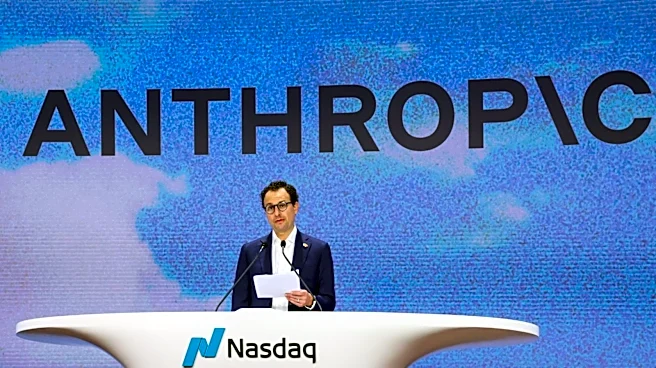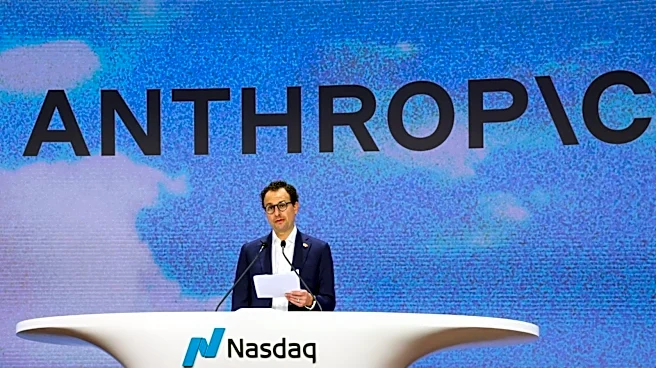




Anthropic, the company behind the Claude AI chatbot, made history on November 19 with an $81.3-billion public offering, marking one of the biggest stock market debuts ever. Priced at $83 per share, the IPO initially valued the company at around $1.5 trillion. Its shares opened sharply higher on Nasdaq and closed their debut session at $97.17, up around 17% from the IPO price.
Meanwhile, major technology companies such as Meta, Alphabet and Microsoft are facing growing investor scrutiny over their massive AI investments and the pressure these expenditures are putting on cash flows. Despite concerns about rising infrastructure costs and intense competition, investors continue to pour money into companies developing advanced AI models.
So, what makes
Anthropic’s IPO significant? How are investors valuing AI companies, and does the blockbuster listing signal confidence in the industry’s future? More importantly, what could it mean for Indian stock markets and IT companies?
Why Is Anthropic IPO Historic?
Anthropic became one of the world’s most valuable firms after just one day of trading. Many of the AI company’s founders, investors and employees are now worth billions of dollars, and the demand for the firm’s stocks remains resilient.
Anthropic shares closed at just above $97, valuing the company at around $1.7 trillion. The stock had surged 34% shortly after trading began on Thursday, briefly pushing its valuation past $2 trillion.
The company’s blockbuster market debut made it the biggest IPO in history. The company raised $81 billion by selling 980 million shares, beating the previous record set by Elon Musk’s SpaceX, which raised $75 billion in June.
“Anthropic’s listing is historic because it is the first public verdict on a frontier AI lab built around vast compute costs, safety commitments and enterprise software. Raising about US$81 billion makes it the biggest IPO, but the important test is whether investors will fund the infrastructure required to compete. It is also the biggest IPO ever, surpassing SpaceX. Besides it is a young company, few years old, and this has been a stratospheric rise,” said Jaspreet Bindra, Co-Founder of AI&Beyond.
Despite the excitement surrounding the listing, major US stock indices fell to their lowest levels in seven months on November 19, amid growing concerns about the AI industry’s long-term prospects.
Are Investors Again Betting Big On AI?
The enthusiasm surrounding the AI market had cooled somewhat in recent weeks. Last week’s resignation of Nvidia CEO Jensen Huang raised fresh concerns among investors. While AI has boosted economic growth, it has also triggered worries about rising debt and warnings about its potential risks. An anti-data centre movement may also have contributed to the Democrats’ sweeping victory in the US mid-term elections.
The six-year-old Anthropic has positioned itself as a leader in AI safety while trying to convince investors that it can turn profitable despite enormous computing costs. Led by Dario Amodei, a former OpenAI employee, the company has also indicated that it could raise funds through debt markets.
“At some point in the future we are hoping to be investment grade, and debt is an instrument that we have available to us, and we’d like to use at some point in the future,” CEO Amodei told CNBC in an interview on November 19.
Anthropic’s net loss narrowed in the third quarter as its revenue rose 47% from the previous quarter. However, the pace of revenue growth slowed sharply compared with the preceding quarter.
“Some of the demand may simply reflect investors not wanting to miss out on the rare opportunity to gain exposure to a leading AI company, even if its long-term profitability remains uncertain,” IPOX associate Lukas Muehlbauer said, according to Reuters.
Based on the IPO price, CEO Amodei and his six co-founders, who collectively own about 10% of the company, held stakes worth nearly $150 billion combined, according to a Reuters calculation based on details in the company’s filing.
Can AI Companies Actually Make Money?
Anthropic’s rapid growth has not shielded it from concerns over the AI boom. Critics question whether soaring valuations and circular deals between AI developers, chipmakers and cloud providers are sustainable in the long run.
The company also has nearly $900 billion in computing commitments with partners, including Amazon and Alphabet’s Google.
Alphabet recently reported a $5.9 billion cash outflow, marking the first time its cash position turned negative in its 22-year history as a public company. The company’s cash burn was driven by spending to boost cloud capacity and fund AI research. It reported a $7.66 billion operating income loss in “Alphabet-level activities”, which it said primarily reflected expenses related to AI research and development.
Meta’s shares fell about 5% in July after CEO Mark Zuckerberg told employees that the company’s AI agent development had not progressed as quickly as expected. He said during an internal town hall that the restructuring process had been less effective than planned as Meta continues reshaping its AI strategy.
However, Microsoft bucked the trend after the company registered the biggest one-day increase in valuation for a stock in July. The historic jump came after the company said it signed more than $130 billion of new data centre leases in the second quarter to capitalise on an AI-driven boom in cloud sales.
These developments raise questions about whether AI companies can achieve sustainable profitability.
What Does Anthropic IPO Mean For Indian IT Stocks?
An IPO of this scale could have implications for three segments of the Indian stock market:
Indian IT stocks: Companies such as TCS, Infosys, HCLTech and Wipro could see greater demand for their AI-related services, including business automation, cloud computing and cybersecurity. However, the growing adoption of AI could also affect jobs in areas such as software development and maintenance.
AI infrastructure stocks: The global expansion of AI is driving demand for data centres, networking and computing infrastructure. This could create opportunities for Indian companies such as Netweb Technologies and E2E Networks, which operate in the technology infrastructure space.
Mid-cap technology companies: Indian firms such as Persistent Systems, Coforge, LTIMindtree and Mphasis could find new revenue opportunities in AI consulting, enterprise software, technology services and digital transformation as businesses increase their adoption of AI.
For Indian investors looking to tap into the AI boom, it is important to look beyond the hype and assess a company’s fundamentals. Key factors to examine include the share of revenue generated from AI-related businesses, overall revenue growth, new client contracts, order books, profitability and cash flow. Investors should also consider how much the company is spending on AI technology and infrastructure, and whether its current stock valuation is justified by its earnings.
Most importantly, investors should avoid buying a stock simply because it has an AI connection. The focus should be on companies that can demonstrate actual business growth and turn AI investments into sustainable revenue and profits.
Could India’s AI And Data-Centre Companies Benefit?
A successful IPO could give Anthropic greater access to capital to develop its AI models, expand computing infrastructure and enter new markets. Indian businesses building products around Claude could also benefit if the company continues to invest in its technology and operations in the country.
When Anthropic opened its Bengaluru office on February 16, it announced partnerships across enterprise technology, education, agriculture and public services. The company said its India team would work with enterprises, digital businesses and start-ups to help them develop and scale AI-powered solutions. It also named several Indian companies and start-ups, including Air India, CRED, Cognizant and Razorpay, among those using Claude.
This highlights how start-ups can build products using existing AI models rather than spending heavily on developing their own large language models from scratch. Such an approach can help smaller businesses bring products to market faster and focus on specific customer needs across sectors such as financial technology, software development, healthcare, customer support and enterprise automation.
Anthropic said nearly half of Claude’s usage in India involved computer and mathematical tasks. These included building applications, upgrading existing systems and developing production software.
Anthropic’s Managing Director for India, Irina Ghose, has highlighted the country’s strong technical talent and digital infrastructure as key advantages.
However, the broader opportunity will depend on how quickly Indian businesses adopt AI and invest in training employees to use the technology effectively.
“A cash-rich Anthropic will expand demand for cloud capacity, AI implementation, cybersecurity, model evaluation and talent. That can support Indian start-ups, GCCs and data-centre providers. But an IPO does not build Indian capacity. Benefits depend on deployment, affordable compute, power, engineers and companies creating products, not consuming models,” said Bindra.
What The Anthropic IPO Means For OpenAI, SpaceX
Anthropic IPO has also brought its biggest rival, OpenAI, into focus. The ChatGPT maker is reportedly targeting a stock market debut in 2027, while Elon Musk’s SpaceX completed its record-breaking IPO in June 2026.
Although all three companies have attracted significant investor interest, they offer exposure to different areas of the technology sector. Anthropic and OpenAI are competing for a larger share of the artificial intelligence market, while SpaceX operates across space exploration, satellite internet and AI infrastructure.
Their business models are also different. Anthropic develops AI models under its Claude brand, while OpenAI has built a strong consumer presence through ChatGPT and is expanding its enterprise business. SpaceX, meanwhile, generates revenue through rocket launches, satellite services and Starlink, its satellite-based internet business.
OpenAI offers investors exposure to the growing consumer and enterprise AI markets. However, its proposed 2027 listing will depend on its financial performance, infrastructure spending and ability to maintain investor confidence.
SpaceX has an established revenue-generating business and operates across several technology segments. However, it also faces substantial costs linked to rocket development, satellite launches and the expansion of Starlink.
Ultimately, comparing these companies is not just about their valuations or revenue growth. Investors need to assess how much each business earns, how much it spends, the competition it faces and whether its valuation is supported by realistic growth prospects.
“For OpenAI, SpaceX and other capital-intensive frontier companies, the message is encouraging but demanding. Public markets can finance ambition, yet they will scrutinise revenue quality, governance, obligations and returns. Anthropic’s debut creates a valuation benchmark and an exit path, but also raises expectations. Future listings must show more than spectacle,” said Bindra.