
Since 2015, strict vigilance and enforcement by agencies across India have resulted in the issuance of e-challans worth Rs 61,130 crore. However, only Rs 22,124 crore in fines have been collected, leaving
a substantial sum of Rs 39,005 crore uncollected.
On a daily average from 2015 to 2025, traffic violations generated Rs 15 crore in fines per day. Yet, the government managed to recover only Rs 5.5 crore daily, leaving a gap of nearly Rs 10 crore, according to official data analysed by News18.
Data from the Ministry of Road Transport and Highways (MoRTH) reveals that India issued a total of 40.20 crore e-challans between January 1, 2015, and December 25, 2025. Only 15.28 crore challans, about 38%, were disposed of, while 25 crore, nearly 62%, remain pending.
In 2015, the early phase of e-enforcement saw just 1.12 lakh e-challans issued, with only 14,746 disposed of. This limited collection amounted to Rs 5.49 crore out of the Rs 27.46 crore expected.
The number of e-challans issued annually has increased, but the disposal rate has remained relatively constant, causing a backlog. For instance, 4.76 crore challans were issued in 2022, but only 2.37 crore were disposed of, leading to only Rs 3,639 crore collected out of the Rs 7,292 crore expected.
In 2024, the number of issued challans jumped to 8.18 crore, with only 2.52 crore disposed of, reflecting a 30% disposal rate. This year, collections were Rs 3,878 crore out of Rs 12,912 crore expected.
By December 25, 2025, a total of 9.48 crore e-challans were issued, and only 2.05 crore were disposed of, leaving over 7.43 crore pending. Financially, Rs 17,827 crore in fines were issued, but only Rs 3,471 crore was collected, leaving Rs 14,356 crore pending.
Combining past data, India’s total pending challans amount to around 25 crore, worth Rs 39,005 crore.
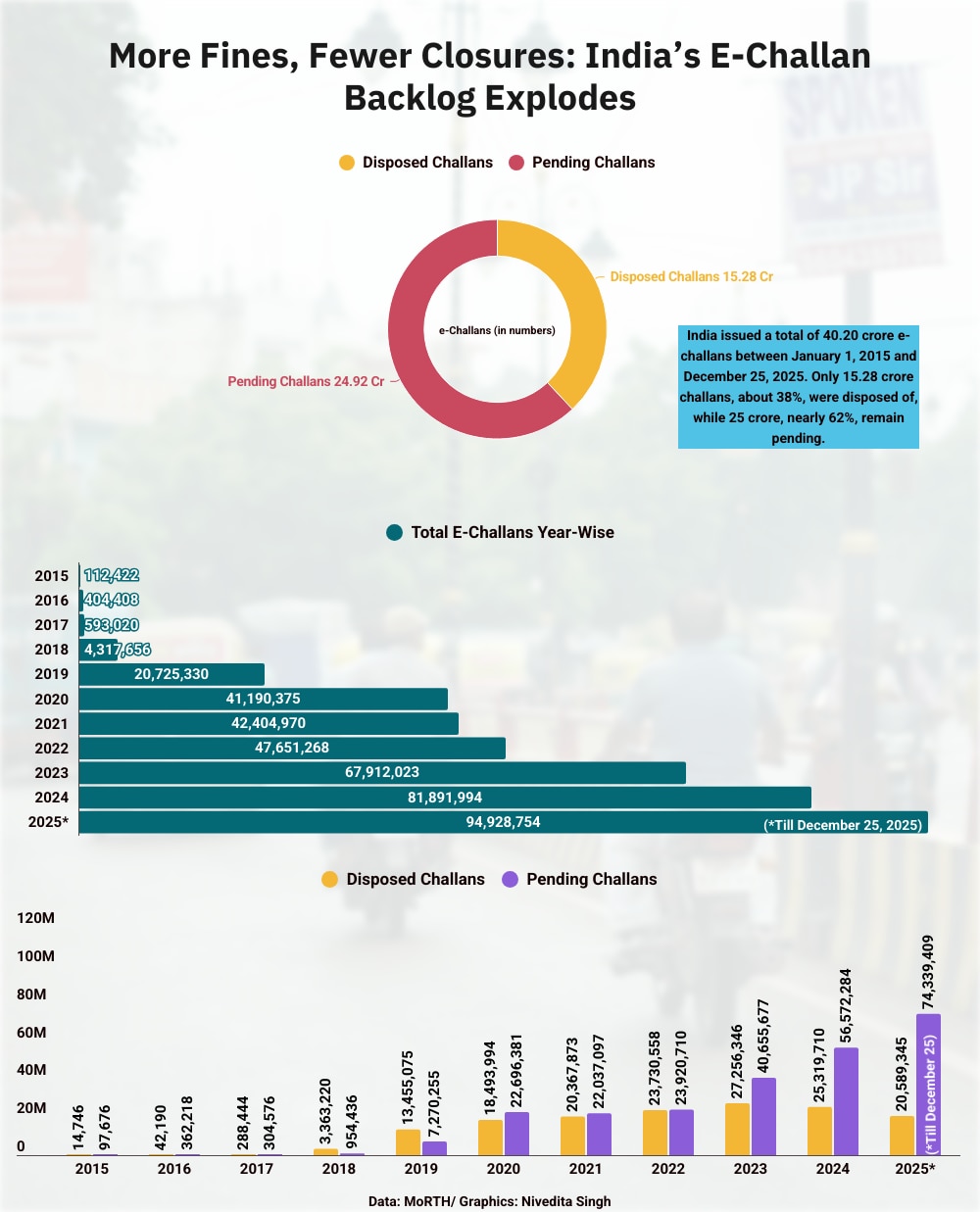
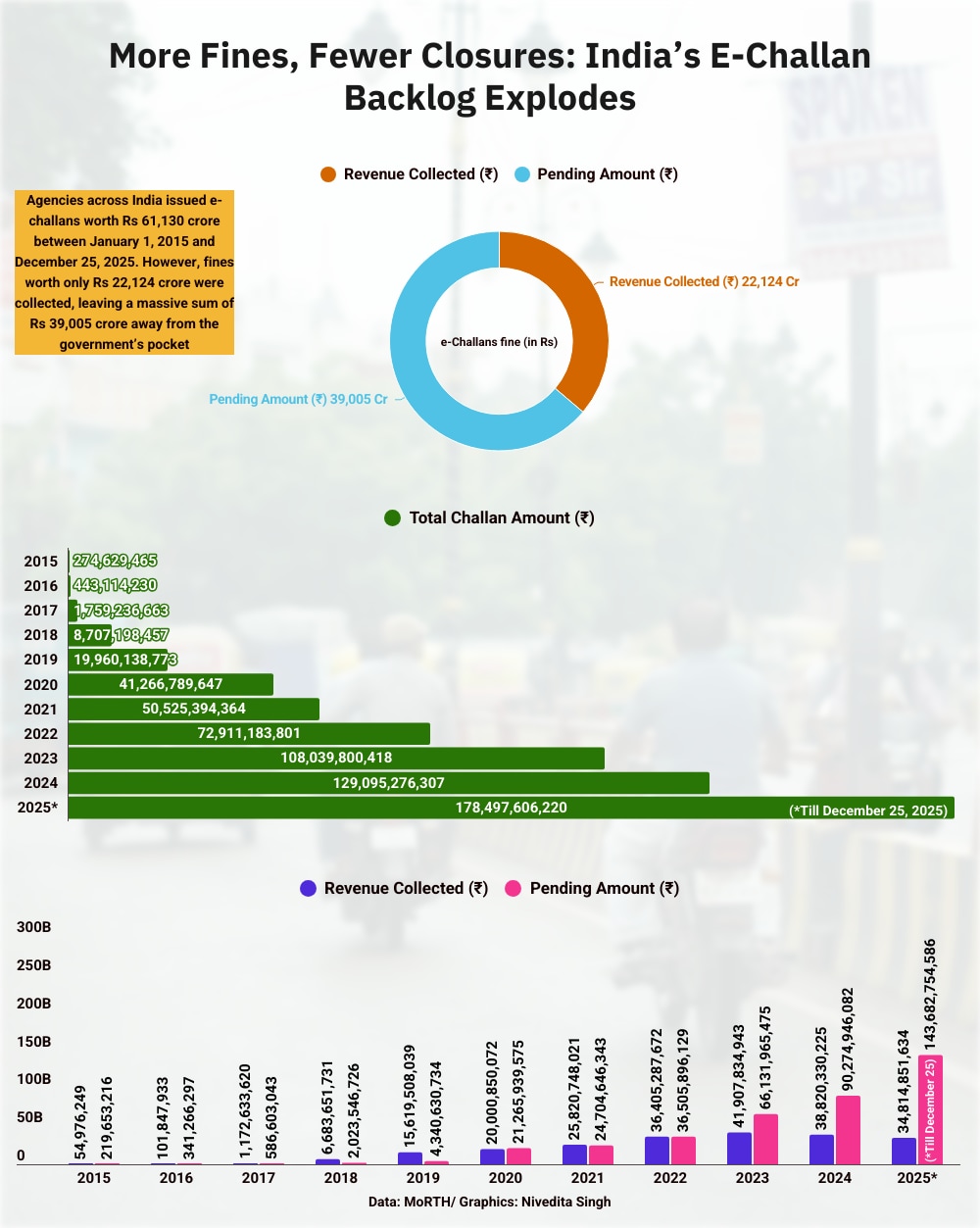
Post-2021, India issued 33.47 crore e-challans, with only 11.72 crore (35%) disposed of, leaving 21.75 crore (65%) pending. Financially, Rs 53,888 crore was expected, but collections stood at Rs 17,761 crore, leaving Rs 36,126 crore unpaid.
From 2021, 10.11 crore e-challans were sent to court, but only 1.33 crore were disposed of, with 8.78 crore still pending. In 2025, 2.91 crore challans went to court, with only 13 lakh disposed of, leaving 2.78 crore pending.
Section 136A of the Motor Vehicles Act, 1988, provides for electronic monitoring and enforcement of road safety. Rule 167A under the Central Motor Vehicles Rules (CMVR), 1989, was introduced in 2021 for electronic monitoring on high-risk corridors. Rule 167 outlines the issuance and payment procedure, stating challans not sent to court must be disposed of within 90 days. If not, applications related to the offender’s license or vehicle registration will not be processed, except for permits, fitness, and tax.
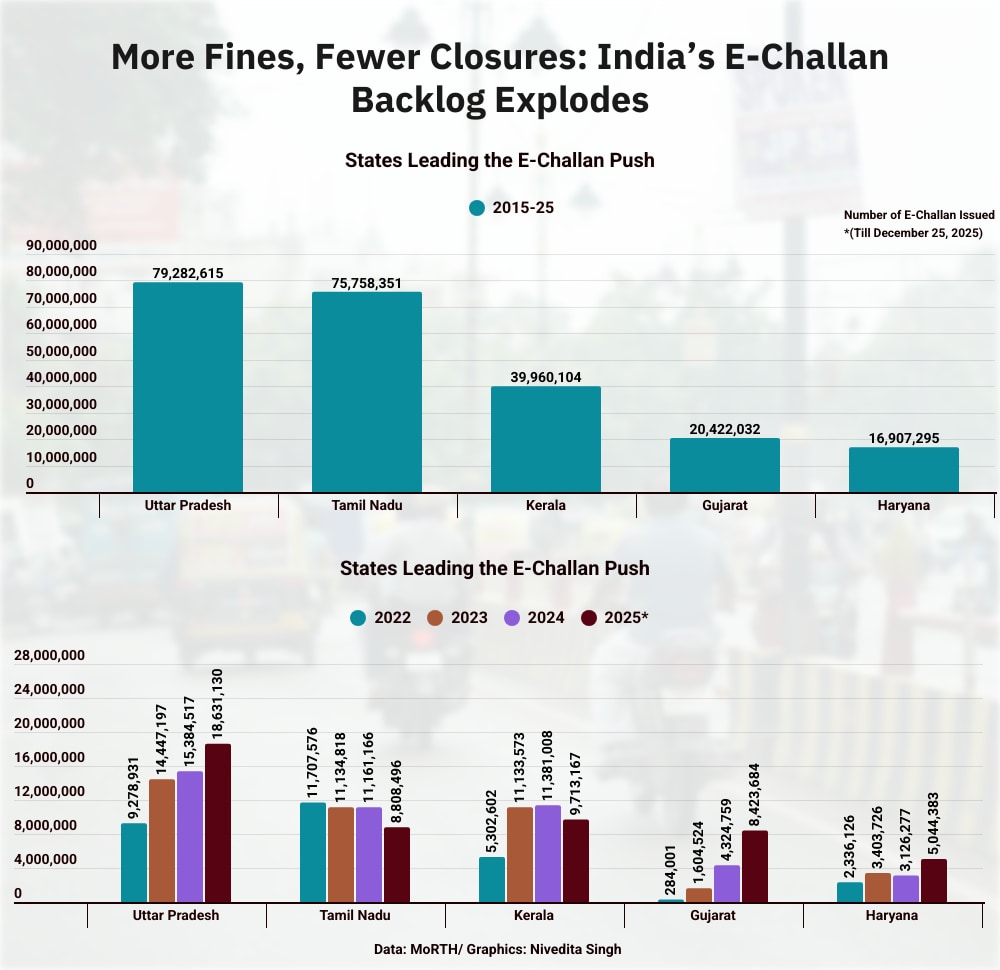
Nearly 40% of e-challans were issued in Uttar Pradesh (7.93 crore) and Tamil Nadu (7.58 crore) between 2015 and 2025. Other top states include Kerala (3.99 crore), Haryana (2.04 crore), and Gujarat (1.69 crore). Delhi issued 1.61 crore challans.
In 2025, Uttar Pradesh accounted for nearly one-fifth of all e-challans at 1.86 crore, followed by Kerala (97 lakh) and Tamil Nadu (88 lakh). Gujarat and Haryana followed with 84 lakh and 50 lakh, respectively, while Delhi issued 43 lakh.
Collection rankings differ, with Uttar Pradesh leading with Rs 3,862 crore collected from 2015-25, followed by Haryana with Rs 2,270 crore, and Rajasthan with Rs 2,165 crore. Delhi collected Rs 775 crore, ranking tenth.
In 2025, Uttar Pradesh collected Rs 481 crore, Maharashtra Rs 384 crore, and Rajasthan Rs 339 crore. Delhi collected Rs 39 crore, ranking 17th.
From 2021 to 2025, Uttar Pradesh collected Rs 2,656 crore, followed by Rajasthan with Rs 1,898 crore and Maharashtra with Rs 1,686 crore. Delhi’s collection was Rs 503 crore, pushing unpaid fines from Rs 1,133 crore in 2022 to Rs 2,247 crore by 2024.
As electronic surveillance expands, the e-challan system is proving to be an effective tool for traffic enforcement. However, without improvements in adjudication, recovery, and inter-agency coordination, it risks becoming a vast ledger of unpaid penalties. The challenge is not just issuing more challans, but ensuring enforcement translates into compliance.



/images/ppid_a911dc6a-image-177092774715746114.webp)

/images/ppid_a911dc6a-image-177092767520012684.webp)
/images/ppid_a911dc6a-image-177092763347449403.webp)
/images/ppid_a911dc6a-image-177092652580356823.webp)