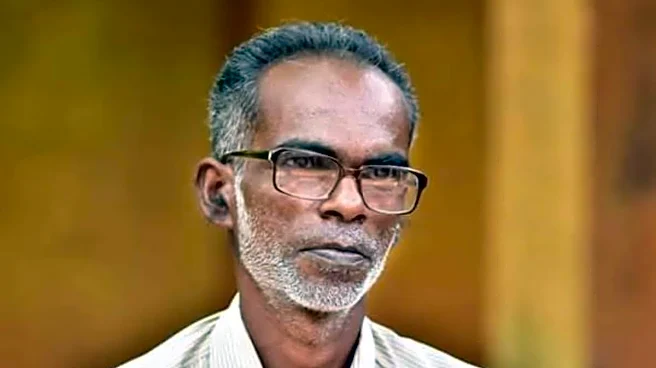


When P.K. Muraleedharan ventured into the thick forests of Idukki district in 1999, he expected his assignment as a volunteer teacher to last only a short while. Instead, the experience ended up changing the course of his entire life.
Over the next two decades, Muraleedharan stayed with the Muthuvan tribal community, teaching children in remote forest settlements and slowly becoming part of their world.
He worked under Kerala’s District Primary Education Project, which aimed to create single teacher schools in inaccessible tribal regions where formal education barely existed. Muraleedharan was posted to Nenmanalkudy, a settlement inside the Edamalakkudy tribal colony in Idukki district.
Getting there itself was difficult.
The settlements were located
deep inside forests with poor roads, little transport, no electricity and almost no communication facilities. In some areas, children reportedly had to walk for hours through wildlife filled forest paths just to reach school.
The Muthuvan community also remained largely isolated from mainstream society.
Most families spoke only their own dialect and had very little interaction with outsiders. Muraleedharan initially struggled to communicate because he did not know the language. Reports suggest that, in the early days, improvised sign language became one of his main ways of teaching.
The conditions inside the settlement were extremely basic.
The “school” functioned from a small shed that had once been used as a grain storehouse. There were no blackboards, notebooks, desks or proper teaching tools. Many children had never attended school before.
One of the biggest challenges, according to reports, was simply getting the children to sit together in one place. Muraleedharan later recalled that many Muthuvan children grew up roaming freely through forests from a very young age and were not used to enclosed classrooms.
At one point, things became even more difficult when the entire tribal settlement temporarily migrated to another forest region called Vazhakuthu for cardamom farming work. Instead of leaving, Muraleedharan reportedly followed them there and continued teaching the children in the new settlement as well.
Slowly, he adapted to life in the forests.
Apart from teaching, he also worked on basic hygiene and sanitation awareness. He learned the tribal dialect over time and built trust within the community. Eventually, local residents began calling him “Murali Maash.”
Reports suggest that many families eventually started treating him as one of their own.
As the years passed, more children from isolated tribal settlements slowly entered the formal education system. Muraleedharan also reportedly helped tribal families access government documents and welfare systems while continuing his educational work.
His story later became one of Kerala’s best known examples of teachers working in difficult tribal regions, where educators often cross forests, rivers and remote mountain terrain simply to ensure children receive an education.
For Muraleedharan, however, what began as a short-term volunteer posting eventually turned into a lifelong mission.
/images/ppid_a911dc6a-image-177852483313315970.webp)