
/images/ppid_59c68470-image-178654006521624387.webp)
/images/ppid_59c68470-image-178658502685899562.webp)

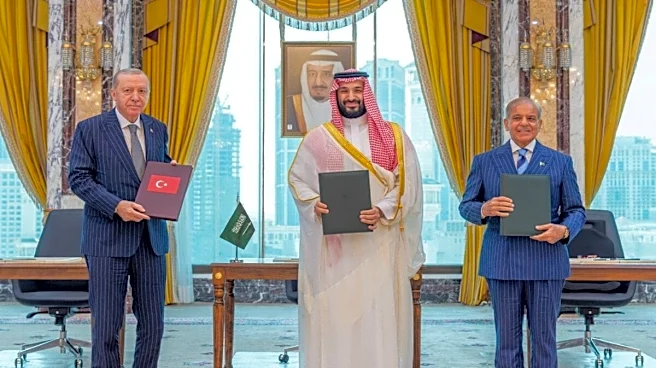
Turkey, Saudi Arabia and Pakistan have signed a new defence pact built around a NATO-like collective security principle, and Ankara is already signalling that the arrangement could expand beyond its three founding members.
The Mecca or Makkah Joint Defence Agreement, signed in Mecca on Friday by Turkish President Recep Tayyip Erdogan, Saudi Crown Prince Mohammed bin Salman and Pakistan Prime Minister Shehbaz Sharif, is intended to strengthen collective deterrence amid growing regional instability.
Pakistan’s foreign ministry has said an attack on any one member would be regarded as an attack on all. But the precise nature of any military response remains flexible, with Turkish officials saying members would consult on the degree, form and format
of assistance required.
Turkey Wants The Pact To Expand
Turkish Foreign Minister Hakan Fidan has made clear that Ankara does not see the three-country format as the end point.
“Under our president’s vision, we should not remain limited to three countries. We should grow and, if necessary, bring [other] countries under this umbrella,” Fidan told Turkish state news agency Anadolu.
Fidan also said some countries had already expressed interest, although he did not name them.
A Turkish official cited by Reuters said the agreement was defensive in nature and open to regional countries that may want to join. The official also said it was not intended to replace existing bilateral or multilateral arrangements or target any particular country.
Egypt Is The Clearest Candidate
Fidan has openly said he wants Egypt to join the pact, calling Cairo a “natural partner” and indicating that its entry could come once certain “technical issues” are resolved.
“I believe that at the next stage, Egypt will also be among us in the alliance,” Fidan said. “We already act towards one another as if we were alliance members.”
Egypt already maintains working relationships with Saudi Arabia and Pakistan and has also strengthened ties with Turkey after years of tensions over the 2013 overthrow of President Mohamed Morsi, Libya and disputes in the Eastern Mediterranean.
But formally entering a collective defence pact would be a more complicated decision.
Karim Elgendy, associate fellow at Chatham House’s Middle East and North Africa Programme, told Al Jazeera that Cairo would want any agreement to protect its relationship with Washington, existing alliances and peace treaties, while allowing it to decide when and where its forces are deployed.
“If the pact stays a political framework with room to calibrate each response, Cairo can live with it and may eventually sign. If it hardens into an obligation that could pull Egyptian forces into someone else’s war, the answer is likely to be negative,” Elgendy said.
Ahmed Aboudouh, also an associate fellow at Chatham House, told Al Jazeera that while Egypt broadly shares the trilateral pact’s security concerns, it may be reluctant to take on binding “security commitments”.
Qatar And Kuwait Among Gulf Possibilities
The potential expansion of the pact has also triggered discussion about whether other Gulf Cooperation Council members could eventually join.
Former Qatari Prime Minister Sheikh Hamad bin Jassim Al Thani said in a post on X that he hoped all GCC members would “take the initiative to join” the agreement. The GCC comprises Saudi Arabia, Qatar, Bahrain, Kuwait, Oman and the United Arab Emirates.
Elgendy described Qatar and Kuwait as “the names to watch first”, saying both are close to the three signatories and may see value in additional security guarantees after recent regional turmoil.
Ali Bakir, professor of international relations, security and defence at Qatar University, told Al Jazeera that Azerbaijan, Syria and Jordan could join the pact “relatively quickly”.
The UAE may be a more difficult potential entrant. Relations between Abu Dhabi and Riyadh are currently strained, which could complicate its inclusion in the pact.
What Do The Founding Members Bring To The Pact?
Andreas Krieg, a lecturer in security at King’s College London, told AFP that the three states complement one another unusually well.
Saudi Arabia has oil wealth but more limited domestic defence technology and has traditionally relied heavily on the United States. Turkey, meanwhile, has an advanced defence-industrial sector but needs markets and investment. Pakistan brings military institutions, manpower and nuclear deterrence, but also needs financing and industrial capacity.
That combination could support cooperation in areas such as defence production, technology transfer, investment and military coordination.
Is An ‘Islamic NATO’ Really Taking Shape?
The comparison comes from the pact’s collective-defence clause, but the agreement remains much looser than NATO.
Dania Thafer, executive director of the Gulf International Forum, described it to DW as an “elastic defence pact”, arguing that it provides Saudi Arabia with an additional layer of deterrence while Turkey and Pakistan retain their own relationships with other regional and global powers.
Recent developments have also shown that the agreement does not necessarily mean an automatic military response every time one member comes under attack. Following a Houthi attack on Saudi oil facilities, neither Turkey nor Pakistan entered the conflict on Riyadh’s behalf.
The pact is therefore better understood, at least for now, as a flexible collective-security and deterrence arrangement rather than a fully integrated military alliance.
Its future shape will depend on how far the founding members are willing to formalise their commitments, and how much strategic flexibility prospective members are prepared to give up in return for coming under the same security umbrella.

/images/ppid_59c68470-image-178654252605728677.webp)


/images/ppid_59c68470-image-178647502639032597.webp)