

/images/ppid_59c68470-image-177558003667368083.webp)

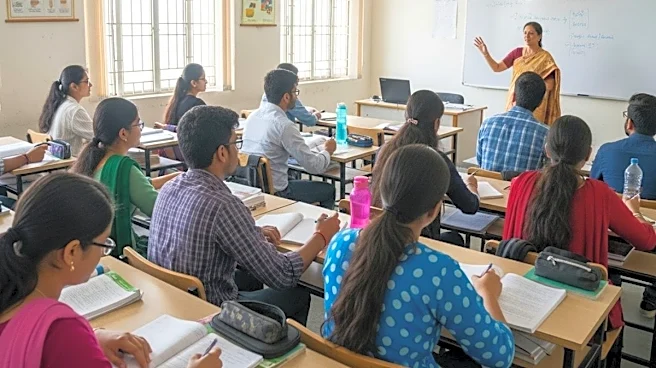
The Maharashtra government has cleared the way for a major shift in undergraduate education, approving the launch of four-year degree programmes from the 2026-27 academic year. In line with the National Education Policy (NEP) 2020, students across public universities and affiliated as well as autonomous colleges in the state will now be able to pursue honours and honours with research degrees.
This decision is aimed to bring uniformity to the new four-year structure and ensure that all institutions in Maharashtra follow a common, well-defined framework. As outlined in a government resolution (GR) issued on Monday, the programmes will span eight semesters and offer students a crucial choice at the end of the third year: either continue into a standard
honours degree or opt for an honours with research degree.
Under the honours track, students must earn between 160 and 176 credits over four years, including an internship in the final year to build practical exposure. Those choosing the honours with research route will undertake a research project or dissertation in their major subject, carrying 12 credits, giving them an early taste of academic research.
The GR further clarifies that to enter the fourth year of the honours programme, students must have successfully completed 120–132 credits in the first three years. For the more rigorous honours with research option, students will also need to maintain a minimum cumulative grade point average (CGPA) of 7.5, ensuring that only those with a strong academic record move into the research-intensive track.
States And Universities That Introduced 4-Year UG Courses
Maharashtra’s move comes as part of a broader, phased transformation of undergraduate education across India under NEP 2020. Different states and universities have entered this new era at different times, creating a timeline of adoption that shows how the four-year undergraduate programme (FYUP) has taken shape across the country.
Iin 2022–23, the University of Delhi implemented FYUP. The varsity introduced multiple exit options and a fourth year that culminated in an honours with research degree.
ALSO READ | Flexibility Or Institutional Reputation: Can Online UG Degrees Match Campus Learning?
Around 2022, Panjab University also stepped in as one of the first traditional universities to run NEP-based four-year programmes, while institutions in Assam, such as Tezpur University, began adopting the FYUGP framework from around the same time.
The University of Mumbai, initiated a phased transition in 2023–24, guiding its affiliated colleges towards a four-year structure with a focus on research and specialisation in the fourth year. Maharashtra itself began a phased rollout of FYUGP across universities and colleges from 2023–24, now culminating in the comprehensive, state-wide implementation planned for 2026–27.
In Delhi, Jamia Millia Islamia expanded its undergraduate structure in 2023–24 to align with the FYUGP model. In the same academic year, West Bengal started shifting universities, including the University of Calcutta, to four-year programmes, while Odisha began a phased implementation across its state universities from 2023 onwards.
Central universities across India have also been gradually adapting. Institutions such as Aligarh Muslim University and Visva-Bharati University have been adopting the new structure from around 2022 onwards, while the Central University of Haryana and the Central University of Tamil Nadu are in the implementation phase.

/images/ppid_59c68470-image-177574260315746376.webp)