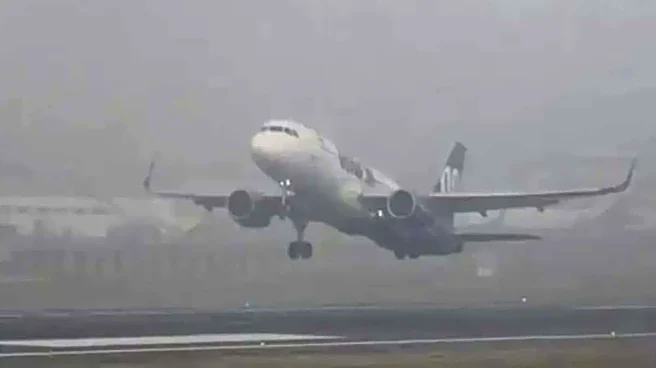

Dense fog and smog once again disrupted flight operations at Delhi’s Indira Gandhi International Airport on Monday morning, sharply reducing visibility across the National Capital Region and triggering
a wave of delays and cancellations. At least 100 flights were cancelled and over 300 delayed as airlines adjusted schedules, with authorities saying that operations are currently being conducted under CAT III conditions.
The Ministry of Civil Aviation issued a heavy fog alert for northern India, advising passengers to check flight status before travelling and to allow extra time for road movement, which had also slowed.
Heavy Fog Alert for Northern India
Delhi (DEL) & other airports in Northern India are experiencing dense fog, severely affecting visibility.
For Passengers:
Before heading to the airport, please check the latest flight status with your airline.
Check flight information on the…— MoCA_GoI (@MoCA_GoI) December 15, 2025
Delhi airport repeated that poor visibility meant operations were taking place under CAT III protocols, a message echoed by airlines such as IndiGo and Air India, which asked passengers to monitor updates closely.
Fog Update issued at 0918 hours.
Kind attention to all flyers!#Fog #FogAlert #DelhiAirport pic.twitter.com/w2f2LrRrHO— Delhi Airport (@DelhiAirport) December 15, 2025
IndiGo said visibility had dropped significantly due to dense fog and that some flights might be proactively cancelled to avoid long waiting times at the airport.
Travel Advisory
Dense fog continues to affect visibility at Delhi and other airports across Northern India, leading to delays and changes to flight schedules.
Prolonged low visibility during the morning hours has impacted air traffic movement, and as a result, some flights have…
— IndiGo (@IndiGo6E) December 15, 2025
The weather deterioration reflects a familiar pattern during north India’s winter months, when prolonged spells of fog repeatedly test the aviation ecosystem. Although Delhi is equipped with a CAT IIIB low-visibility landing system, disruptions continue because landing aircraft safely in such conditions requires the right combination of airport systems, aircraft equipment, and pilot training.
This makes it important to understand how CAT III works and why delays still occur even when the system is active.
Why Did Fog Disrupt Flights In Delhi?
Fog severely reduces visibility, and even a short spell of dense fog can affect how quickly aircraft land, take off, and taxi. Operations slow down because pilots have fewer visual cues during approach, landing, and ground movement. Airlines often pre-emptively delay or cancel flights to maintain safety margins, and runway spacing increases because aircraft need more time between landings.
These slowdowns happen even when an airport is operating under CAT III procedures. CAT III is the highest category of the Instrument Landing System (ILS) used during low-visibility conditions. It allows pilots to land even when the runway visual range is extremely limited, but it does not guarantee that every aircraft or pilot is authorised to use the system. As a result, some flights cannot land until visibility improves, causing the ripple of delays and cancellations that Delhi witnesses each winter.
What Is CAT III And Why Is It Used In Winter?
CAT III refers to a category of the Instrument Landing System that guides aircraft during approach and landing in extremely poor visibility. It is a ground-based radio navigation system that provides information about the aircraft’s alignment with the runway and its vertical descent profile.
Airports use CAT III particularly during winter fog spells, when pilots cannot rely on visual references such as runway lights or markings.
Delhi’s airport is equipped with a CAT IIIB Instrument Landing System that allows landings in visibility as low as 50 metres. CAT III is meant to keep the airport functional during dense fog, but it does not eliminate disruptions entirely. Landings can proceed only when an aircraft, its pilots, and the runway are all certified for the category in force. If any one element is not compliant, the flight must wait, divert, or be cancelled.
How Does The Instrument Landing System Work?
The ILS provides two essential streams of information to a pilot during landing: azimuth guidance and vertical guidance.
Azimuth guidance tells the pilot whether the aircraft is correctly aligned with the runway’s centreline. This comes from the localiser (LOC), whose antennae are placed at the far end of the runway. They transmit two narrow radio beams—one slightly to the left of the centreline and one to the right. The point at which the beams intersect marks the runway’s centreline. The aircraft’s instruments interpret this information and display how far the plane is from the correct horizontal path.
Vertical guidance comes from the glideslope (GS), whose antennae are usually positioned along the runway’s mid-section. These antennae also transmit two intersecting beams, one slightly above the ideal vertical profile and one slightly below it. The intersection marks the correct descent path. This allows the pilot to know instantly whether the aircraft is too high or too low at any point during approach.
Because pilots cannot rely on sight during dense fog, the ILS becomes critical. It replaces visual cues with precise, continuous guidance on where the aircraft should be horizontally and vertically. In some advanced systems, automated call-outs count down the distance to touchdown and give prompts for deploying flaps and applying brakes.
How Do CAT I, CAT II And CAT III Differ?
ILS categories are defined by two parameters: decision height (DH) and runway visual range (RVR). DH is the altitude at which a pilot must be able to see the runway environment; if visibility is below the threshold at that point, the landing must be aborted. RVR measures how far a pilot can see the runway lights or markings.
Based on the Airports Authority of India’s classification, the categories are:
- CAT I
DH: Not lower than 60 m
RVR: Not less than 550 m
- CAT II
DH: Lower than 60 m but not lower than 30 m
RVR: Not less than 350 m
- CAT III A
DH: Lower than 30 m, or no decision height
RVR: Not less than 200 m
- CAT III B
DH: Lower than 15 m, or no decision height
RVR: Not less than 50 m
- CAT III C
DH: No decision height
RVR: No visibility requirement (zero visibility permitted)
These thresholds determine how low a pilot can descend using instruments alone, and how much of the runway must be visible for a safe landing.
CAT III C is the highest capability and allows landings even in zero visibility. Airports such as New York’s John F Kennedy and London Heathrow support CAT IIIC operations. India does not yet have any runway certified for CAT IIIC.
Which Indian Airports Support CAT III?
Six Indian airports can support CAT IIIB operations: Delhi, Lucknow, Jaipur, Amritsar, Bengaluru, and Kolkata. Delhi was the first to install the system. Runway 28 received CAT IIIA in 2001, which was upgraded to CAT IIIB with the Advanced Surface Movement Guidance and Control System (ASMGCS) in 2005 at a cost of Rs 55 crore.
Why Do Delays Happen Even When CAT III Is Active?
Even with CAT IIIB, flights can and do get delayed or cancelled during heavy fog. Some aircraft may not be certified for the category in effect, and some pilots may not be trained to land using CAT IIIB procedures. If the airport is operating under CAT III and a flight is only certified for CAT I or CAT II, it cannot land until conditions improve.
Ground operations also slow down significantly. Taxiing in low visibility requires more space between aircraft and more time between movements on the runway. This reduces how many take-offs and landings can be handled per hour.
Fog also affects departure sequencing. Aircraft may need to wait longer between take-offs to maintain safe spacing, and slower ground movement can cause further backlogs. Over a few hours, this accumulates into large delays across the network.
What Makes Winter Landings So Sensitive?
Landing is the shortest but riskiest phase of a flight. Research from Boeing indicates that the final descent and landing occupy about 4 per cent of total flight time, yet 49 per cent of fatal accidents occur in this window. Low visibility adds another layer of complexity because pilots cannot use external references to judge alignment or height. The ILS compensates for this by providing precise radio-based cues, but only when the aircraft, crew, and runway are all certified for the category of operation.
Winter fog in north India is persistent and often dense enough to drop visibility well below 200 metres for hours at a time. When that happens, airports must switch to CAT III procedures, but the overall pace of operations inevitably slows. A single extended fog spell can push delays deep into the day, affecting flights nationwide.
/images/ppid_a911dc6a-image-177092652580356823.webp)







/images/ppid_a911dc6a-image-177092306157991736.webp)