



When Mona Patel steps onto a red carpet, the moment rarely belongs to fashion alone. It becomes engineering, storytelling, and spectacle all at once. The tech entrepreneur and philanthropist – educated at Harvard, Stanford, and MIT – has quietly built global businesses while cultivating an equally serious reverence for couture. From Iris van Herpen’s kinetic wings to a Thom Browne ensemble accompanied by an MIT-designed robotic dog, her appearances have redefined what it means to “wear” fashion.
Through her foundation, Couture for Cause, she channels that passion into purpose, supporting girls’ education and women’s entrepreneurship worldwide. For Mona Patel, style isn’t ornamentation, but it’s intention. In this conversation with News18, she reflects
on virality, artisanship, South Asian visibility, and the delicate dance between technology and craft.
Your looks have consistently gone viral — from Iris van Herpen’s kinetic wings to Thom Browne’s MIT-designed robotic dog. Which moment felt like a true turning point for you?
My real turning point happened long before I stepped onto a red carpet. It was the Savage Beauty exhibition at the Met. I walked in as one person and walked out as another. McQueen taught me that fashion isn’t decoration — it’s self-expression, performance art, even sublimation.
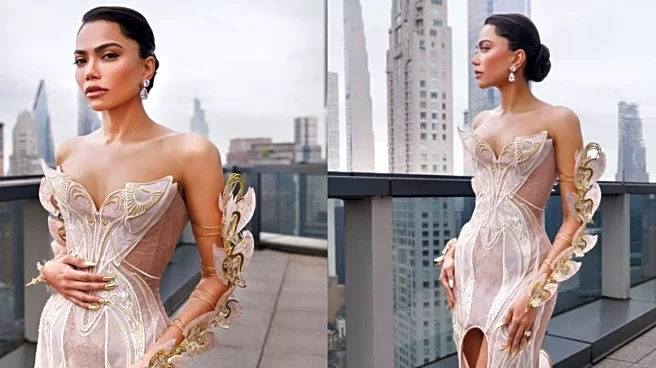
Until then, I admired fashion as a fan. I didn’t collect couture and thought it might detract from becoming the woman I wanted to be – someone building companies and operating in high-stakes boardrooms. When my first Met Gala invitation arrived, I wanted tohonourr that lineage through transformation. I chose Iris van Herpen. Her work sits at the intersection of construction, physics, and poetry – garments that breathe and move like architecture.
For the Garden of Time theme, I evoked the Lotus Temple and brought Iris to India so the piece carried the craftsmanship of home. I introduced her to a Zardozi atelier whose artisans now continue working with her team. Because I live in technology and collaborate with engineers and robotics artists, I wanted the garment to express that too, and that’s how the kinetic sleeves emerged. Virality was a very unexpected byproduct of that commitment to my vision. I’m actually very offline; I don’t even use an iPhone. I’m dressing to express my truth and to give form to something interior.
Every viral moment has a backstory. What’s one behind-the-scenes challenge you’ll never forget?
I style myself and hold very high standards when realising my vision. I travel anywhere to source components – working with designers, artists, and engineers to bring ideas to life.
For the British Fashion Awards, I wore a vintage Lacroix haute couture corset. The media noticed the skirt didn’t match the runway look – that was intentional. I biked to the garment district multiple times to source metallic lilac silk from Japan and worked with a tailor in Brooklyn and a pattern maker to recreate it as trousers or an A-line skirt. It was completely rebuilt by hand.
View this post on Instagram
Do you ever feel pressure to outdo your last look?
No. My looks are simply extensions of what I’m studying, absorbing, or fascinated by at that moment. I’m a lifelong student. I’m literally still taking college courses, so as my influences constantly shift, my looks evolve. If I see an exhibition that captures my imagination, you can trust you’ll see that influence in my style.
Has social media changed how South Asian women show up in fashion — bolder, more experimental, less apologetic?
South Asian women have always been bold and experimental. Our textile history proves that. Our heritage is maximal – luminous silks, intricate weaves, and embroidery that catches light. Especially in my hometown of Baroda, women have never hesitated to be “a lot.” What’s changed is documentation. Platforms have made us visible and reminded the world where many visual languages originated. My hope is that this visibility supports and sustains our artisans. These crafts survive only when they’re valued and invested in.
Has the industry’s perception of South Asian representation shifted since your first Met Gala?
What’s shifted is less about being South Asian and more about who’s allowed to be visible. My profession doesn’t naturally lead to red carpets. I come from tech and building companies. The response feels like the arrival of a new archetype – someone who loves engineering and entrepreneurship as much as couture and craft. I’m proud to be Indian, but what people respond to is the merging of worlds.
As a ‘fashion-tech disruptor,’ what needs to be broken and rebuilt?
There is artificial intelligence. Then there is aesthetic intelligence. One is machine. The other is ethereal and felt only by humans. Tech can support beauty, but it can’t replace artistic genius. We must nurture imagination. What needs rebuilding is the paradigm. Age-old artisans are the original technicians. So many people come together to make a single thread happen. It’s never just one of us; it’s a massive human machine.
Is fashion becoming something we experience rather than simply wear?
I don’t see it as a dichotomy. The two collapse into each other. McQueen’s spray-painted runway proved that the power lies in the fusion. Wearing becomes experiencing. I’m interested in clothes as catalysts – something that shifts your energy or alters the atmosphere around you. Today’s woman is layered and self-possessed. When she experiences what she wears, everyone observing does too. I plan to execute all extreme ideas — so stay tuned.
What misconception about tech-infused fashion frustrates you most?
Technology and fashion aren’t opposing forces. Fashion has always depended on technology – photography, lighting, broadcast, digital platforms, even the loom and dye processes. They’re codependent. My Iris sleeves couldn’t exist without engineering. That’s the future: a dialogue between human craft and technological possibility. Tech isn’t disruptive; it’s collaborative.
In one sentence, what’s your North Star for the future of fashion and technology?
Fearlessly be yourself, always stay curious and collaborate with brilliant people.


/images/ppid_59c68470-image-177098010776243677.webp)

/images/ppid_59c68470-image-177096756236953747.webp)
/images/ppid_59c68470-image-177089753887696314.webp)