
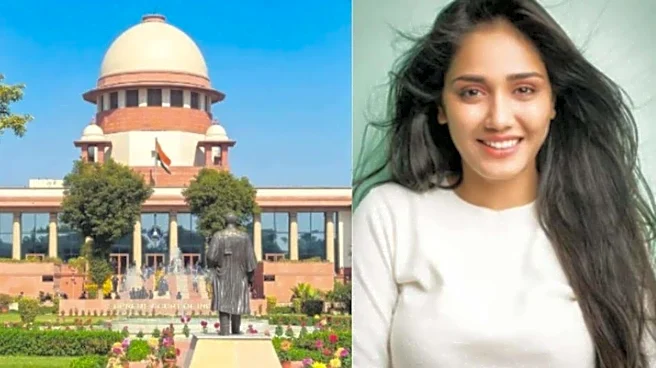
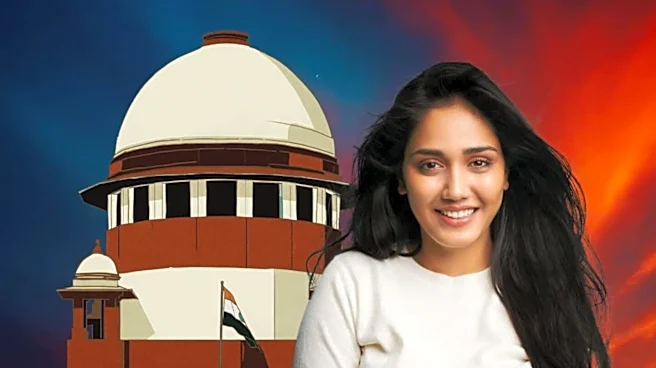
The Supreme Court on Monday underscored the need for a “fair, independent and impartial” investigation into the death of model-turned-actor Twisha Sharma, while noting that the Central Bureau of Investigation (CBI) would immediately take over the probe after the Madhya Pradesh government recommended a transfer of the case.
Hearing the suo motu matter, a three-judge bench led by Chief Justice of India Surya Kant, along with Justice Joymalya Bagchi and Justice Vipul Pancholi, repeatedly cautioned all sides against sensationalising the case in the media.
The bench said the unfortunate incident must be investigated without prejudice and urged the victim’s family, accused persons and potential witnesses to place their statements before the investigating
agency instead of making public comments.
COURT STRESSES NEED FOR IMPARTIAL INVESTIGATION
During the hearing, the Chief Justice said the court was concerned over the “narrative” being built around the case, particularly allegations suggesting that the judiciary or local authorities were obstructing a fair investigation because the deceased woman’s mother-in-law, Giribala Singh, is a former district judge and her husband is a practising lawyer.
“We are against the narrative that is being created. That is why the CBI should take it over. We believe the state police and judiciary,” the CJI observed during the proceedings.
The bench further remarked, “Whatever unfortunate incident has taken place, it should be ensured that a fair, impartial investigation takes place.”
The court noted that the Madhya Pradesh government had already recommended a CBI probe and that the only issue presently before it was facilitating the transfer of the investigation.
Dictating the order, the bench observed that Twisha Sharma had died an “unfortunate unnatural death”.
The court recorded Solicitor General Tushar Mehta’s assurance that the matter would be immediately taken up with the concerned authorities so that the CBI could formally assume control of the investigation without delay.
“The only issue as of now for our consideration is the recommendations made by the state of MP to hand over the investigation to CBI,” the order stated.
COURT EXPRESSES CONCERN OVER MEDIA COVERAGE
A substantial part of the hearing focused on media reportage and public statements being made by both sides in the case.
CJI Surya Kant said the court was “slightly at pain” because of certain developments and requested journalists not to broadcast statements made by relatives or potential witnesses while the investigation was underway.
“We will request our media friends not to go for the statements of the victim’s family or the other family. Let the things move as per law and procedure,” the bench said.
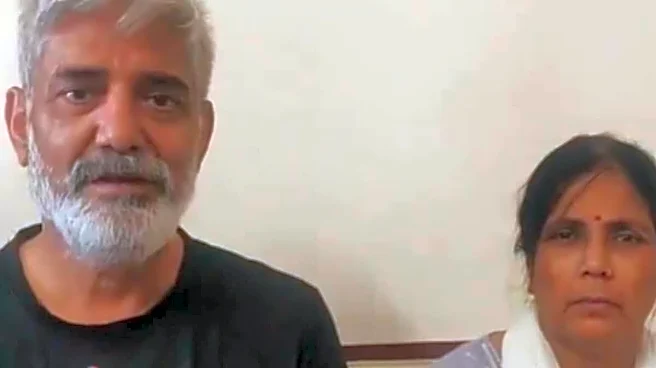
The court also appealed to Twisha Sharma’s family to refrain from speaking publicly and instead cooperate with investigators by officially recording their statements.
“We would like to impress upon the family of the victim that instead of making statements in public or before the media, they should get their versions recorded before the investigating agency so that no prejudice or adverse impact is caused to the ongoing investigation,” the CJI observed.
The bench also urged media organisations to avoid turning the grief of the victim’s family into “sound bites”.
SG MEHTA ALLEGES NON-COOPERATION, SAYS CASE SHOULD NOT BE SENSATIONALISED
Appearing for the Madhya Pradesh government, Solicitor General Tushar Mehta said the matter had already been handed over to the CBI and criticised attempts to sensationalise the case through television appearances and media interventions.
“The former judge has been giving interviews on some or other channel maligning the deceased,” Mehta told the bench, referring to the victim’s mother-in-law.
He further alleged that despite repeated requests, she had not cooperated fully with investigators.
“We requested her so many times to record her statement. She does not want to do it. We were okay to go to her place also. But she is not cooperating,” he said.
At the same time, the Solicitor General acknowledged that media attention had also contributed to developments in the case becoming public.
“It should not be sensationalised, but at the same time, because of the media and intervention, several things have come out,” Mehta submitted.
In an emotional remark during the hearing, Mehta said, “For parents, it’s better to have a divorced daughter than a dead one.”
LAWYERS FLAG DELAY IN FIR, EVIDENCE CONCERNS
Senior advocate Sidharth Luthra, appearing in the matter, raised concerns over procedural lapses in the initial investigation.
He pointed to a three-day delay in registration of the FIR and alleged failure to preserve evidence.
Luthra also alleged that the victim’s mother-in-law had been producing her own call detail records and other material, arguing that such processes should be handled strictly through lawful procedure.
However, the bench maintained that since the investigation was now being transferred to the CBI, procedural safeguards would be followed and the probe should be allowed to proceed without interference or public commentary.
Justice Joymalya Bagchi also observed that the timeline of the investigation had to be considered fairly, noting that the matter had unfolded within months and not over several years.
THE TWISHA SHARMA DEATH CASE
The Supreme Court had on May 23 taken suo motu cognisance of the case following widespread media reports and allegations of institutional bias and procedural irregularities in the investigation into Twisha Sharma’s death.
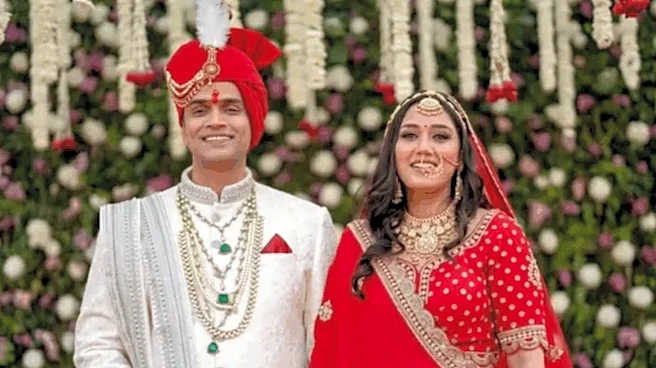
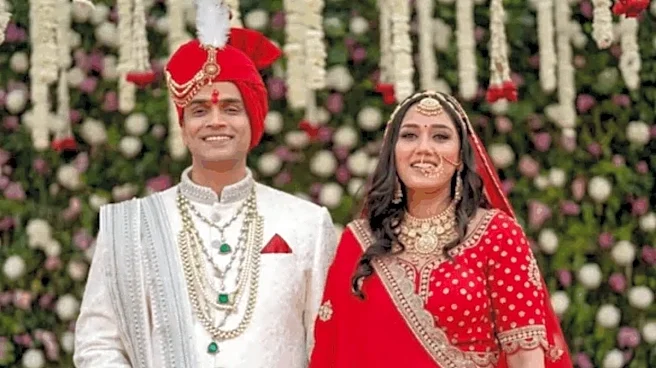
Twisha Sharma was found hanging at her matrimonial home in Bhopal’s Katara Hills area on May 12.
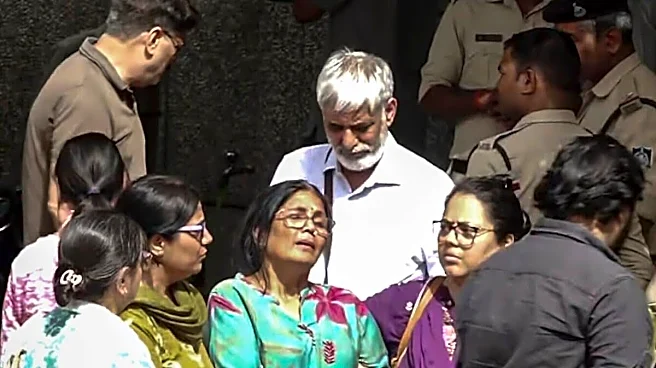
Her family has alleged dowry harassment, procedural lapses in the probe, delay in FIR registration, inconsistencies in the post-mortem examination and possible tampering with evidence.
The Madhya Pradesh High Court had earlier ordered a second post-mortem examination by a medical team constituted by AIIMS Delhi.
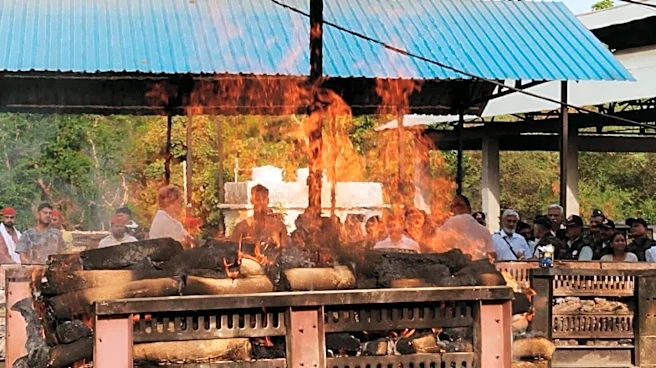
The second autopsy was conducted in Bhopal on May 24, following which her cremation took place later that evening.
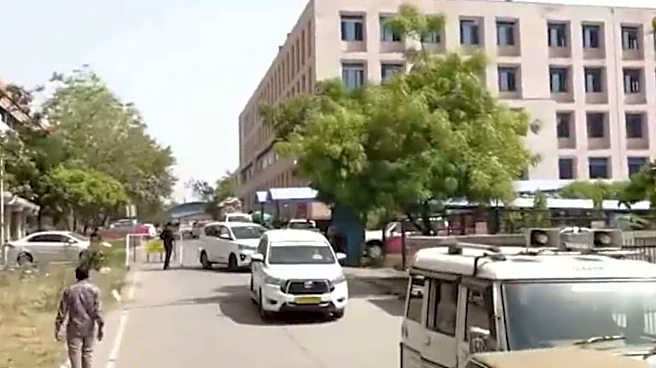
Meanwhile, Twisha Sharma’s husband, Samarth Singh, who is the prime accused in the case, was sent to seven days of police remand by a Bhopal district court after being brought from Jabalpur under heavy security.
The state government has also sought cancellation of the interim bail granted to Twisha Sharma’s mother-in-law, Giribala Singh, a retired judicial officer, alleging non-cooperation and concerns over possible compromise of evidence.
/images/ppid_a911dc6a-image-177973128947692746.webp)




/images/ppid_a911dc6a-image-177968962554868525.webp)