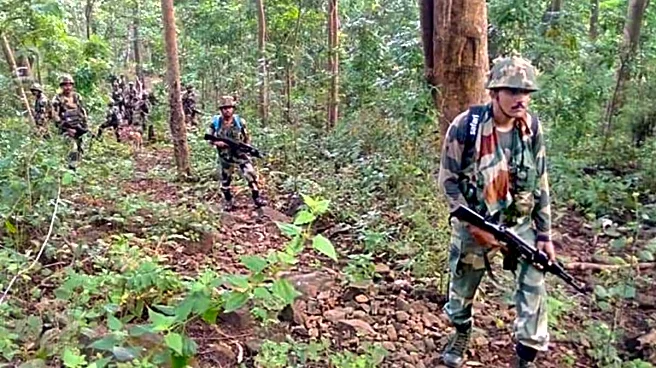



Operation Kagar, currently underway in parts of south Bastar and adjoining regions, has drawn criticism from sections sympathetic to Left Wing Extremism (LWE). The operation has been portrayed as indiscriminate and harmful to civilians. Recent disclosures by a surrendered senior CPI (Maoist) commander, however, challenge this view and suggest that its focus is on armed insurgent leadership and formations rather than civilian populations.
Badse Sukka alias Deva, who recently surrendered before the Telangana police, was a senior operational figure within the CPI (Maoist). According to police briefings, he joined the organisation in 2003 under the influence of senior leader Madvi Hidma and rose through the ranks by specialising in military planning,
procurement of explosives, and the manufacture of firearms and improvised explosive devices. Following organisational changes in late 2023, he was appointed commander of a People’s Liberation Guerrilla Army (PLGA) battalion, placing him within the armed wing of the movement.
During 2024, as security forces intensified operations in south Bastar, officials say Deva was involved in reorganising Maoist formations under pressure and later tasked with overseeing security and logistics in the Karregutta Hills region. These responsibilities indicate that his targeting was linked to operational roles and command authority over armed cadres, rather than political belief or social identity.
Deva’s surrender offers insight into the effects of Operation Kagar. He has stated that several Maoist cadres were either killed in encounters or surrendered during the operation. Police have also said that he provided information, including a diary detailing weapons storage locations. While these disclosures rest on official accounts, they point to organised and militarised infrastructure in areas often described as civilian by pro-LWE narratives.
The circumstances surrounding his arrest further complicate claims of arbitrary action. Deva reportedly admitted that he was intercepted during a police check while carrying arms, supporting the assessment that the operation is intelligence-led and verification-based rather than indiscriminate or punitive.
The broader context is relevant. For decades, Maoist groups have maintained influence in tribal regions by obstructing governance and isolating communities from the State. Roads, schools, healthcare facilities, mobile towers, and welfare delivery systems have frequently been targeted, as development weakens insurgent control. In this sense, security operations such as Kagar are not limited to neutralising armed threats but also aim to reclaim civic space for civilian administration.
There are early indications of such a transition. In areas where Maoist presence has weakened, schools have reopened, public distribution systems have stabilised, healthcare outreach has improved, and infrastructure projects have resumed. Security deployments have enabled teachers, health workers, and officials to operate in regions long affected by insurgent intimidation.
The coordinated involvement of police forces from Telangana, Chhattisgarh, and Maharashtra, along with the National Investigation Agency, reflects an institutional approach grounded in the rule of law. The cumulative reward announced for Deva was linked to his role in armed violence and logistics.
Seen in this context, Operation Kagar addresses an armed insurgency that has disrupted security and governance in tribal regions. By weakening Maoist command structures, it seeks to create conditions in which civilian administration, welfare delivery, and infrastructure activity can resume, while maintaining safeguards for civilian life and the rule of law.






/images/ppid_59c68470-image-177088252673355494.webp)