

/images/ppid_59c68470-image-178059752912058550.webp)
Every Indian election produces unusual stories. But few are stranger than a polling booth hidden deep inside a forest filled with Asiatic lions — created for a single voter.
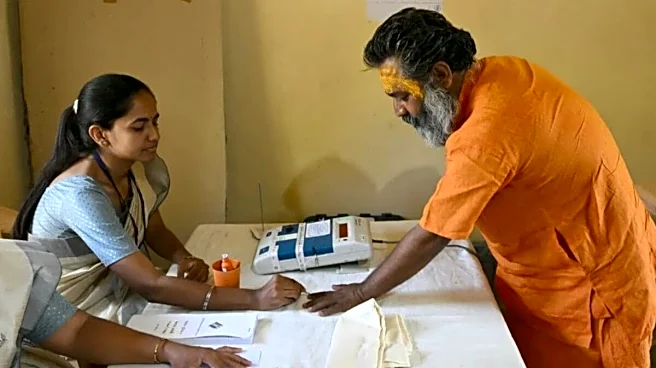
Inside Gujarat’s Gir Forest National Park, the Election Commission of India sets up a fully functional polling station every election season in a remote place called Banej, despite the fact that only one registered voter lives there permanently.
That voter is usually the caretaker-priest of an ancient Shiva temple located inside the protected forest region.
According to the Election Commission, polling officials travel nearly 40 kilometres through dense forest terrain to establish Booth No. 95 at Banej during state and national elections. The effort is part of India’s long-standing
election principle that no voter should be located more than two kilometres away from a polling station wherever practically possible.
The result is one of the most extraordinary examples of democratic logistics anywhere in the world.
The booth itself is not symbolic or temporary theatre.
Election officers carry Electronic Voting Machines, security personnel, polling materials and communication equipment into the forest exactly as they would for any urban polling centre serving thousands of people. The station includes proper voting procedures, official staffing and security arrangements despite expecting only one actual vote.
The location adds another layer of surrealism.
Gir Forest is the last natural habitat of the endangered Asiatic lion and contains leopards, hyenas, crocodiles and dense protected wilderness spread across Gujarat’s Junagadh district. Polling teams often remain stationed overnight in the forest area while preparing the booth.
The lone voter connected to the booth is linked to the Banej Shiva temple, a site that carries religious significance within the forest region. Because the priest resides there continuously, election authorities classify him as a legitimate permanent voter entitled to the same electoral access as any citizen elsewhere in India.
Officials have repeatedly defended the arrangement as an important constitutional principle rather than an administrative burden.
As former Chief Election Commissioner SY Quraishi told several publications while discussing remote polling stations, the Indian election system is designed around inclusion first, even if the logistical costs appear disproportionate.
And India has many such extreme polling locations.
Election teams routinely travel by camel through Rajasthan deserts, cross Himalayan terrain in Arunachal Pradesh and Himachal Pradesh, sail across river islands in Assam and trek through insurgency-prone forests in Chhattisgarh to reach isolated voters.
But Banej remains one of the most famous because of the sheer contrast between effort and turnout.
A fully operational democratic exercise unfolds in the middle of lion territory for a booth that may record only one vote by the end of the day.
Yet for election officials, that single vote represents something larger.
India’s election system often describes itself as the world’s biggest democratic exercise. But places like Banej reveal another side of that identity — an insistence that even the most isolated citizen inside a forest still matters enough for democracy to arrive at their doorstep.




/images/ppid_a911dc6a-image-178050083776054694.webp)



/images/ppid_a911dc6a-image-178057366087567467.webp)
/images/ppid_a911dc6a-image-178065171192646070.webp)