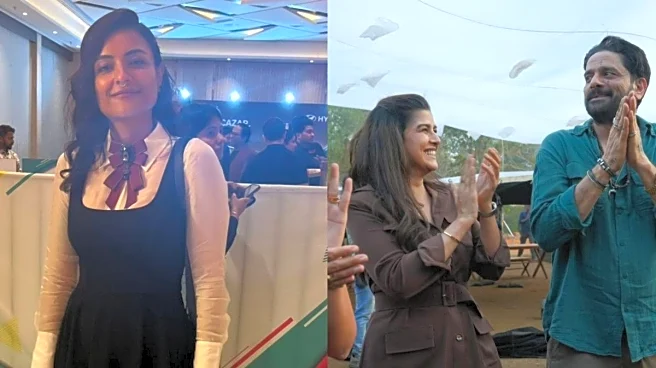

For costume designer Neha Bajaj, when actors are open to discussing backstories, it makes a costume designer’s job so much easier. From her first film, Omerta, Guns and Gulaabs, to The Family Man (Season 3), Neha’s creative vision has brought life to each character she has designed for.
In conversation with News18, Neha Bajaj takes a deep dive into designing for actors Jaideep Ahlawat and Nimrat Kaur, her next project – Toxic and unlike Hollywood the concept of personal stylists working in a film.
How has costume designing shaped your perception of the film industry?
Once you work behind the camera, you honestly can’t watch films like a normal audience anymore. I’m always clocking colours, fabrics, palettes, and how costumes affect the way an actor
moves. Costume design today is also slowly overlapping with personal styling, which changes certain dynamics on set. That said, it’s a creative job that comes with a lot of logistics, commerce, and yes, a few egos thrown in.
You designed costumes for the antagonist characters played by Jaideep Ahlawat and Nimrat Kaur. What was the vision behind their character build-up?
They [Jaideep Ahlawat and Nimrat Kaur] come from completely different worlds, so the approach had to be very different.
For Nimrat [character: Meera], she’s a powerful boss lady who is sharp, controlled, and not loud. The idea was never to make it a costume story. Her character needed to speak first; costumes just supported that. In her world, power translates through clean silhouettes, solid colours, couture, high heels, and strong jewellery. Everything is minimal, well-fitted and intentional. And we jammed on every single detail.
For Rukma [played by Jaideep], it was the opposite. He’s raw, lived-in, constantly on the move, literally surviving in jungles. There’s no access to salons or shopping. Hair is unkempt, tied by finger-combing. Clothes repeat, shirts get layered with more shirts in winter, and are shed in summer. Jewellery has a tribal touch, silhouettes are functional, and the swag is inherent, not designed.
How was it working with Jaideep Ahlawat and Nimrat Kaur on set?
When actors are open to discussing backstories and are willing to jam on character choices, it makes a costume designer’s job so much easier. Both Jaideep sir and Nimrat are extremely thorough with their craft. Half the work gets done because they already understand their characters so deeply, and there was trust in what I deliver. If an actor doesn’t feel his/her costume, it shows on camera.
As a costume designer, what challenges do you feel no one really talks about?
I wouldn’t call it a challenge, but I do find it interesting how Hollywood usually has one costume designer carrying the entire visual vision of a film. In our industry, the concept of personal stylists is becoming more common. It works well for ads and events, but for films, in my view, the narrative works best when it comes from a single, cohesive vision.
A costume from a film or OTT series that will always be special to you?
Of the released projects, Guns and Gulaabs was a fun show from the get-go. The characters were relatable yet twisted, and the treatment was pulpy. I really enjoyed that. In my upcoming projects, I am really looking forward to Toxic; it will be a visual treat for the audience.
A word of advice for aspiring costume designers entering the profession in 2026?
Observe people more than Pinterest. Real colours, textures, and fabrics come from watching how people live. Clothing and accessories can’t hide information about where someone comes from.
/images/ppid_59c68470-image-177087511517964359.webp)

/images/ppid_59c68470-image-177087506780469811.webp)
/images/ppid_59c68470-image-177087509425024425.webp)
/images/ppid_59c68470-image-17708750252627929.webp)
/images/ppid_59c68470-image-177087512498797308.webp)
/images/ppid_59c68470-image-177087503117363518.webp)
/images/ppid_59c68470-image-177087502814279655.webp)