

The Great Nicobar Island Development Project is a Rs 81,000-92,000 crore mega-infrastructure initiative aimed at transforming India’s southernmost island into a global maritime and strategic hub.
Why is it in the news? What is the plan? What are the ecological risks? News18 explains.
Why is the Great Nicobar project in the news?
The project is a major focal point of political and legal debate. Leader of the Opposition Rahul Gandhi visited the island on April 28, 2026, labelling the project a “crime against natural and tribal heritage”. The government responded with a detailed press note on May 1 defending its strategic necessity. In February 2026,the National Green Tribunal (NGT) cleared the project, citing its “strategic importance” and dismissing challenges to its environmental clearance.
The tribunal on February 16 emphasised a “balanced approach,” ruling that the project’s significance for national security and trade near the Malacca Strait outweighed the grounds for halting it. Bidding for major components, including the international transshipment port and solar power facilities, is currently active, according to reports.
I travelled through Great Nicobar today.
These are the most extraordinary forests I have ever seen in my life. Trees older than memory. Forests that took generations to grow.
The people on this island are equally beautiful – both the adivasi communities and the settlers – but… pic.twitter.com/vYdBWdYfIJ
— Rahul Gandhi (@RahulGandhi) April 29, 2026
What is the plan?
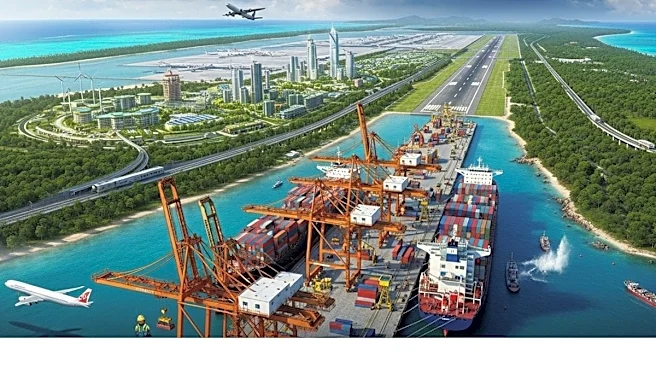
The project, implemented by the Andaman and Nicobar Islands Integrated Development Corporation (ANIIDCO), spans 166 sq. km and includes four core components:
Galathea Bay Transshipment Port: A deep-sea port with a 16 million TEU capacity to compete with Singapore and Colombo.
Greenfield International Airport: A dual-use (civil and military) facility with a 4,000-peak-hour passenger capacity.
Integrated Greenfield City: A township planned to house over 3.5 lakh people by 2047.
450 MVA Power Plant: A hybrid gas and solar power facility to support the island’s energy needs.
What are the ecological and social risks?
Critics and environmentalists have flagged several irreversible risks to the island’s fragile ecosystem:
Deforestation: Official estimates for tree felling range from 7.11 lakh to 9.64 lakh trees, though some scientists fear the actual number could be higher.
Endangered Wildlife: The project area includes Galathea Bay, the primary nesting site for the Giant Leatherback Turtle. It also threatens the endemic Nicobar Megapode (a ground-nesting bird).
Indigenous Rights: Concerns remain for the Shompen (a Particularly Vulnerable Tribal Group) and the Nicobarese. Experts warn that contact with large outside populations could lead to mass deaths due to a lack of immunity.
Seismic Vulnerability: The island is in a high-seismic zone (Zone V). During the 2004 Tsunami, the southern tip sank by 15 feet, raising fears about the safety of large-scale infrastructure.
What did the government say?
The Centre defends the project as a “strategic national asset” for several reasons:
National Security: Its location near the Six Degree Channel—a chokepoint for 30-40% of global trade—is critical for monitoring maritime traffic and countering regional naval expansion.
Economic Sovereignty: Currently, about 75% of India’s transshipped cargo is handled at foreign ports; this terminal seeks to capture that revenue and create over 50,000 jobs.
Indo-Pacific Influence: It bolsters India’s “Act East Policy” and maritime domain awareness in the eastern Indian Ocean.
With agency inputs

/images/ppid_a911dc6a-image-177771106629999753.webp)



/images/ppid_a911dc6a-image-177773962748957751.webp)


/images/ppid_a911dc6a-image-177781102784459687.webp)