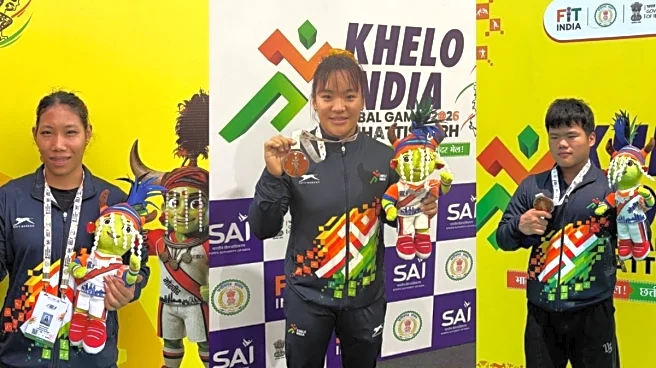

When weightlifter Mirabai Chanu, who hails from Manipur, inaugurated the Khelo India Tribal Games (KITG) 2026 last week, she called it a game-changer for India’s tribal communities. Just a few days later, the North-East contingent secured over half of the weightlifting medals across the various categories on offer.
Even before arriving in Raipur on March 25, Chanu had praised the resilience and natural strength of tribal athletes. The launch of KITG delighted her, as it was designed to provide a platform for those who have long awaited an opportunity to showcase their hunger and talent.
The hunger Chanu, an Olympic silver medallist, spoke of was evident as athletes from Arunachal Pradesh, Mizoram, Assam, Meghalaya, and Manipur combined to win
27 of the 48 weightlifting medals. Arunachal Pradesh stood out with five golds, Mizoram claimed four, and Assam took three. Notably, all eight medals won by Arunachal so far were in weightlifting.
|
State
|
Gold
|
Silver
|
Bronze
|
Total
|
|
Arunachal Pradesh
|
5
|
1
|
2
|
8
|
|
Mizoram
|
4
|
3
|
1
|
8
|
|
Assam
|
9
|
3
|
2
|
4
|
|
Manipur
|
0
|
1
|
0
|
1
|
|
Meghalaya
|
0
|
0
|
1
|
1
|
The Tribal Games proved to be a game-changer for the North-East states, allowing them to stamp their authority in the sport. The dedication of these athletes is simply commendable. Each medal winner carries a unique story, one that must have flashed through their minds as they stood on the podium.
Arunachal weightlifter Anai Wangsu was hospitalised due to a chronic gastric flare-up days before the event. She had weakened and required IV fluids, yet the 21-year-old returned to training the next day, determined to break her streak of near-podium finishes.
Ruba Tadu, from the Nishi tribe in Arunachal Pradesh’s Kurung Kumey district bordering China, drew inspiration from Chanu. He clinched gold in the men’s 88-kg category with a total lift of 274 kg.
Drawing strength from his faith in Jesus Christ, Tadu had visualised the gold the night before the competition, ultimately executing a 107-kg snatch and a 157-kg clean and jerk.
“I’ve been manifesting this gold medal since last evening. Usually, I keep doing self-talk and motivating myself. Even during my final attempt in clean and jerk, I told myself that this gold is mine. My energy was drained out, but self-belief pushed me to lift 157 kg,” Tadu said.
“We are never short of preparations. We have a strong body,” Taku told this website, highlighting the natural strength of North-East athletes. “We are born in the mountains. What we have known since childhood is hard work. So, it’s all in our genes.”
Chanu, in her column for the Hindustan Times, wrote, ‘sport is deeply embedded in tribal culture and daily activities’, and Mh Silvan Beihrothatlo is a living embodiment of that.Inspired by his father, who trained in martial arts, Silvan took up weightlifting in 2020. Six years later, his gold medal in the men’s 71-kg category brought his parents to tears.
“I thank my mummy and papa for the endless support. Mizo people love boxing and football, but the weightlifters are really strong,” Silvan, who hails from the Lakher tribe in Mizoram, said. “I train before and after my daily routines. It keeps me focused.”
A common thread runs through these stories: hard work from a young age.Tribal children grow up independent and responsible, often helping their families earn a living rather than being pampered.
“We become independent at a very young age,” said Boni Mangkhya, who won Arunachal’s only silver in the women’s 63-kg category.
“As females, we learn how to take care of the house and our younger siblings. We don’t get a pampered upbringing. And we possess a strong mindset,” added Boni, who also belongs to the Nishi tribe.
Some athletes had no prior exposure to weightlifting before the Games. Tayar Ronik from Itanagar barely knew the sport existed until his father encouraged him to try out for sports trials. That introduction eventually led him to train at the Pune Sports Institute.The 18-year-old from the Nishi tribe notes the importance of diet in supporting their training.
“Diet matters a lot. People in other states consume more carbs, and some are vegetarians. But we eat meat from childhood, which gives us more strength and higher testosterone levels. I think that’s why we excel in power sports,” Ronik said after winning bronze in the men’s 71-kg category.
It’s clear why the North-East contingent returned from Raipur with a rich medal haul, leaving an indelible mark.The Khelo India Tribal Games could prove to be a vital stepping stone, helping athletes dream bigger.
“The Tribal Games are just the beginning. They have had a psychological impact on the players, especially those who never received recognition. These medals have ignited the hunger to win more. Those who have won gold will not settle for anything less and will push themselves to improve their personal records,” said Harnam Singh, former Indian weightlifting coach and current Chef de Mission.
The Sports Authority of India (SAI) has been instrumental in supporting Arunachal Pradesh’s emergence as a budding sports hub. During the Games, SAI’s talent identification teams closely observed athletes, identifying those with exceptional potential. Selected athletes will be sent to SAI centres for advanced training, ensuring the region’s future in weightlifting remains bright.
Harnam, overseeing the Khelo India Centre in Itanagar, said the efforts are moving in the right direction.
“Government involvement has made a difference. It’s a budding sports hub, and since the population of the state is small, we are leaving no stone unturned to promote it. The Chief Minister, Sports Minister, Sports Secretary, and Director of Sports all support us and approve our schemes. That support helps us function efficiently,” he said.

/images/ppid_a911dc6a-image-177524552946592325.webp)



/images/ppid_59c68470-image-177524252899637980.webp)

/images/ppid_a911dc6a-image-177524206328463302.webp)
/images/ppid_a911dc6a-image-177524214123849498.webp)