

/images/ppid_59c68470-image-178662253597111037.webp)
/images/ppid_59c68470-image-178654252605728677.webp)
US President Donald Trump’s confirmation that he secretly switched aircraft while leaving a NATO summit in Turkey last month has drawn attention to a little-seen part of presidential security: the use of decoys and deception to conceal exactly where the president is.
Trump said the decision to move him to a different aircraft came from the Secret Service and the military after a possible threat was detected. “I go by Secret Service and the military. They wanted me to go in a different flight, different plane,” Trump told reporters. “I just have to do what they say.”
Officials told CBS News that the United States had detected a credible Iranian threat to fire a missile at the aircraft.
The reported operation in Turkey was unusually complex, but
the basic idea behind it is well established. Former Secret Service officials and experts told the BBC that presidential protection often relies on creating uncertainty over which vehicle, helicopter or aircraft is actually carrying the president.
Secret Service’s ‘Shell Game’
Former senior Secret Service agent Robert McDonald told the BBC that presidential motorcades often include two versions of the heavily protected limousine known as “The Beast”.
One carries the president, while the other acts as a decoy. The two can switch positions during a journey, making it difficult for anyone watching the convoy to know which vehicle the president is in.
“It’s what we call a shell game,” said McDonald, who drove one of the vehicles during George W Bush’s administration.
“Even in DC if we headed to Andrews [Joint Base Andrews – where Air Force One flies from], those two limousines would change position, like under a highway overpass.”
Such switches can be carried out away from public view, including under overpasses or in tunnels. “Different things are used to mix up the bad guy,” McDonald said.
How Are Decoys Used In Presidential Helicopter Movements?
The same principle is used when the president travels by helicopter. According to the BBC, Marine One routinely flies as part of a group of three helicopters that change positions during the journey.
That makes it harder for a potential attacker or observer to determine which aircraft is carrying the president.
Marine One, like Air Force One, is a call sign. It applies to a Marine Corps aircraft when the US president is aboard.
Ronald Kessler, an author who has written extensively on the Secret Service, told the BBC that this kind of deception is longstanding. “That’s very common,” he said. “There’s a long history of strategies to mislead anybody who might be trying to harm the president.”
How Did The Secret Service Pull Off Trump’s Plane Switch?
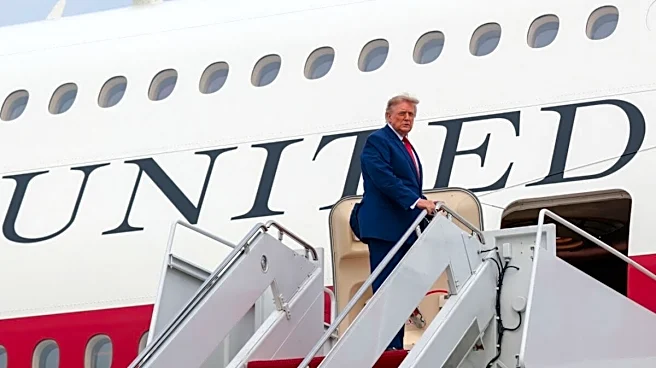
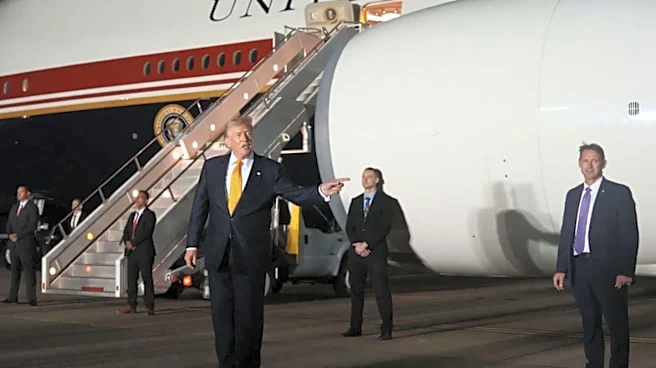
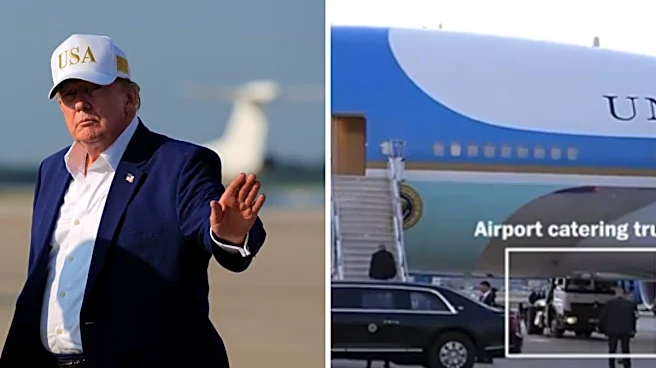
Trump was seen boarding Air Force One at Ankara airport on July 8. But according to The Washington Post, he later left the aircraft via a catering truck raised to plane level on the opposite side from where television cameras had filmed him boarding.
He was then taken to a C-32A military aircraft, a modified Boeing 757 often used by the vice-president.
Defence Secretary Pete Hegseth reportedly boarded the C-32A separately using external stairs, helping the flight appear normal.
Journalists and some White House staff remained on the original aircraft and were not told that Trump was no longer aboard. They were also instructed to keep their window shades down.
The deception extended to the aircraft call signs. The C-32A carrying Trump reportedly flew as “Reach 18”, while the aircraft carrying journalists continued using “AF1”. Technically, Air Force One is the call sign for any US Air Force aircraft carrying the president.
When Does The Secret Service Use More Elaborate Deception?
Former Secret Service agent Paul Eckloff told the BBC World Service’s Newshour that an aircraft switch of this kind is not routine, but remains an available option. “I would say it does not happen often,” he said. “But it is an option that the Secret Service and others in executive protection always have.”
Such measures are more likely during high-risk overseas travel, particularly when a president is entering or leaving a conflict zone. “When the president travels to war zones, there are frequently tactics and techniques used to create doubt in an adversary of which aircraft or which movement that he’s going to make,” Eckloff said.
In March 2000, then US President Bill Clinton flew from India to Islamabad aboard an unmarked executive jet after a decoy aircraft bearing Air Force One livery landed first.
In 2003, the White House said George W Bush would spend Thanksgiving in Texas, while he instead travelled secretly to Baghdad aboard a blacked-out Air Force One.
Joe Biden was also taken secretly to Ukraine in 2023 with a sharply reduced press pool of one reporter and one photographer.
In those cases, however, the journalists involved knew about the deception and had been asked not to report it in real time.
Were Those Left On The Decoy Plane Put At Risk?
It remains unclear whether the journalists and White House staff left on the aircraft were ever in direct danger.
Trump later said the military aircraft carrying him was at “greater risk”.
Jose Zamora, regional director for the Americas for the Committee to Protect Journalists, told the BBC the administration “has a responsibility to ensure that journalists covering the president are not unnecessarily exposed to danger”.
“Reporters should be informed of credible security threats so they can make informed decisions about their safety,” he added.
/images/ppid_59c68470-image-178667258456057730.webp)


/images/ppid_59c68470-image-178656006579066640.webp)
/images/ppid_59c68470-image-178654006521624387.webp)
/images/ppid_59c68470-image-178660753149453365.webp)