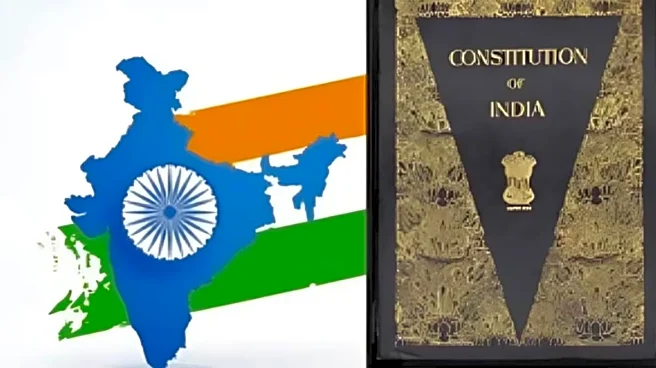

India won its freedom on August 15, 1947, but the country continued to be governed by British-era laws, with a government in place but no Constitution of its own.
To give independent India a legal and democratic
foundation, the Constituent Assembly was formed. After nearly three years of intense debate and drafting, India finally adopted a Constitution that reflected the will and aspirations of a free nation.
Why January 26 Was Chosen
A key question often asked is why January 26 was selected to implement the Indian Constitution. The answer lies in the historic Purna Swaraj declaration of 1930. On this day, India formally rejected British dominion status and asserted its demand for complete independence.
January 26 held deep significance in the freedom struggle. In 1929, the demand for complete independence was adopted as a formal political objective. On January 26, 1930, the first Purna Swaraj Day was observed across the country, with Indians pledging to reject British rule and strive for full freedom. This moment marked a major turning point in the independence movement.
To honour this historic resolve, January 26 was chosen as the date on which the Constitution of India would come into force, symbolically linking the freedom struggle to the birth of the republic.
The Making Of The Indian Constitution
The process of drafting the Constitution of India began on December 9, 1946. Dr Rajendra Prasad was appointed President of the Constituent Assembly, while Dr BR Ambedkar was made Chairman of the Drafting Committee.
Former Law Minister Salman Khurshid has noted that Mahatma Gandhi and Jawaharlal Nehru believed the Constitution would be incomplete without Ambedkar’s leadership. Without his presence, they felt people might question whether their voices had truly been represented.
After 2 years, 11 months, and 17 days of intensive work, the drafting was completed. The Assembly held 11 sessions and spent 114 days debating the draft in detail.
Adoption And Implementation
The Indian Constitution replaced the British-era Government of India Act 1935. It was formally adopted on November 26, 1949, but came into effect on January 26, 1950. With this, the Government of India Act 1935 ceased to exist, and India officially became a sovereign democratic republic.
In 1976, the words ‘socialist’ and ‘secular’ were added to the Preamble through the 42nd Constitutional Amendment. With the implementation of the Constitution, democratic institutions received full authority, marking the beginning of a new era in India’s governance.
Republic Day And India’s Global Image
Today, India’s strength and unity are showcased to the world on Kartavya Path. Every year on Republic Day, a grand parade is held in New Delhi, highlighting the nation’s military strength and rich cultural heritage.
The day begins with the Prime Minister paying tribute at the National War Memorial. The President then hoists the national flag, followed by a 21-gun salute and the national anthem. Contingents from the Army, Navy, and Air Force march in disciplined formation, while school children and colourful tableaux add vibrancy to the celebrations.