

/images/ppid_a911dc6a-image-177063607691813949.webp)
/images/ppid_a911dc6a-image-177061302968174841.webp)
The Calcutta High Court ordered the deployment of central forces to control the unrest at Beldanga in West Bengal’s Murshidabad district, triggered by the alleged murder of a Bengali migrant worker in Jharkhand.
The high court ordered the use of central forces already present in the Murshidabad district.
The division bench of Chief Justice Sujoy Paul and Justice Partha Sarathi Sen directed the deployment of central forces to bring the situation in violence-hit Beldanga under control. It instructed the West Bengal government to ensure effective use of the forces already deployed in the district.
The bench directed the superintendent of police and district magistrate to ensure people’s safety and protect their livelihoods. It said a recurrence of such
incidents in Beldanga must be prevented.
“Any untoward situation must be dealt with firmly. The situation has to be brought under control before it goes out of hand,” the bench observed.
The court noted that it is at present concerned about the protection of people’s lives, livelihoods, and property. “The same kind of incident is recurring at the same place. The court is issuing directions to ensure the safety of citizens,” it observed.
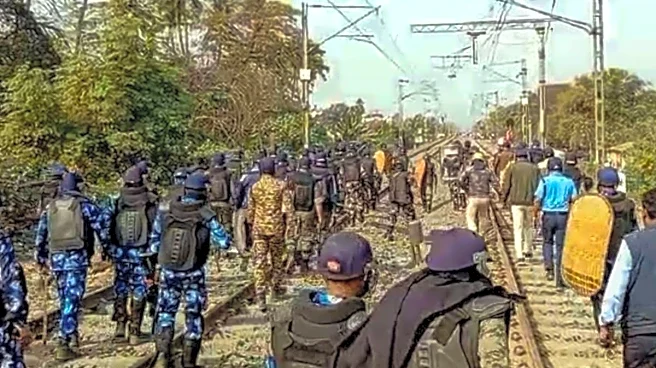
On the issue of an NIA probe, the Calcutta HC said the Centre is free to take steps in accordance with the law. The central government told the court that out of five companies of forces, only one has been deployed so far. Route marches were conducted in the afternoon for 90 minutes on January 16 and for more than two hours on January 17, it said.
Responding to the Chief Justice Ghosh’s query on deployment in Murshidabad, the government said five companies are deployed in and around Beldanga, eight companies in the Jangipur region, and four companies in the Samserganj region.
The court directed the state government to file an affidavit in two weeks. It will hear the matter again after four weeks.
WHY DID HC ISSUE ORDER?
The HC was hearing a petition filed on Monday (January 19) seeking the deployment of central forces at Beldanga over last week’s violence in connection with alleged attacks on migrant workers in neighbouring states.
The PIL’s lawyer Billwadal Bhattachara questioned why the situation at Beldanga could not be controlled initially with road blocks on the national highway 12 for hours and violence erupting on January 16 and 17. The plea prayed for a probe by the National Investigation Agency (NIA) into the violence at Beldanga.
The high court had in April 2025 ordered the deployment of central forces in Murshidabad district following communal violence that claimed at least two lives, over protests against the Waqf (Amendment) Act.
WHAT HAPPENED IN BELDANGA?
On January 16, protesters blocked NH-12 for around six hours over the alleged death of a migrant worker from Beldanga in Jharkhand.
A woman journalist, who was covering the violent incidents, was allegedly attacked by some protesters following which the police arrested four persons. On the morning of January 17, road and rail blockades were staged over the alleged heckling of a migrant worker from Murshidabad in Bihar.
The situation was brought under control in the afternoon after the police carried out route marches and area domination with additional deployment of personnel. A senior police officer said 30 people were arrested from different places after verifying social media and CCTV footage.
(With agency inputs)
/images/ppid_59c68470-image-177073503438256591.webp)



/images/ppid_a911dc6a-image-17707256352893847.webp)

/images/ppid_a911dc6a-image-177057403153775600.webp)