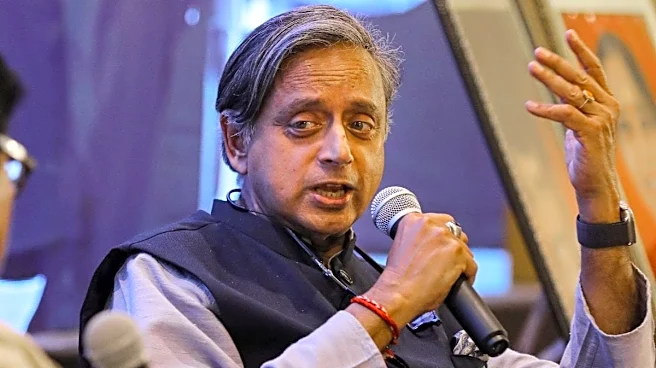


Shashi Tharoor’s latest column in The Indian Express, reflecting on the rise of the “Cockroach Janta Party” and the inability of India’s Opposition to channel the energy of a politically restless generation, makes an important observation: young Indians are increasingly unwilling to remain passive spectators in public life. Tharoor argues that established Opposition parties have failed to provide meaningful avenues for young people to participate in politics because of hierarchical structures, political gatekeeping and an entrenched “high command” culture.
He is right about the symptom, but from a right-of-centre perspective, his diagnosis remains incomplete.
The deeper lesson of the Cockroach phenomenon is not merely that the Opposition needs
better youth wings, more social-media campaigns or a more flexible organisational structure. It is that political energy does not emerge in a vacuum. It is cultivated through ideas, institutions, cultural confidence and a credible civilisational narrative. The Indian right has spent decades building precisely that ecosystem.
The Opposition is now discovering what happens when a political establishment loses contact with the cultural and aspirational vocabulary of a generation.
The most striking feature of the Cockroach Janta Party phenomenon is that it did not begin as a conventional political organisation. It emerged from frustration, humour, digital culture and a desire among young Indians to make themselves heard. Tharoor rightly identifies this as a warning to established parties. But the important question is: why have young people increasingly found alternative political and cultural platforms more attractive than traditional Opposition parties?
The answer cannot simply be “high command culture.”
India’s political right has demonstrated that politics can be organised beyond conventional electoral structures. Over several decades, an extensive network of social, cultural, intellectual, student and volunteer organisations has created pathways through which individuals can acquire political experience, develop ideological commitments and participate in public life without necessarily possessing a dynastic surname.
This is one of the fundamental differences between an organically expanding political movement and a party establishment trying to manufacture youth enthusiasm from the top.
The Bharatiya Janata Party’s electoral success cannot be understood merely through election management, social media or the personal popularity of Narendra Modi. Beneath electoral politics lies a much larger institutional and ideological ecosystem. The Rashtriya Swayamsevak Sangh and numerous organisations associated with the broader nationalist movement have historically provided avenues for participation, training, debate and grassroots mobilisation. Whatever one’s political assessment of this ecosystem, its organisational depth cannot seriously be dismissed.
The right understood something that much of the traditional Opposition failed to appreciate: political participation must precede political recruitment.
A young person does not necessarily enter public life because a political party sends a social-media invitation. He or she becomes politically engaged after discovering an idea worth believing in, a community worth belonging to and a cause worth serving.
This is where Tharoor’s argument needs to move beyond organisational reform.
The crisis confronting the Opposition is not simply that its youth wings are ineffective. It is that large sections of India’s young population no longer accept the ideological assumptions that dominated the political discourse of the post-Independence establishment.
India has changed dramatically.
The young Indian of 2026 is more confident about India’s civilisational identity, more connected to global technology, more ambitious economically and increasingly impatient with inherited ideological categories. This generation grew up in an India that speaks about becoming a developed nation, building digital infrastructure, launching satellites, producing technology and exercising strategic autonomy on the world stage.
Yet much of the Opposition’s vocabulary remains anchored in an older political grammar, one that often interprets Indian nationalism through suspicion, treats cultural assertion as inherently problematic and approaches the politics of identity primarily through the lens of minority-majority arithmetic.
That is increasingly inadequate.
The political right’s advantage has been its ability to connect contemporary aspirations with an older civilisational vocabulary. “Bharat” is presented not merely as a geographical territory but as a historical and cultural continuity. Hindutva, in its intellectual formulation, is presented by its proponents not simply as an electoral ideology but as a civilisational framework. Nationalism is linked with cultural confidence, technological modernisation, strategic autonomy and the aspiration for a stronger India.
One may disagree with this framework, but one cannot deny its political effectiveness.
That distinction matters.
Tharoor observes that young people want visibility, dignity and agency. Precisely. But agency does not arise simply because political parties give young people microphones. It arises when young people believe that their participation can contribute to something larger than themselves.
The right has been particularly successful at creating that sense of mission.
This also explains why the Opposition’s invocation of the historical Janata Party offers only a partial lesson. The Janata experiment demonstrated the power of combining disparate political forces against a dominant establishment, but it also demonstrated the limitations of an alliance constructed primarily around opposition to one leader or one party.
The historical Janata Party was united by a common adversary but divided by deeper ideological and organisational contradictions. Once the immediate political objective had been achieved, those contradictions became difficult to contain.
That is a warning for today’s Opposition.
An anti-BJP coalition is not, by itself, an alternative political philosophy.
If the Opposition wants to capture the energy represented by movements such as the Cockroach Janta Party, it must answer a much harder question: what does it actually want to build?
Opposing the BJP is a political strategy. It is not a political vision.
Young Indians want jobs, entrepreneurship, technological opportunity, national security, educational excellence, social mobility, clean governance and a country capable of asserting itself globally. They also want cultural recognition. They are not necessarily willing to choose between economic modernisation and civilisational identity.
The political right has understood this synthesis remarkably well.
The Opposition often assumes that the contest is between secularism and nationalism, or between liberalism and Hindutva. Increasingly, the real contest is between competing visions of what a confident twenty-first-century India should look like.
The right’s answer is broadly clear: a technologically advanced, economically powerful, culturally self-confident and strategically autonomous Bharat.
The Opposition’s answer remains considerably less coherent.
There is another point in Tharoor’s argument that deserves examination. He correctly criticises political gatekeeping. But gatekeeping is not exclusively a feature of the right, nor is decentralisation an automatic virtue of the Opposition.
Indian political parties across the ideological spectrum have struggled with internal democracy. Dynasticism, patronage and personality-driven politics have existed across parties. The Congress, in particular, cannot credibly present itself as the victim of a political culture it helped institutionalise for decades.
The irony is that Tharoor himself is an example of the contradiction. He is an accomplished intellectual and communicator who has frequently demonstrated an ability to speak beyond conventional party rhetoric. Yet his own party has often struggled to convert such individual talent into a coherent generational political renewal.
The problem, therefore, is not the absence of talented young Indians. India has millions of them.
The problem is that political establishments often want the energy of young people without surrendering any institutional power to them.
That is precisely why spontaneous movements become attractive.
The Cockroach Janta Party phenomenon should therefore not simply be interpreted as an opportunity for the Opposition to recruit Gen Z. It should be read as a warning to the entire political class.
But there is a larger lesson for the right as well.
Electoral dominance can never be treated as permanent. The very energy that helped create today’s political transformation can eventually demand more from the political system that it helped empower. Young Indians who once responded to the language of national revival will eventually demand results: better institutions, employment, education, innovation, transparency and greater accountability.
The right cannot afford to assume that cultural nationalism alone will permanently sustain political loyalty.
If the Opposition’s mistake is believing that anti-BJP sentiment is a substitute for an alternative vision, the BJP’s potential mistake would be believing that electoral success is a substitute for continuous renewal.
The Cockroach phenomenon ultimately reveals something larger than the weakness of the Opposition.
It reveals that Indian politics is becoming increasingly participatory, digital, decentralised and culturally assertive. Political authority is no longer produced exclusively in party offices, television studios or parliamentary corridors. It is also produced in universities, online communities, creator networks, civil-society groups and informal movements.
The political right recognised this transformation earlier than many of its opponents.
The Opposition is now trying to catch up.
Tharoor is therefore correct that India’s young generation cannot simply be treated as an electoral demographic waiting to be mobilised. But the solution is not merely to open the doors of old political organisations a little wider.
The political establishment must ask a more fundamental question: what ideas will persuade India’s young people that politics is worth their time?
For the right, that question has an established answer: national confidence, civilisational continuity, development, technological modernisation and strategic self-reliance.
For the Opposition, the search for that answer continues.
And that may be the real lesson of the Cockroach Janta Party: India’s youth are not necessarily moving away from politics. They may simply be moving away from a political establishment that has failed to understand what they have already become.
The writer is a technocrat, political analyst, and author. He pens national, geopolitical, and social issues. His social media handle is @prosenjitnth. Views expressed in the above piece are personal and solely those of the author. They do not necessarily reflect News18’s views.


/images/ppid_59c68470-image-178782005677361209.webp)