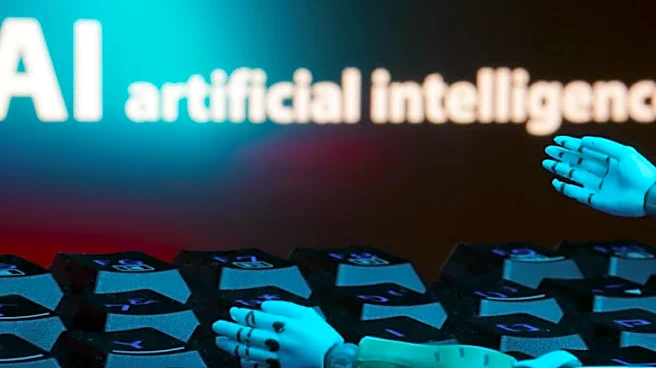




No matter which side of AI you land on, there is no denying that the genie cannot be put back in the bottle anymore. Remember, this genie did not escape. We let it out. And it’s now taking over every sphere of human life.
Soon it will be capable of diagnosing a patient better than the doctor and could explain a lesson better than a teacher. But just because it could, does it mean it should?
That is the question posed by Bill Gates’ latest proposal for a ‘Human Reserved’ category of work. In a lengthy essay on the AI transition, Gates argues that some tasks should remain with people even when machines can technically do it. Citing a personal example of caregivers looking after his father during advanced stages of Alzheimer’s, Gates said the care and
attention was “irreplaceably human”.
So what does ‘human reservation’ mean? The idea is not to ban AI from whole professions, but to enforce a mix of permanent protections, cautious automation and earmark jobs where AI can assist, but the decision rests on a human.
Perhaps, ‘enforce’ is not the right verb to use in this context? Because how do you actually enforce such protections! Who decides what gets reserved? How do you stop companies from getting around the rules? And what happens when different countries make different choices? Not to mention, how do you ensure the human tasked with the decision-making doesn’t end up copy-pasting AI suggestions?
The apparent futility of the exercise almost makes these questions rhetorical.
Why Exactly Would We Be Protecting?
Any attempt at protecting jobs from AI begins with defining what actually is a ‘job’. It’s rarely ever just one thing. For example, a teaching job is not limited to just preparing lesson plans, answering questions and testing students. It’s also mentoring, nurturing, spotting signs of trouble, imbibing ethics and inspiring.
Same goes for doctors. AI can scan, analyse and even diagnose. But should it deliver the diagnosis, counsel those affected, decide the course of treatment?
This is where the International Labour Organization’s May 2025 research is useful. Rather than simply asking whether an entire profession will disappear, the analysis looks at the individual tasks within occupations. According to this analysis, one in four workers globally are in jobs with some exposure to generative AI, but it predicts transformation as the likelier outcome rather than outright replacement because in most cases human input remains critical.
Perhaps we don’t need to ‘human reserve’ entire jobs. Perhaps we need to reserve certain tasks and decisions within those jobs.
A Version Of This Idea
The European Union has already put something similar into regulation, although for a different purpose.
Under the AI Act, high-risk AI systems must allow effective human oversight. The human overseeing the system must be able to understand its limitations, recognise when it is going wrong and, most importantly, disregard or overrule the output.
It’s not the same as Gates’ proposal, but raises an interesting possibility.
Could ‘Human Reserved’ mean certain decisions must always have a person at the centre of the thought-process, rather than requiring an entire occupation to remain human-only?
It’s easier to imagine, impossible to practise.
Who Draws The Line?
This is where the proposal gets difficult to implement.
If the AI can handle 90% of a caregiver’s work, is the remaining 10% ‘human reserved’? What if a robot can physically care for an elderly person but cannot provide companionship? What if the person being cared for actually prefers the robot?
In his essay, Gates points to Japan as an example of why there may not be one global answer. A country with a shrinking workforce and a shortage of people to care for the elderly may welcome caregiving robots, while another country may choose to keep that work human.
That means any ‘human reserved’ list would probably have to change with time, place and circumstance.
Let’s Talk Money
Gates presents another ambitious proposal: taxing AI use.
His argument is simple. A tax on AI or robots could reduce the financial incentive to replace human workers, and raise money for retraining and social protection.
There is some economic research behind the broader idea, though it focusses on automation before AI as we know it today. A National Bureau of Economic Research’s (NBER) 2020 study found that the US tax system has favoured capital over labour and argued that an appropriately designed automation tax could improve employment outcomes. Other research has also explored robot taxes as a temporary measure for workers who cannot easily move into new occupations.
But there is an obvious problem, one the world has seen before.
If one country makes AI more expensive while another does not, companies have an incentive to move the work elsewhere. Experts have also questioned whether taxing AI tokens measures worker displacement at all, rather than simply measuring how much AI is being used.
Protecting workers, in other words, could come with an economic cost. The question is whether companies, and society, would consider that cost worth paying.
And what about India?
This is where the debate becomes particularly complicated.
India has a very different labour market from the US. It needs more productive jobs, not simply fewer job losses. The World Bank’s 2026 assessment says developing economies face lower immediate automation risks than richer countries, while having significant potential to use AI to increase productivity.
India is also actively thinking about how AI can create jobs. A NITI Aayog roadmap has called for a national AI talent and reskilling effort, pointing to India’s large technology and customer-experience workforce.
So would India want to reserve jobs for humans? Or would it want to use AI to help a smaller workforce serve far more people?
Think Of The Children…
Gates makes another thought-provoking argument: young workers may not get the chance to enter some professions in the first place.
A 2026 US Census working paper found a marked decline in hiring among 22-to-24-year-olds in industries most exposed to AI since ChatGPT was launched.
If AI takes away the basic jobs through which people learn a profession, the problem is bigger than just unemployment. These jobs could make the strongest case for ‘human reserved’ protections.
For now, Gates has proposed a starting point. He leaves us to ponder not what AI can do, but what we, the humans, decide it should do.

/images/ppid_59c68470-image-178797252242039528.webp)

/images/ppid_59c68470-image-178781003032777722.webp)

/images/ppid_59c68470-image-178780755089241965.webp)
/images/ppid_59c68470-image-178789752815388883.webp)