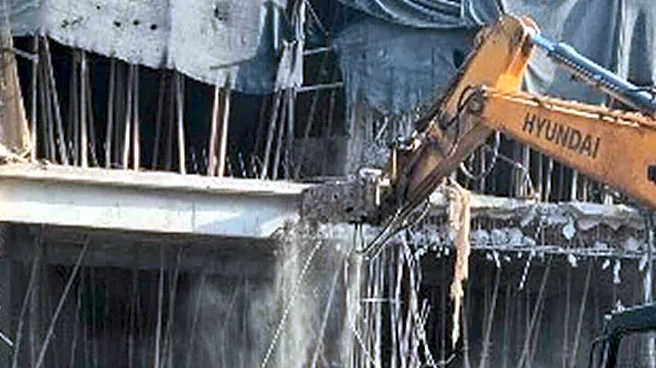






A court-appointed amicus curiae has told the Supreme Court that the Municipal Corporation of Delhi allowed an illegally constructed five-storey building in the capital’s Said-ul-Ajaib area to keep adding floors for over a decade before it collapsed on May 30, killing six people and injuring at least 14.
Senior Advocate Ajit Kumar Sinha, the amicus curiae in an ongoing Supreme Court matter, filed a status report on June 4 through Advocate Govind Jee, seeking urgent intervention from the top court following the collapse at Said-ul-Ajaib, New Delhi, which came down around 7:30 PM. The dead included students and local residents.
In the report, Sinha accused MCD officials of having “turned a blind eye” to construction at the site despite knowing it was
illegal. Municipal records cited in the report show the building was first booked for unauthorised construction in 2012, covering the basement, ground floor and first floor. The second and third floors were booked in 2015. The fourth and fifth floors were allegedly added recently, and the cumulative load ultimately brought the structure down.
A Decade Of Violations, Zero Enforcement
The amicus report argued that despite violations being detected repeatedly, no effective action was taken by the MCD. “The corporation failed to discharge its statutory obligations despite repeated notice of the violations and also failed to seal the premises and take consequential action when the fourth and fifth floors were being constructed recently,” the report said.
Sinha told the court the construction violated Sections 332, 346 and 348 of the Delhi Municipal Corporation Act, 1957, as well as the Unified Building Bye Laws, 2016.
The building had also been the subject of multiple rounds of litigation over the years.
In Shri Mangal Singh v. South Delhi Municipal Corporation, the owner challenged a proposed demolition. The Delhi High Court directed in December 2020 that the owner be given a hearing before any action was taken. In a separate matter, Sunita R. Choudharie v. South Delhi Municipal Corporation, the court granted the corporation further time while directing it to deal with any unauthorised construction at the site per law. Neither order produced demolition or sealing.
MCD Told High Court ‘No Construction’ Was Underway
The amicus pointed to what he called a direct falsehood submitted to the Delhi High Court. In Abdul Sakir v. MCD, a petition specifically flagging ongoing illegal construction at the Said-ul-Ajaib property, counsel for the MCD allegedly told the High Court that “no construction whatsoever is going on in the subject property” and that the dispute was private in nature.
Per the amicus report, that statement caused the petition to be dismissed. The building collapsed less than two months later.
Sinha described the post-collapse suspension of an Assistant Engineer and a Junior Engineer as a “whitewash,” arguing it did not reflect accountability proportionate to a decade of regulatory failure.
“The gross violation and illegal construction which went on since 2015 ultimately led to the horrific and unfortunate incident where innocent students and residents of the locality lost their lives whereas the beneficiary of said illegal structures as well as officers who failed to discharge their statutory obligations are still enjoying the benefits derived from the unauthorized construction,” the report stated.
What The Amicus Has Asked The Supreme Court To Do
Sinha has sought a series of directions from the top court.
He wants the MCD to file an affidavit detailing surveys conducted and action taken against all illegal and unauthorised constructions within its jurisdiction, including cases of residential premises being used commercially.
He has also sought a separate affidavit from the MCD and Delhi Police specifically addressing the Said-ul-Ajaib collapse and what was done before and after it.
Beyond Delhi, Sinha asked the court to direct the MCD to conduct structural audits of all buildings under its jurisdiction and carry out sealing and demolition of unsafe structures within a fixed timeline.
The Broader Supreme Court Proceedings
The application was filed within proceedings already before a bench of Justices Ahsanuddin Amanullah and R. Mahadevan. On March 25, that bench had directed a pan-India inquiry into the misuse of residential properties and violations of building regulations, impleading all municipal corporations and municipalities across states and union territories as parties.
The amicus sought urgent listing of the matter before the Supreme Court, however, the court declined.