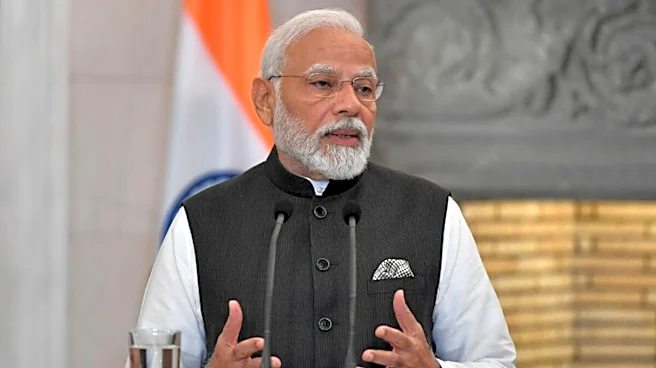



Prime Minister Narendra Modi has asked Union ministers to step up coordination with state governments and institutionalise regular interactions with their state-level counterparts, with a focus on improving the implementation of government schemes and development programmes.
Sources told CNN-News18 that ministers have been advised to organise sector-specific meetings with state ministers and officials, allowing issues related to implementation to be discussed directly rather than being addressed only through routine administrative channels.
The push comes after the Jal Shakti Ministry’s recent departmental summit, which the government has described as the first in a series of such Centre-State engagements envisioned by the prime minister.
Recently,
Union Jal Shakti Minister CR Patil brought together state water resources ministers for a two-day departmental summit in New Delhi on September 1-2. The meeting focused on water infrastructure projects, water-source sustainability, Jal Sanchay Jan Bhagidari and the implementation of Jal Jeevan Mission 2.0.
The state ministers also interacted with PM Modi during the concluding session. BJP national president Nitin Nabin was also part of the interaction.
The prime minister has now asked other ministries to replicate this model, sources said, with the broader objective of creating a more structured mechanism for Centre-State coordination across sectors.
Women And Child Development, Environment Ministries Next
The Ministry of Women and Child Development is likely to organise the next such sectoral conclave, followed by the Environment Ministry, according to sources.
The timing also comes as the Centre is placing greater emphasis on translating national schemes into measurable outcomes on the ground. Several flagship programmes, from drinking water and sanitation to nutrition, healthcare, agriculture and environmental protection, require states to play a crucial role in implementation.
For instance, the Women and Child Development Ministry has just launched the ninth Rashtriya Poshan Maah, with a focus on community participation and strengthening the role of Anganwadi centres in nutrition and early childhood development.
Similarly, environmental issues often require coordination across multiple states, particularly on pollution, forests, water resources and disaster preparedness. The Centre has recently been pushing coordinated action among Delhi-NCR states ahead of the winter pollution season, with states submitting action plans covering September 2026 to March 2027.
Why The Centre Is Pushing The Model
The initiative is being positioned as an extension of the government’s “Team India” and cooperative federalism approach.
The Jal Shakti summit was explicitly conceived as a platform where Union and state governments could jointly identify sectoral priorities, share best practices, flag implementation bottlenecks and agree on time-bound action. The idea now is to move beyond occasional meetings between Union ministers and state governments and create more regular, ministry-wise channels of engagement.
This could be particularly important for schemes where the Centre provides policy direction, funding or broad guidelines but states are responsible for much of the actual delivery.
The proposed model would give Union ministers a direct forum to hear from their state counterparts about problems such as delays in approvals, funding, land availability, inter-departmental coordination and differences in implementation capacity. It would also allow states to share practices that could potentially be adopted elsewhere.
The move comes against the backdrop of the Centre’s broader emphasis on reviewing governance and welfare delivery. PM Modi recently held a lengthy review meeting with ministers focused on the progress and implementation of government initiatives, with further ministerial review meetings planned.
The larger message from the prime minister’s latest push is that Centre-State coordination should become a continuous administrative process rather than an occasional exercise, particularly in sectors where the success of a central scheme ultimately depends on its delivery by state governments.

/images/ppid_59c68470-image-178913502656121376.webp)

/images/ppid_59c68470-image-178913506932268890.webp)