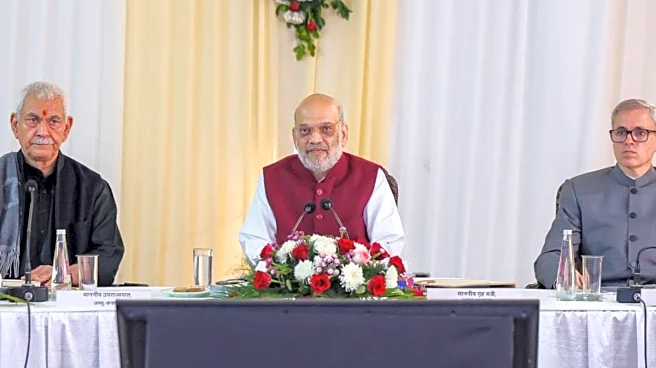



Union Home Minister Amit Shah’s recent two-day visit to Jammu and Kashmir must be seen as yet another renewed effort by the central government to beef up internal security, ensure socio-economic stability and accelerate development in the region.
Seen in the backdrop of intensified anti-terrorism operations across the region, it is a critical visit and reflective of the need for heightened vigilance to neutralise any attempt by local and Pakistan-sponsored militants to recreate an environment of fear and instability that once prevailed across the Valley and Jammu.
The determined objective to dismantle all terror networks and maintain stability was voiced loudly and clearly by Shah at a high-level security review meeting he presided over at Lok
Bhawan, Jammu with J&K Lt. Governor Manoj Sinha, senior civil administrative officers, paramilitary chiefs, and police and intelligence agencies officers in attendance.
Shah and other participants also undertook an assessment of the region’s security landscape, operational preparedness, and counter-terror strategies comprehensively. The interaction also reaffirmed the government’s commitment to support the families of those who had lost their lives due to militancy.
The Union Home Minister also used his two-day visit to Jammu to evaluate progress of development initiatives, including major infrastructure projects and central government-sponsored schemes.
Fostering inclusive growth to ensure J & K’s long-term stability has been a goal of the Narendra Modi-led NDA government since abrogation of Articles 370 and 35-A in the latter half of 2019. That commitment has been reiterated once again in the budget proposals for J&K for FY 2026-27.
Based on early 2026 reports, the further development of Jammu & Kashmir will be heavily focused on prioritising sustainable tourism, rural infrastructure and employment opportunities for Kashmiri youth. According to official sources, the proposed budget for 2026–27 envisions a GSDP growth of around 9.5 per cent.
Aiming to achieve infrastructural growth for the long term, the Centre and the UT administration are looking to primarily use the 2026–27 estimated budget of Rs.1,27,767 crore for capital investment schemes (approximately Rs.33,127 crore) and securing interest-free loans for projects for the next 50 years.
A bottom-up approach is likely to be taken for rural infrastructure, especially with regard to improving the region’s road network and other forms of connectivity. The Holistic Agriculture Development Programme (HADP) aims to provide 2.87 lakh jobs, with a new dairy scheme targeting increased milk production.
The government will also be pushing for industrial growth through inclusive development, while on the infrastructure and the tourism front, the focus will be on completing the construction of the All India Institute of Medical Sciences in Awantipora, cent per cent smart metering of urban areas, new eco-tourism trails and adventure sports, besides refurbishing of Amarnath Yatra infrastructure.
Driving development comprehensively will also include the launch of 32 new welfare measures to meet the long-term vision of peace and progress in Jammu and
A key element of Shah’s visit to Jammu last week was his high praise of Border Security Force personnel at Bobiya for their unwavering service and exceptional courage. He noted that recent operations, including during Operation Sindoor along the J&K frontier had resulted in the destruction of 118 Pakistani border posts and three terrorist launch pads.
Highlighting the force’s steadfast performance not only in J&K, but also in other challenging theatres like in Manipur, the Northeast and Maoist-affected regions of Odisha and Chhattisgarh, Shah said, “Wherever the BSF is deployed, it hoists the flag of bravery and commitment.”
He added that every visit to a border outpost had reinforced his admiration for the discipline, sacrifice, and spirit of service embodied by India’s border guards.
The Home Minister said Jammu and Kashmir will soon be terror-free.
Shah’s confident assessment about the future progress of Jammu and Kashmir appears to have resonated well with Chief Minister Omar Abdullah, as he has reaffirmed his government and the Centre’s commitment to provide the people of Jammu and Kashmir with opportunities for sustained economic growth, social welfare and inclusive development.
For the near future, the UT government is hopeful about creating more employment opportunities, strengthening infrastructure, improving public services, and ensuring transparent development in every section of society. Through the focus on tourism, agriculture, horticulture, animal husbandry, fisheries and dairy, the government aims to promote entrepreneurship, self-employment, and skill development in J&K’s economic growth journey.
Budget 2026–27 provides a roadmap for inclusive growth, social justice, and sustainable development and tangible results.
The author is editor of Brighter Kashmir, author, TV commentator, political analyst, and columnist. Views expressed in the above piece are personal and solely those of the author. They do not necessarily reflect News18’s views.


/images/ppid_59c68470-image-177087010153493874.webp)

/images/ppid_a911dc6a-image-177089383008043008.webp)

/images/ppid_a911dc6a-image-177071443822834480.webp)
