



The Gujarat Titans’ win against the Delhi Capitals on Wednesday (April 8) was a perfect showcase of not only their strengths but also one of their biggest weaknesses.
In the first innings, till captain Shubman Gill was at the crease, they scored 183 runs in 17.3 overs at 10.57 runs/over. After he got out, they managed 17 runs in 15 balls at 7.39 runs/over, to end up with a sub-par 210/4, which was barely defended on the last ball.
That wicket column is telling. They had seven batters left when Gill holed one out against Lungi Ngidi’s superb cutter, including the not-out Washington Sundar and three finishers, but still couldn’t find much impetus.
A lot of it was due to the situation, but DC managed 67 runs in the last five overs in the second innings,
compared to GT’s 49. In GT’s previous match against Rajasthan Royals, they scored 43 runs in the last five overs, seven fewer than RR’s 50. In the game before that, it was 34 in the same phase, compared to the Punjab Kings’ 44 in five fewer deliveries.
It’s not a new phenomenon either. Below is data from IPL’s 2024 and 2025 seasons: we have used all ten teams with two extra rows — for when Gill is not at the crease (either striker’s or non-striker’s end) and for when both Gill and Sudharsan are not at the crease.
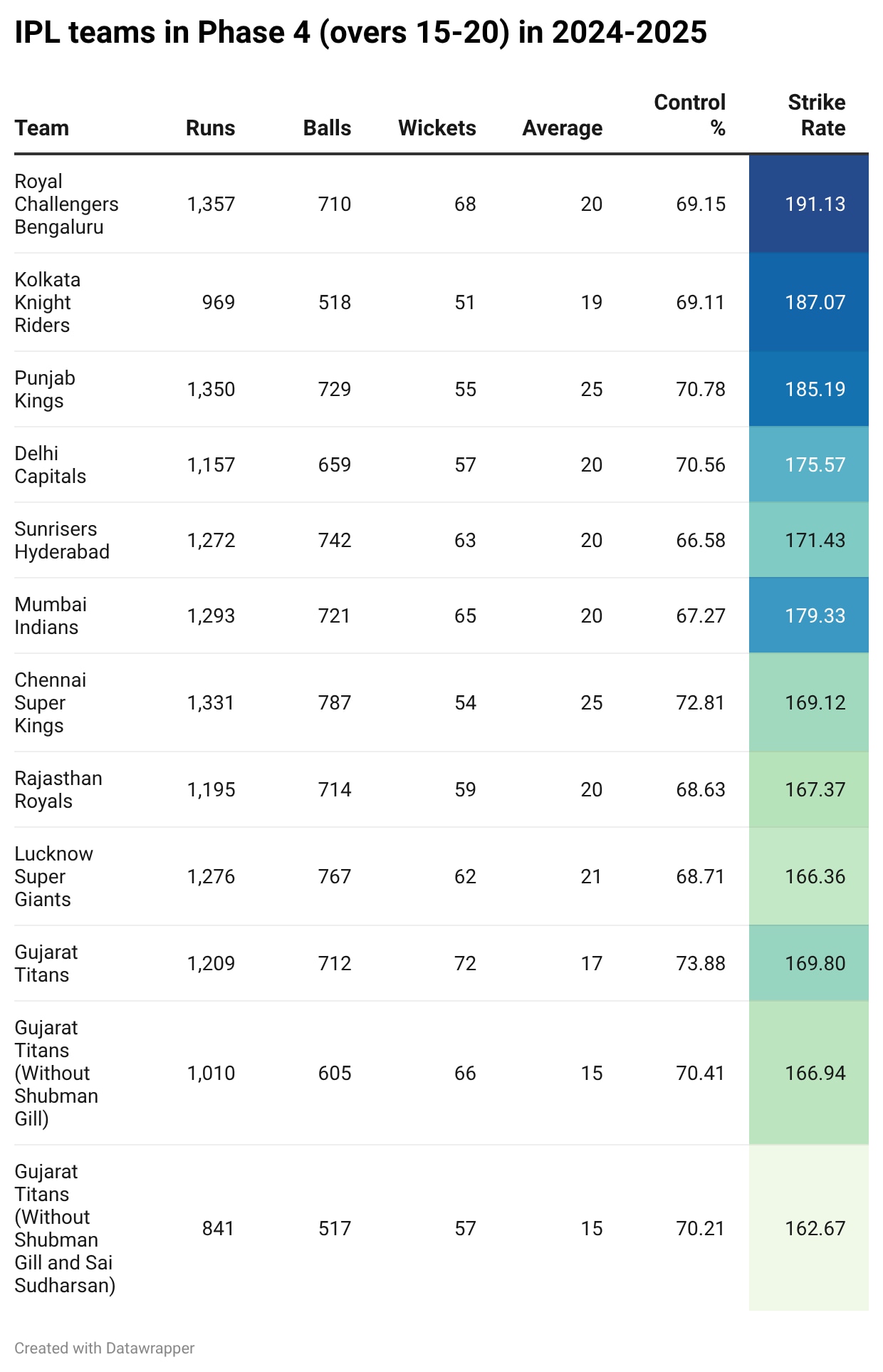
You’ll notice that GT already have the third-worst strike-rate of this phase, only behind Chennai Super Kings and Rajasthan Royals. But when you take out Gill, it falls to the lowest at 166.94 and even further to 162.67 without both openers at the crease.
There’s another interesting thing in the table. Overall, GT’s control percentage in this phase is 73.88%, the highest among the ten teams. Usually, that’s a good thing, but in T20s, when your team is looking for high-risk shots in the death overs, this shows that GT don’t take enough risks.
Now, strike-rate and control percentage don’t tell the full picture in T20s. A strike-rate of 150 when your team is eight down in the 15th over is commendable, but the same strike-rate when you are 180/0 in the 19th over would be considered poor at best.
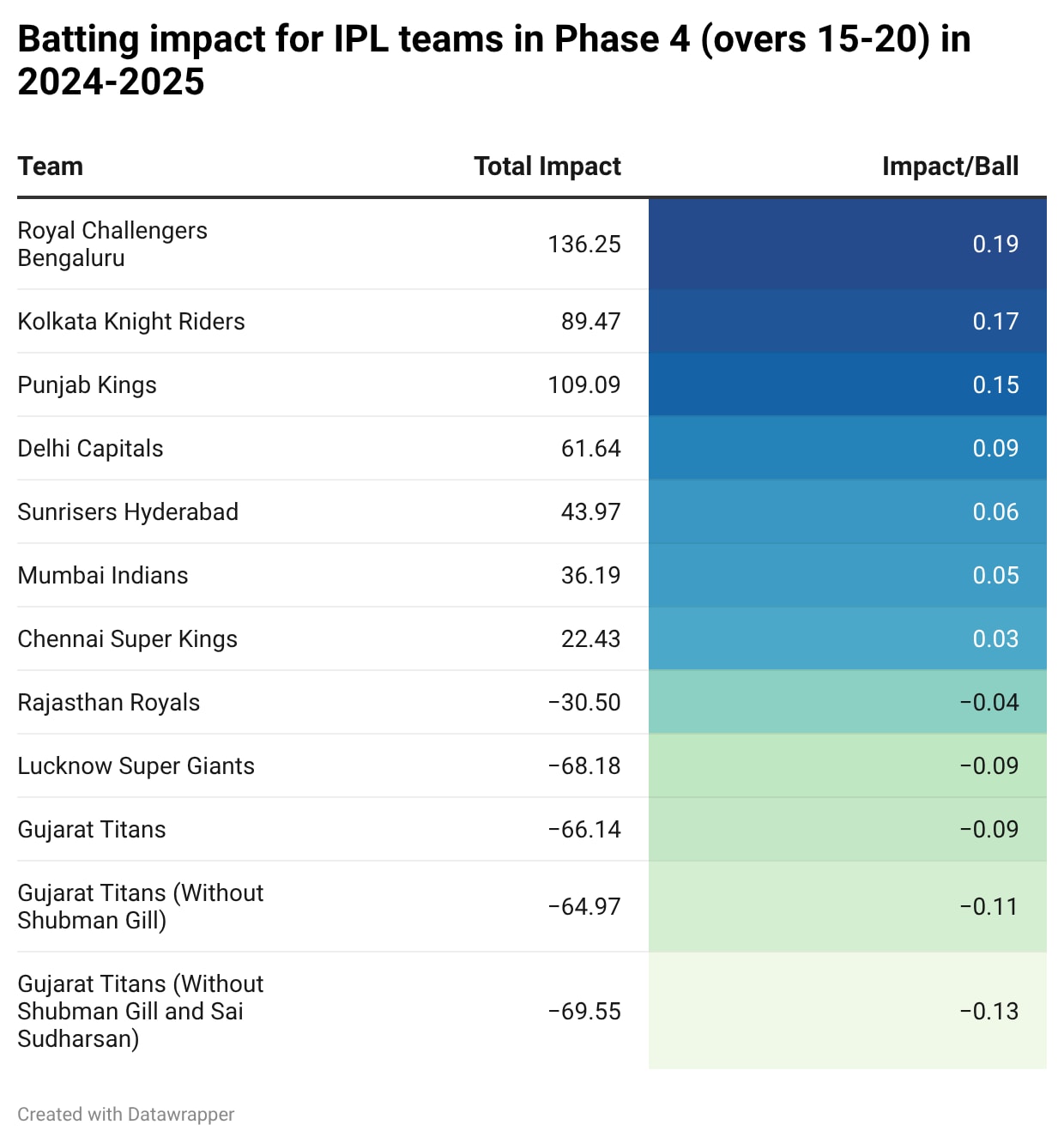
So we’ll use a more detailed metric: batting impact. This measures how many runs a batter scores compared to what’s expected for that ball, depending on the situation.
Using the Duckworth-Lewis model (devised by Himanish Ganjoo), each delivery gets an ‘expected’ value based on how many balls and wickets are left. So if the expected runs for a ball in a particular situation is 2 and the batter scores 4, he gets a positive impact of 2.
Now, an impact per ball of 0.2 means the player scores about 0.2 extra runs per ball, adding roughly 20 runs every 100 balls. A value of -0.1 means they fall short by about 0.1 runs per ball, costing the team around 10 runs every 100 balls.
In IPL 2025 and 2024, the Titans lost about 66 runs in the last five overs. In comparison, RCB scored a staggering 136 runs more than expected for the match situations. On per/ball basis, they were the worst, jointly alongside Lucknow Super Giants. As expected, without Gill and Sudharsan, the numbers go to detestable lows: -0.11 and -0.13.
This may be simple to explain: you can’t expect a team to perform well without two of its best players (considering Jos Buttler’s recent form). The Titans’ problem is that Gill and Sudharsan are their best batters and thus are their openers — but they are also their best finishers in the current set-up, at least according to the data from the last two years.
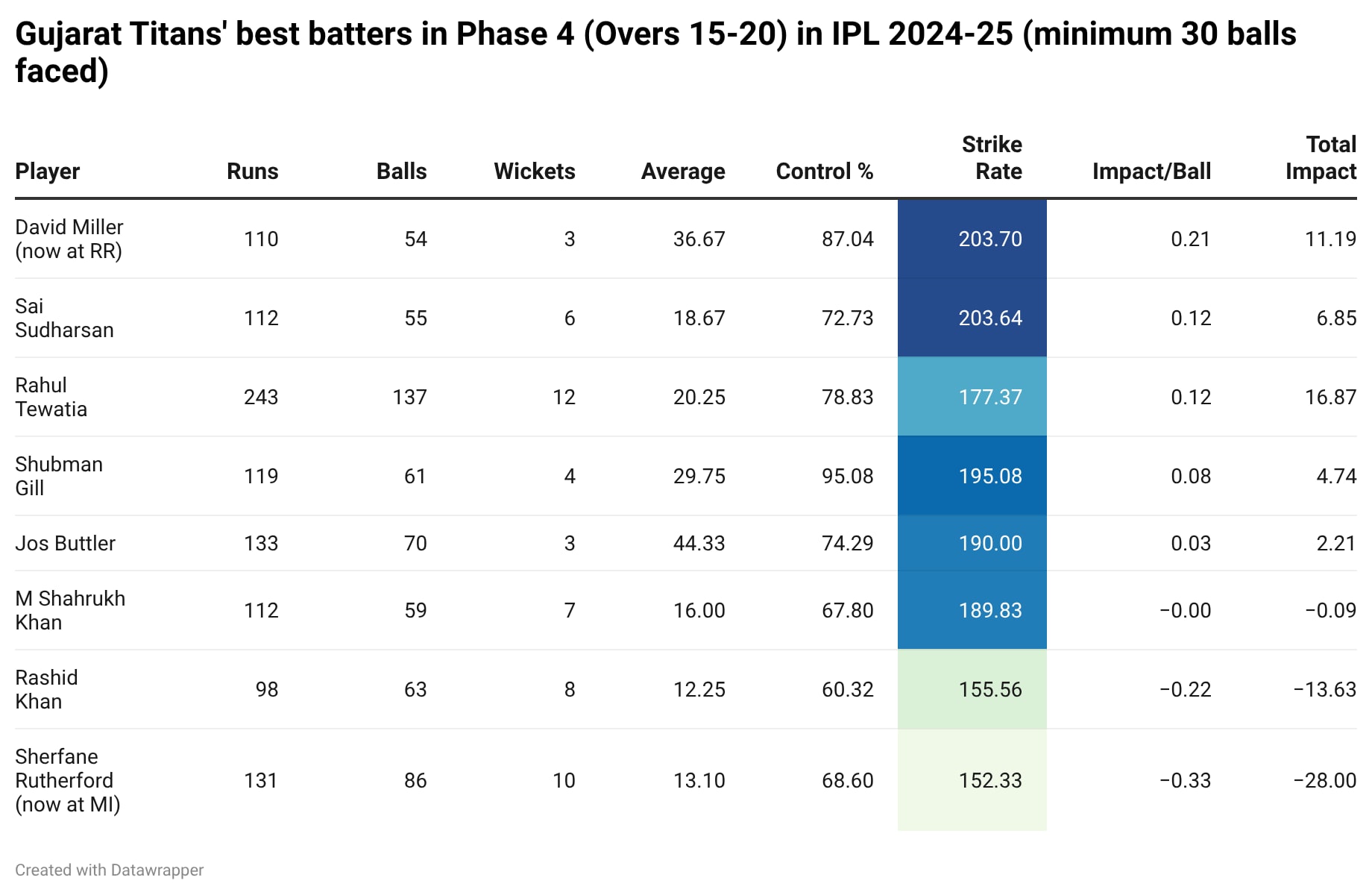
Apart from the familiar name at the top, who was in the DC camp on Wednesday, Sudharsan and Gill have the best strike-rates in the phase. Although Tewatia beats Gill in terms of impact, he’s nowhere near the best batters of this phase, despite it being his only job. So far in 2026, he has only managed an 11* (10), 12 (6), and 1* (1).
Similarly, Shahrukh Khan has scores of 4 (6) and 11 (4) to show for himself, while Glenn Phillips has managed 25 (17), 3 (4) and then 14 (9) against DC on Wednesday.
We can also gauge GT’s over-reliance on openers if we focus only on those balls in phase 4 when neither Gill nor Sudharsan was at the crease and compare it to other teams’ similar situations. Here, too, GT are only marginally ninth best, ahead of LSG.
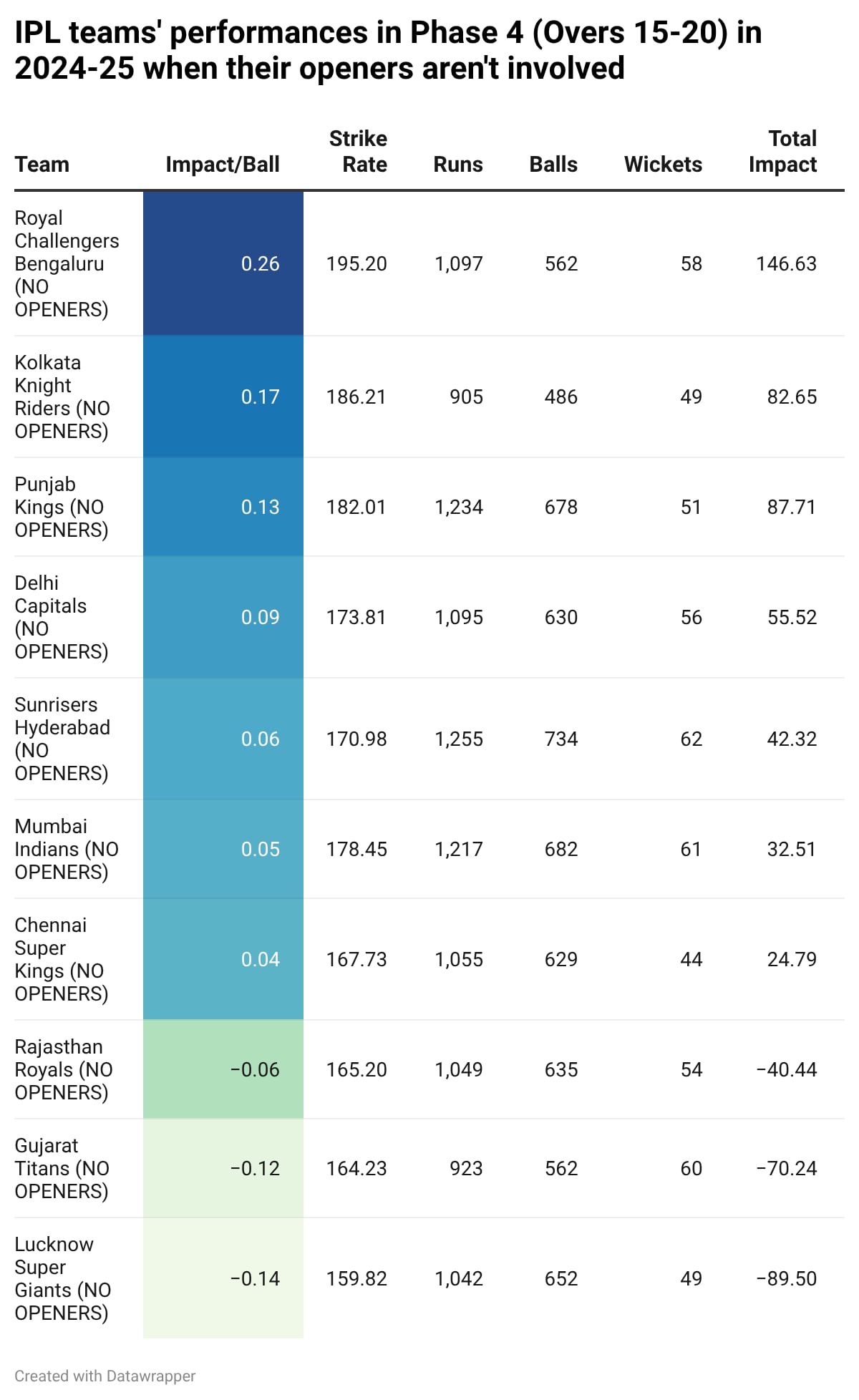
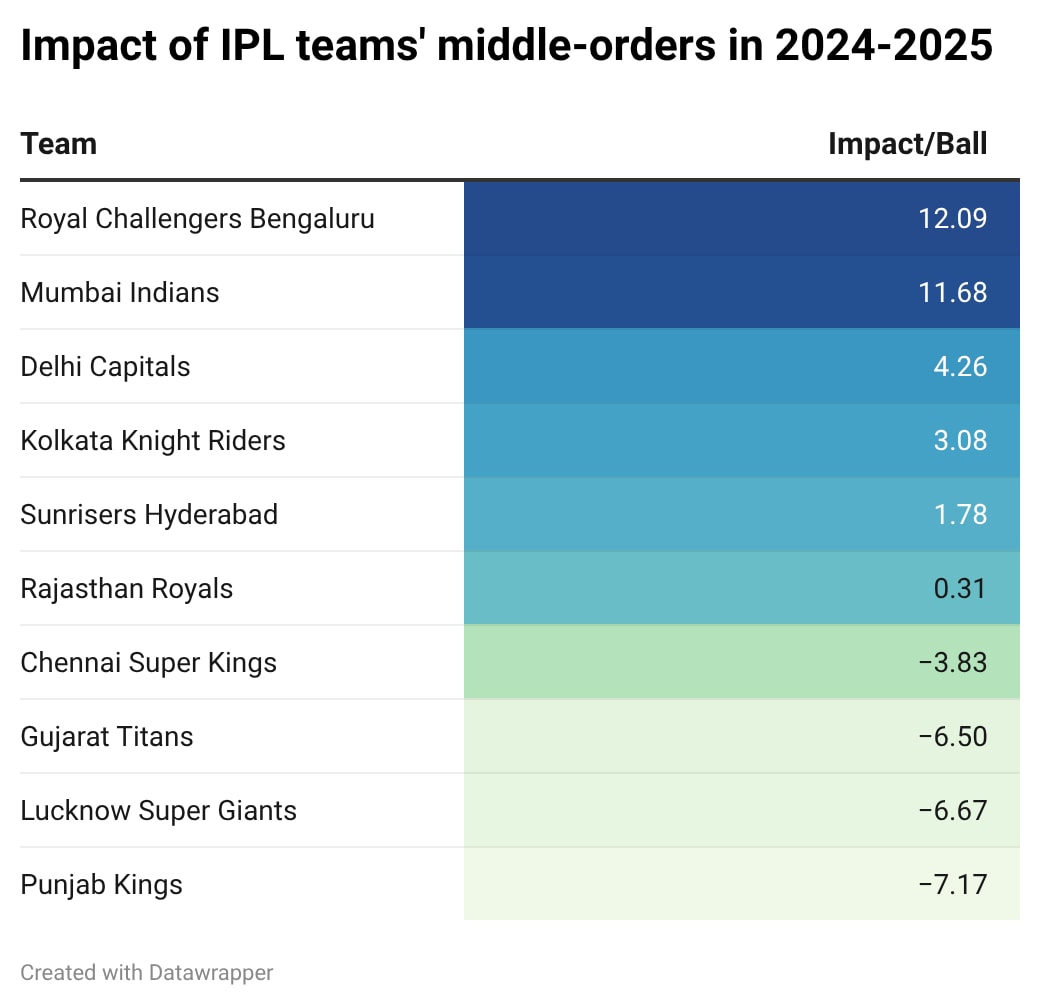
Finally, let’s divide the three sections of the batting order – top: bat position 1-3, middle: 4-7, lower: 8-11. GT’s top-order was the fifth best for IPL 2024-25 in terms of impact/ball, which is basically average. Their middle-order, on the other hand, was the third-worst after PBKS and LSG, and their lower-order was the second-worst after only RR.
Wednesday’s match against DC was won by GT’s bowlers, especially Rashid. The previous game was kept alive by Rashid and Kagiso Rabada’s late partnership. The PBKS game was made interesting by Prasidh Krishna’s brilliant middle-overs spell.
News18 CricketNext asked about the middle-order’s missing contributions to Rashid Khan, the GT vice-captain, who came at the press conference after the win over DC.
“In a tournament, not every player will perform in every game,” he said. “Whoever comes to bat, they might have a good day or a bad day – that’s how it goes. It’s too early to say our middle order isn’t clicking or is struggling. Everyone is in very good shape and in the right phase to score runs. We still have 11 more games – you will see the middle order firing. (Glenn) Phillips is going to jump in one day. Shah Rukh Khan is hitting the ball cleanly. It’s sometimes difficult to do it when you go out and need to hit at 180-200 from the get-go. He’ll score runs too. I’m coming in at No. 8 – it’s a long batting lineup! When I get the chance to score, I’ll also try to make the most of it.”
GT will hope that Rashid is right, and what looks like a manageable chink in the armor doesn’t prove to be a bottomless crater as the season goes on.


/images/ppid_59c68470-image-177605766287485167.webp)


/images/ppid_59c68470-image-177605752910817274.webp)
/images/ppid_59c68470-image-177605756419723298.webp)
/images/ppid_59c68470-image-177605763272851186.webp)
/images/ppid_59c68470-image-17760575971513176.webp)