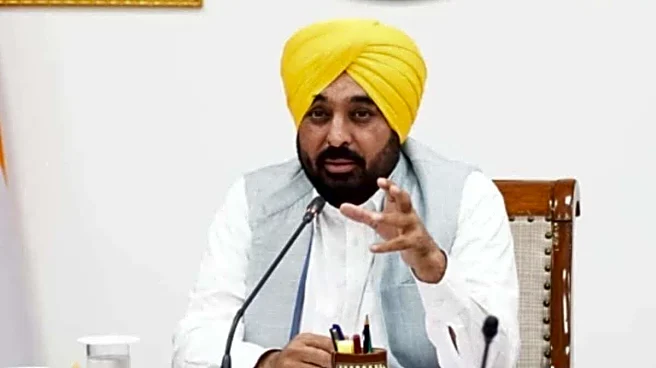




The Punjab Cabinet on Sunday objected to the appointment of Justice Ashwani Kumar Mishra as Chief Justice of the Punjab and Haryana High Court, alleging that the Centre notified the appointment without waiting for the state government’s views.
The Cabinet, chaired by Chief Minister Bhagwant Singh Mann, resolved that the appointment and the administration of oath should be kept on hold until Punjab’s position is obtained and considered by the competent authorities.
Mann said the move was part of a wider pattern of what he described as the Centre’s interference in Punjab’s constitutional rights. In a post on X, the Chief Minister said, “Today, the Punjab Cabinet unanimously passed an important resolution against the continued assault on Punjab’s rights by
the Central Government and the violation of constitutional norms.”
He further alleged that the Centre’s actions on Rural Development Fund (RDF) dues, Bhakra Beas Management Board (BBMB) rules and Punjab University, along with the latest judicial appointment, showed increasing interference in matters concerning the state.
Punjab cites Memorandum of Procedure
The Cabinet’s main objection centres on the procedure followed for appointing a Chief Justice of a High Court. It referred to Paragraph 6 of the Memorandum of Procedure for appointment and transfer of Chief Justices and Judges of High Courts, under which the Union Law Minister is required to obtain the views of the concerned state government after receiving the recommendation of the Chief Justice of India.
According to the Punjab government, the Supreme Court Collegium recommended Justice Mishra’s appointment on August 6, 2026. Punjab said it received a letter from Minister of State for Law and Justice Arjun Ram Meghwal on August 12 seeking the state’s views.
However, the state claimed that the Centre notified the appointment on September 5 without waiting for its response.
“The Ministry of Law & Justice, Government of India, the President of India passed an order appointing Justice Ashwani Kumar Mishra as the Chief Justice of the Punjab and Haryana High Court. This appointment has been made without obtaining the consent of the State government thereby bypassing all Constitutional norms and set procedures,” the Cabinet said.
Punjab also pointed out that the procedure does not prescribe a specific deadline for the state or Governor to send their views on such an appointment.
Cabinet raises earlier Madhya Pradesh example
The state government cited the 2024 case of Justice Gurmeet Singh Sandhawalia to argue that similar appointments had previously taken longer.
According to the Cabinet, Sandhawalia, then a judge of the Punjab and Haryana High Court, had been recommended by the Supreme Court Collegium for appointment as Chief Justice of the Madhya Pradesh High Court. Punjab claimed that the proposal was not notified for more than two months while the Madhya Pradesh government’s recommendation was awaited. The appointment was later changed to the Himachal Pradesh High Court.
The Cabinet said the contrast had strengthened its perception that judges from Punjab were being treated differently when compared with appointments involving judges from other states.
₹9,000 crore RDF dues, BBMB rules also cited
The Mann government also linked the latest dispute to several other issues between Punjab and the Centre.
The Cabinet alleged that more than ₹9,000 crore in RDF dues remained unpaid, affecting funds meant for agricultural infrastructure. It also said that a ₹1,600-crore flood relief package announced by Prime Minister Narendra Modi after the devastating floods of 2025 had not yet been released to Punjab.
On the BBMB, the state alleged that changes to the rules removed the traditional arrangement under which the Member (Power) was selected from Punjab, reducing the state’s representation in the management of its river waters and dams.
The Cabinet also reiterated its opposition to what it described as the Centre’s move towards greater centralisation of Punjab University.
The state government said these issues had collectively prompted the Cabinet to raise concerns about Punjab’s constitutional rights and its treatment within India’s federal structure.
It maintained that the appointment of Justice Mishra should remain on hold until Punjab’s views are obtained and properly considered, after which the process should continue according to the prescribed procedure.





/images/ppid_59c68470-image-17886750294423191.webp)