
/images/ppid_59c68470-image-178523252409762786.webp)
/images/ppid_a911dc6a-image-178523245208184113.webp)

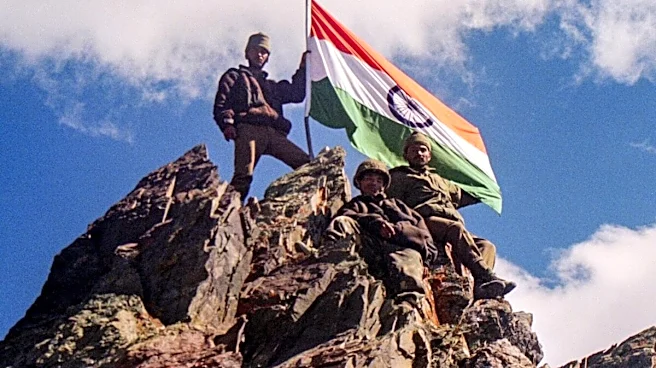
In the summer of 1999, Indian troops were sent to take back peaks the enemy already held. In mountain warfare, that is the hardest fight there is.
Whoever holds the heights holds every advantage. They see you coming from kilometres out. They fire down while you climb up, exposed on open rock, carrying weight through air so thin it saps the strength from your legs. At those altitudes, the cold does its own damage. Metal seizes. Weapons jam. A wound that would be survivable lower down can kill a man before he reaches an aid post. Pakistani troops had spent the winter fortifying positions above Kargil, Dras and Batalik, and by every rule of mountain combat, dislodging them should have cost far more than it did, if it could be done at all.
It was
done. Operation Vijay asked everything of the men in uniform, and they gave it, the infantry storming the slopes, the gunners, and the supporting arms carried the fight up with them. One position at a time, the heights came back into Indian hands. The valour shown across those weeks stands among the proudest chapters the Indian Armed Forces have ever written.
The men who fought Kargil asked for nothing and delivered everything. They out-climbed, out-lasted and out-fought an enemy holding every advantage, and they took back every peak. The gaps lay behind them, in the intelligence that missed the intrusion, the equipment that came up short, the systems that had not kept pace with the soldiers at the front. Kargil made that gap impossible to ignore, and closing it became the work of the next twenty-seven years.
What Kargil Exposed
The war was won by courage, but courage was compensating for gaps that should never have existed. India did not see the intrusion coming. Surveillance over the Line of Control was thin. Precision firepower barely existed. Infantry were sent to storm heights that stand-off munitions should have neutralised. The three services fought their own wars in their own silos.
Five gaps: blind intelligence, no stand-off strike, thin modern firepower, weak jointness, brittle high-altitude logistics. Every reform since was built to close them. India resolved never to be caught off guard again. It kept that resolve.
Building the Military Kargil Demanded
Better eyes. The Defence Intelligence Agency and the National Technical Research Organisation were raised to fix the coordination failure at its root. Above them now sit military satellites, a large UAV fleet, and networked ISR that pushes targeting data straight down to formations. A silent build-up across the LoC today would not stay silent. India is far harder to surprise.
Longer reach. Kargil was won by men walking uphill into fire. India spent a generation engineering that fight out of its playbook. BrahMos gave it a supersonic cruise missile. Rafale brought precision-guided stand-off strike. The doctrine is settled now: hit the target from distance, do not send a rifle company up a ridge to do a missile’s job. Operation Safed Sagar, the air campaign over Kargil, became the blueprint. Balakot proved it. Sindoor perfected it.
Stronger firepower. Artillery was the war-winning arm on those slopes, and India acted on it. The M777 ultra-light howitzer, flown into the mountains where it matters most. K9 Vajra for the plains. Dhanush, ATAGS, Pinaka, most of them built at home. The gun line that broke Tiger Hill is a different weapon today.
Faster decisions. This ran slowest and mattered most. The Chief of Defence Staff, created in 2019, gave the military a single professional head. The Department of Military Affairs put uniforms inside the ministry. Integrated Battle Groups made formations quicker and more lethal. Theatre commands are being built now as joint warfighting structures, and the Army calls the direction irreversible. Jointness is no longer an an aspiration. It is doctrine.
Self-reliance. Kargil was fought off a shopping list sent abroad. That instinct is gone. Make in India, defence corridors, positive indigenisation lists, and a homegrown drone industry flipped the default from import to build. Akash guards the skies. Tejas flies. Loitering munitions built in India proved themselves in combat last year. The forces now field what the country makes.
The Next War Will Not Look Like Kargil
Kargil was a soldier’s war. Ridge by ridge, bunker by bunker, decided by men who closed with the enemy and held the ground they took. The next conflict will be decided differently.
It will be contested first in the electromagnetic spectrum and in cyberspace, before a shot is fired. Drone swarms and loitering munitions will saturate the battlespace. Electronic warfare will blind sensors and sever communications. Artificial intelligence will collapse the targeting cycle from hours to seconds. Long-range precision fires will strike command posts and logistics deep in the rear. Space-based assets will surveil the theatre and, in turn, be targeted. Information warfare will run alongside the kinetic fight, shaping perception as fast as any weapon shapes terrain.
This is grey-zone conflict, waged below the threshold of open war, where escalation follows no settled rules. Operation Sindoor was the demonstration. Precision strikes, drone swarms, layered air defence and electronic warfare, fused into a single system and delivered in a short, sharp, decisive engagement. The Indian military that fights the next war will fight it as one integrated force. The next Kargil may be won before a single soldier reaches the ridgeline.
The Reckoning
India’s military today bears little resemblance to the force that fought its way up those ridges in 1999. That force prevailed on sheer resolve. This one prevails on sensors, reach, jointness and firepower, and the resolve remains intact.
The direction is unmistakable. From reactive mobilisation to technology-driven deterrence. From a shopping list to a production line. From three separate services to one joint force. Kargil’s greatest victory was never the territory. It was forcing India to build the military that guards it now, and the one it will need for whatever comes next.
The soldiers of 1999 won with what they had. Those men deserved better intelligence behind them, better firepower above them, better systems binding the force together. What India has spent decades building is the answer to that debt. That is the real measure of whether Kargil was truly learned from. Not the anniversaries, not the ceremonies at Dras, not the defence budget headlines. Whether the soldier who goes up the next ridge finds the system ready and waiting behind him.



/images/ppid_59c68470-image-178523268214695769.webp)

/images/ppid_59c68470-image-178523264525763852.webp)
/images/ppid_59c68470-image-178523261455168095.webp)
/images/ppid_59c68470-image-178523252550529797.webp)
/images/ppid_59c68470-image-178523255980219657.webp)