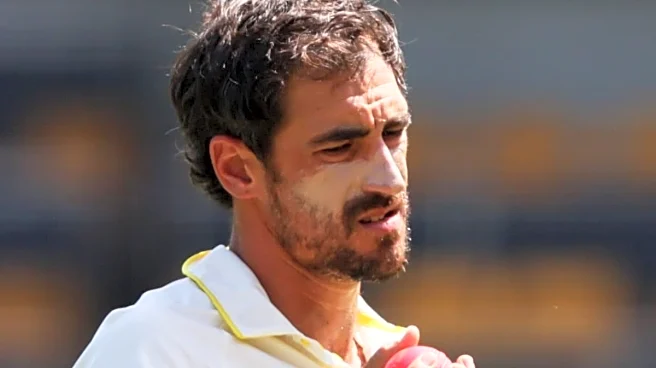



Australia pacer Mitchell Starc has questioned the International Cricket Council (ICC) over the multiple discrepancies in the edge-detecting systems during the ongoing Ashes. Starc said the Snicko technology’s errors have been ‘frustrating’ for everyone, calling on the ICC to pay for a better, standardised alternative.
Currently, there are two major providers of audio-based edge-detecting technology. Snicko is used in England and Australia, while UltraEdge is used in India, South Africa, and other countries. The ICC lets the home broadcaster decide which vendor they want to operate with, depending on the cost and logistics.
There were several apparent errors in the usage of Snicko in the most recent third Test of the Ashes in Adelaide. England
were deprived of Alex Carey’s wicket in the first innings when the wicketkeeper, who hit a century, went on to admit that he did edge a ball which didn’t show up in Snicko. Then, Australia were on the receiving end when Jamie Smith survived gloving a ball behind because of the technology.
Starc was heard on the stump-mic calling for Snicko to be ‘sacked’.
“I’m sure it’s frustrating for everyone, viewers, officials, and broadcasters, no doubt. One thing I will say … I’m only going to speak for myself here, the officials use it, right? So why doesn’t the ICC pay for it?” Starc said after the match, which Australia won. “And why is it not just one [provider] across the board? Why don’t we use the same technology in all different series, that’s going to perhaps create less confusion, less frustration. So that’s where I’ll leave that.”
Brendon McCullum, the England coach, put up a formal complaint over the Carey incident. It turned out the Snicko ‘miscaliberated’ the delivery and it’s parent company, BBG, apologised for the error.
Starc is not the first to question it either. Earlier, captain Pat Cummins had suggested that UltraEdge would be better.
“The one here seems a little bit different to sometimes what you get overseas,” he said. “There’s always a few murmurs. You’re hoping that it matches up if you’re the bowling team. Sometimes you kind of just making sure that it’s all okay if you’re batting, even though you feel like you haven’t hit it. It sometimes doesn’t feel super consistent, but you just crack on whatever the umpire says.”
Some viewers of the sport would remember the ‘HotSpot’ technology that was popular a few years ago. Instead of sound, HotSpot uses infrared cameras to catch the heat released by friction between bat and ball to determine the edges and has proven to be much more accurate.
However, that’s extremely expensive, costing by some estimates around $ 10,000 (Around Rs. 9 lakh) a day.