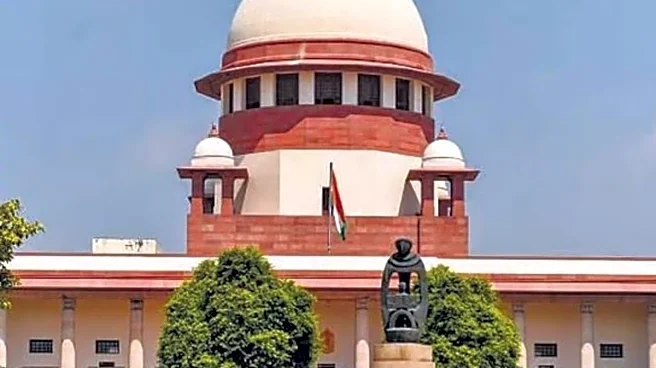

In a significant verdict clarifying the jurisdictional boundaries of anti-corruption agencies, the Supreme Court has ruled that state police authorities are fully competent to investigate and file chargesheets
against central government employees accused of offences under the Prevention of Corruption (PC) Act, 1988. The bench, comprising Justices JB Pardiwala and Satish Chandra Sharma, dismissed the notion that the Central Bureau of Investigation (CBI) holds exclusive jurisdiction over such cases, asserting that state-level agencies like the Anti-Corruption Bureau (ACB) do not require prior CBI permission to act.
The ruling came during the hearing of an appeal against a Rajasthan High Court decision, which had refused to quash a corruption case registered by the state’s ACB against a central government official. The petitioner had argued that as a central employee, he should be subject only to the oversight of the Delhi Special Police Establishment (CBI) and that any state-led investigation into his conduct was legally invalid. Rejecting this contention, the apex court clarified that the DSPE Act does not divest regular state police of their inherent power to investigate cognisable offences committed within their territorial jurisdiction, regardless of the accused’s employer.
A critical aspect of the judgement touched upon the “general consent” and “prior sanction” frameworks. The court noted that while Section 17A of the PC Act requires prior approval from the “appropriate government” before investigating official decisions, this does not mean the investigation must be restricted to a specific federal agency. As long as the alleged corruption occurs within the state’s borders, the state’s investigative machinery is empowered to proceed. This effectively prevents central employees from using their federal status as a shield to evade local anti-corruption scrutiny.
Legal experts suggest that this verdict reinforces the “cooperative federalism” model in criminal justice, ensuring that corruption does not fall through the cracks of administrative silos. By confirming that the state ACB and the CBI share concurrent jurisdiction, the Supreme Court has cleared the path for more efficient enforcement of the PC Act. The ruling ensures that state agencies can maintain their “merit-induced” independence, preventing administrative delays that often occur when cases are exclusively routed through federal channels. This decision is expected to streamline several high-profile graft probes currently stalled over jurisdictional disputes across various states.
/images/ppid_a911dc6a-image-177101752951095973.webp)




/images/ppid_a911dc6a-image-177101403147018469.webp)
/images/ppid_a911dc6a-image-177101053501199609.webp)
/images/ppid_59c68470-image-177101003680064644.webp)