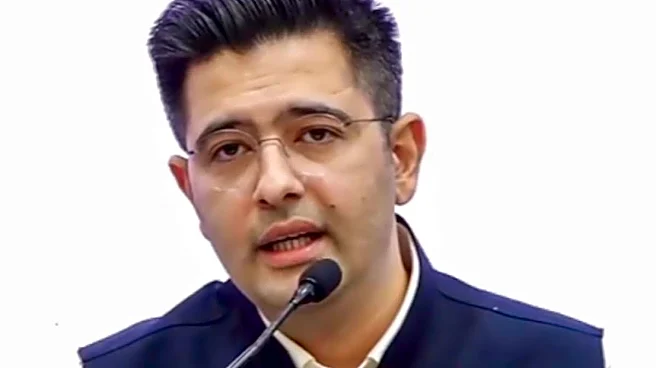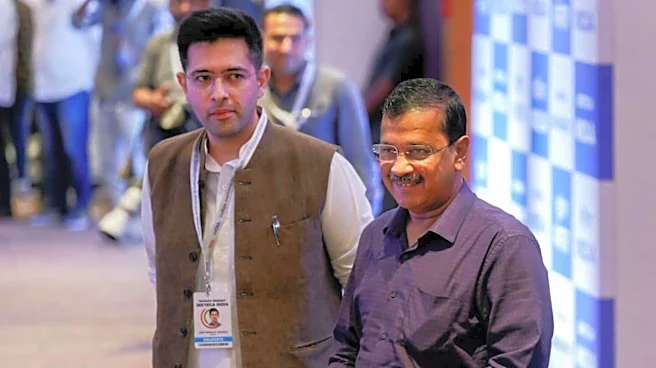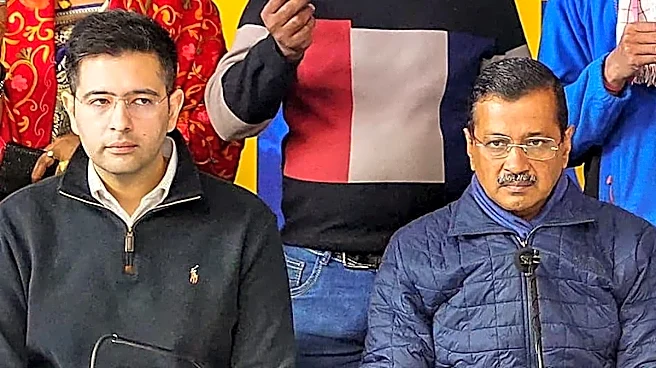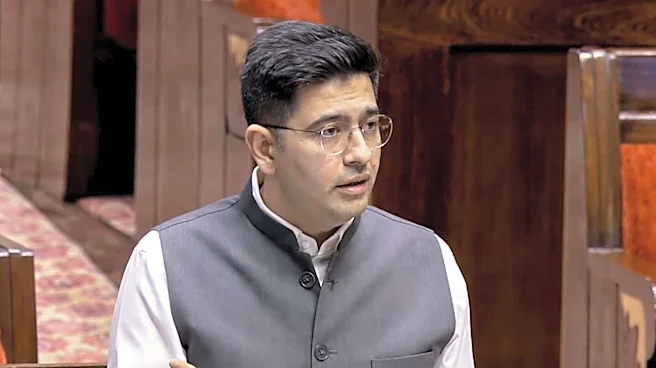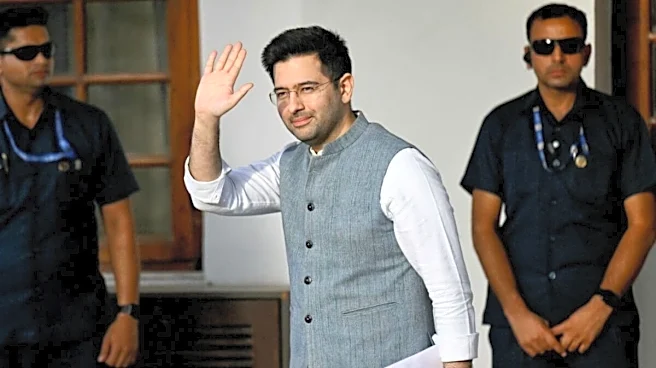

The omission of Bharatiya Janata Party (BJP) Rajya Sabha MP Raghav Chadha’s name from Punjab’s draft electoral roll under the Special Intensive Revision (SIR) has triggered a political controversy, with Chadha accusing the Aam Aadmi Party government in Punjab of “political vendetta”.
Chadha, who was elected to the Rajya Sabha from Punjab in 2022 as an AAP nominee and joined the BJP this year, said his name has been classified as “shifted” in the draft electoral roll despite having his voter registration in Mohali. He alleged that officials at various levels of the electoral-roll exercise were acting under political pressure.
The AAP has rejected the charge, saying the SIR is conducted by the Election Commission of India (ECI) and that the Punjab
government has no role in deciding which names are included or deleted from the electoral roll. The party has also alleged that Chadha has been living in Delhi and was trying to get his voter registration shifted to Delhi’s Rajinder Nagar through a “backdated” process.
EC officials, speaking to News18, also said the Punjab Chief Election Officer (CEO) is aware of the issue. “The claims and objection period is on… Mr Chadha, through his BLO, can get his name added in this period. It is correct that his name is not part of the draft rolls but if he has wrongly been marked as permanently shifted, then it can be corrected in this period.”
ALSO READ | Raghav Chadha Vs AAP: Missing Name In Punjab’s Draft Voter Rolls Sparks Fresh Political War
But beyond the political allegations, a more important question has emerged: If Chadha’s name remains out of the Punjab electoral roll, can he lose his Rajya Sabha membership?
The Short Answer: No, Not Automatically
The most important thing to understand is that Chadha’s name is currently missing from a draft electoral roll, not a final roll.
The Punjab SIR process provides a claims-and-objections window during which voters whose names have been excluded can seek inclusion or correction. The revised schedule provides for claims and objections from August 13 to September 12, 2026, with disposal of claims and objections by October 8 and publication of the final electoral roll on October 12.
Chadha himself has acknowledged this distinction, saying the present list is only a draft and that he is availing the remedies available under the SIR guidelines. He has said he expects the “wrongful classification” to be corrected in the final roll.
The AAP government in Punjab has now taken its politics of revenge to the Draft Electoral Rolls.
I am a sitting Rajya Sabha MP from Punjab, with my voter ID registered in Mohali, Punjab. Yet my name has been classified as “shifted” in the draft electoral rolls.
Thankfully,… pic.twitter.com/laAFAAWYiQ
— Raghav Chadha (@raghav_chadha) September 3, 2026
That means it is too early to treat his omission as a final deletion.
In fact, given that the claims-and-objections process is specifically designed to correct such omissions, there is a strong likelihood that Chadha’s name could be restored to the final electoral roll if his claim is accepted.
So, for now, this is primarily an electoral-roll dispute, not a Rajya Sabha membership crisis.
Why Was Chadha’s Name Marked “Shifted”?
Chadha says his voter ID was registered in Mohali and questioned why he was classified as “shifted” in the draft roll.
He has also cited Paragraph 4(d) of the ECI’s detailed SIR guidelines, which he says provides for a “protected list” of certain categories of people whose names, if flagged in the electoral database, should nevertheless be included in the draft electoral rolls so that their documents can be collected during the claims-and-objections process.
The provision cited by Chadha says names of members of the judiciary, public representatives, holders of declared offices and personalities from fields including arts, culture, journalism, sports and public service that had earlier been flagged in the electoral database were to be included in the draft rolls for this purpose.
Chadha’s argument is that, as a sitting MP, if his name had been flagged, it should have appeared in the draft roll under this provision. He called the classification “a clear case of political vendetta” and alleged that officials involved in the exercise were vulnerable to political pressure because their transfers and postings were controlled by the state government.
The AAP, however, has strongly disputed this.
A senior Punjab government official told The Indian Express that the allegations were false and that the Punjab government had no role in the exercise, pointing out that the Chief Electoral Officer is appointed by the ECI. The AAP also said that if Chadha no longer resides in Punjab, maintaining or shifting his voter registration was his own responsibility.
This Is Only The Draft List
Punjab’s SIR has resulted in a very large number of names being excluded from the draft electoral roll.
According to the figures reported by The Times of India, around 20.66 lakh voters were excluded from the draft list, representing 9.63 per cent of Punjab’s roughly 2.14 crore registered voters. Of those excluded, around 9.44 lakh were classified as permanently shifted, 5.74 lakh as deceased, 4.12 lakh as untraceable and 1.19 lakh as duplicate entries.
The draft roll is therefore not the end of the process.
Voters whose names are missing can file claims for inclusion, while corrections and objections can also be submitted through the prescribed forms. The ECI’s process allows these claims to be examined before the final roll is published.
For Chadha, this means the immediate question is straightforward: Can he establish that he is entitled to remain an elector in Punjab? If the answer is yes, his name could be restored in the final list.
There is a strong possibility that his name will come back but it would be premature to state it as a certainty.
Chadha has already said that he is using the remedies available under the SIR guidelines. Since the present list is only a draft and the claims-and-objections process is specifically meant to address omissions and disputed classifications, his case can still be corrected before the final roll.
The final word will come only after the ECI’s verification and disposal process.
What If His Name Stays Out Of Final Roll?
This is where the legal position gets more interesting.
Under Section 3 of the Representation of the People Act, 1951, a person seeking election to the Rajya Sabha must be an elector for a parliamentary constituency in India. The law does not say that a Rajya Sabha member elected from Punjab must necessarily be registered as a voter in Punjab.
In simple terms, being a Punjab Rajya Sabha MP does not mean you must necessarily be a Punjab voter.
The statutory requirement is that the person must be an elector for a parliamentary constituency somewhere in India.
Chadha’s 2022 Rajya Sabha election affidavit showed his electoral registration in Rajinder Nagar, Delhi. After becoming a Rajya Sabha MP from Punjab, however, he shifted his electoral registration to Punjab and voted in SAS Nagar/Mohali in the 2024 Lok Sabha election.
This creates an important distinction in the current controversy. If Chadha’s Punjab registration disappears but he has a valid electoral registration elsewhere in India, that by itself would not take away his Rajya Sabha qualification under Section 3.
The more serious question would arise if he ultimately has no valid electoral registration anywhere in India.
What If Chadha Has No Voter Registration Anywhere?
That is the scenario in which the issue could become legally significant.
Section 3 says a person is not qualified to be chosen as a Rajya Sabha representative unless he is an elector for a parliamentary constituency in India.
The Indian Express reported that a search on the ECI’s Voter Services Portal using Chadha’s voter-ID details showed “no result found” for both Delhi and Punjab at the time of its report.
If he ultimately has no valid electoral registration anywhere in India, questions could therefore arise about whether he continues to meet the statutory requirement.
Does A Voter-List Deletion Automatically Vacate An MP’s Seat?
No. The Constitution deals separately with when a parliamentary seat becomes vacant.
Article 101(3) provides that if a member of either House becomes subject to a disqualification under Article 102, the seat becomes vacant. Article 102 and the Representation of the People Act provide the framework for parliamentary disqualifications.
Therefore, a change in someone’s electoral-roll status should not be conflated with an instantaneous cancellation of parliamentary membership.
There would have to be a legal basis for disqualification and the appropriate constitutional/statutory process would apply.
For now, Chadha is not on the verge of automatically losing his Rajya Sabha seat because his name has been marked “shifted” in Punjab’s SIR draft roll.
The first and most immediate point is that this is only a draft list. Chadha has a window to challenge the classification, and the electoral-roll process specifically provides for correction of omissions and disputed entries. There is therefore a strong possibility that his name could be restored in the final roll due on October 12, subject to verification by the election authorities.
Even if his name is ultimately not restored in Punjab, that alone does not settle the Rajya Sabha question. Section 3 of the Representation of the People Act requires a Rajya Sabha member to be an elector for a parliamentary constituency in India, not necessarily in the state from which he is elected.
The real legal question would arise only if, after the SIR process and any correction proceedings, Chadha is found not to be an elector anywhere in India and that status is determined to affect his parliamentary qualification.
For now, however, the October final electoral roll, not the draft, is the key next milestone.