
/images/ppid_59c68470-image-178162002759580262.webp)


When historians assess the legacy of PM Narendra Modi’s first 12 years in office, they will undoubtedly focus on economic reforms, infrastructure expansion, digital transformation, and India’s growing global stature. Yet, among these achievements, stands a quieter but profoundly consequential accomplishment—the revival of yoga as a global movement and the restoration of Bharat’s ownership of one of humanity’s greatest civilisational gifts.
For centuries, yoga remained among India’s most enduring contributions to the world. Born in the spiritual traditions of Bharat and refined through generations of sages and seekers, it offered a holistic pathway to physical well-being, mental balance, and spiritual growth. Yet in the decades preceding 2014,
yoga’s global popularity often came with an unintended paradox. While millions practised it across continents, its civilisational roots in India were frequently overlooked or diluted.
PM Narendra Modi recognised both the universal relevance of yoga and its immense potential as a bridge between India’s ancient wisdom and the modern world. Within months of assuming office, he placed yoga at the centre of India’s cultural diplomacy. His address to the United Nations General Assembly in September 2014 marked a turning point. Proposing an International Day of Yoga, he described yoga not merely as a form of exercise but as a means of discovering harmony between man and nature, mind and body, thought and action.
The response was unprecedented. In one of the most widely supported resolutions in United Nations history, countries across the world rallied behind the proposal, leading to the declaration of June 21 as the International Day of Yoga. The speed and scale of global endorsement reflected a remarkable truth: the world was ready to embrace a philosophy whose origins lay in Bharat but whose message belonged to all humanity.
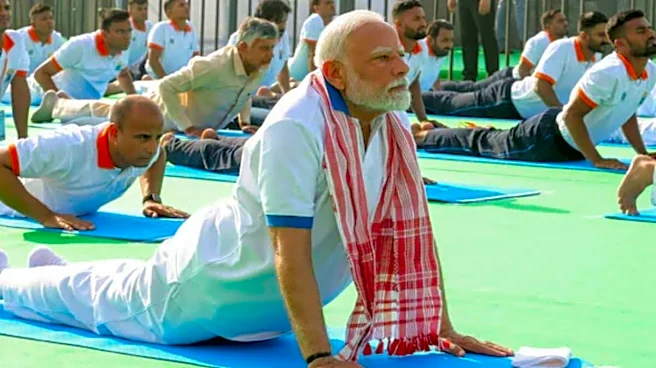
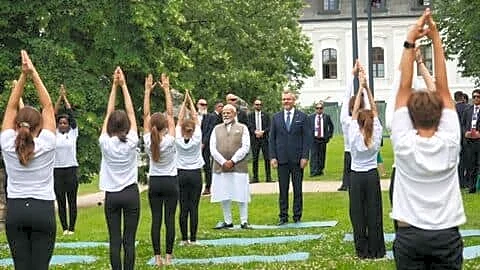
The first International Day of Yoga in 2015 transformed that vision into reality. Millions participated across continents. Iconic landmarks became venues for yoga demonstrations. From major world capitals to remote communities, people gathered in celebration of a practice that transcends borders, languages, religions, and political divides. What had once been viewed largely as a wellness activity was now recognised as a global force for health and harmony.
But the story of yoga’s resurgence extends far beyond international recognition. PM Modi’s contribution lies equally in reintroducing yoga to Indians themselves as a living and accessible tradition. Over the past 12 years, yoga has moved from the margins to the mainstream of public life. Schools, universities, government institutions, community centres, and workplaces have embraced it. The strengthening of the Ministry of AYUSH and the expansion of yoga-related programmes have helped institutionalise a practice that was once largely dependent on individual initiative.
Most importantly, yoga has been democratised. It is no longer confined to wellness enthusiasts or urban elites. Across villages and towns, among students, professionals, women, senior citizens, and members of the armed forces, yoga has become part of everyday life. Millions now view it not as a specialised discipline but as a practical tool for healthier living.
This transformation has acquired even greater significance in an era marked by rising lifestyle diseases, mental health challenges, and growing stress levels. Long before the world began speaking of holistic wellness, Indian traditions understood the inseparable relationship between physical health, mental equilibrium, and spiritual well-being. PM Modi’s consistent advocacy has helped bring this wisdom back into contemporary discourse.
The Covid-19 pandemic further reinforced the relevance of yoga. During a period of global uncertainty, countless individuals turned to yoga, meditation, and breathing exercises to strengthen resilience and maintain emotional balance. The crisis highlighted the value of preventive healthcare and holistic well-being—principles that have long been central to India’s yogic traditions.
Beyond health, yoga has emerged as one of India’s most effective instruments of soft power. Nations project influence through economic strength, military capability, technological innovation, and cultural appeal. Under PM Modi, India has demonstrated that civilisational confidence can be an equally powerful source of global leadership. Through yoga, Bharat has offered the world a message of balance, peace, and self-discovery at a time when these values are needed more than ever.
Indeed, yoga has become a symbol of a larger national transformation. For decades after Independence, India often hesitated to project its civilisational heritage on the global stage. There existed an unfortunate tendency to separate modernity from tradition, as though progress required cultural detachment. PM Modi has challenged that assumption. His approach has demonstrated that a nation can embrace innovation while remaining deeply rooted in its heritage.
The global acceptance of yoga illustrates this principle perfectly. Bharat did not gain influence by abandoning its traditions. It gained influence by sharing them confidently with the world. Yoga’s success has shown that India’s civilisational legacy is not merely a matter of historical pride but a living source of solutions for contemporary challenges.
Equally noteworthy is the connection PM Modi has drawn between yoga and sustainable living. Yoga encourages moderation, mindfulness, self-discipline, and harmony with nature. These values resonate strongly with his broader vision of environmentally conscious lifestyles and responsible consumption. In this sense, yoga is not simply a health practice; it is a framework for living that addresses many of the anxieties and excesses of modern society.
As PM Modi completes 12 years in office, yoga stands as one of the most enduring symbols of India’s cultural renaissance. It reflects a nation that is confident in its identity, comfortable with its heritage, and willing to contribute its wisdom to the world. It represents the revival of an ancient tradition and its successful adaptation to modern realities.
Yet, the journey is only beginning. The coming decade presents an opportunity to transform Bharat into the world’s foremost centre for wellness, preventive healthcare, yoga research, and holistic living. As global demand for these disciplines continues to grow, India is uniquely positioned to lead.
Twelve years ago, yoga was admired. Today, it is celebrated globally. Twelve years ago, its origins were often forgotten. Today, the world unmistakably associates yoga with Bharat. Twelve years ago, it was largely viewed as a fitness practice. Today, it is increasingly understood as a way of life.
That transformation is among the most significant cultural achievements of the Modi era. It represents not only the resurgence of yoga but the resurgence of Bharat itself—a civilisation rediscovering its voice, reclaiming its confidence, and sharing its timeless wisdom with the world.
The writer is national spokesperson of the BJP and an acclaimed author. Views expressed in the above piece are personal and solely those of the author. They do not necessarily reflect News18’s views.
/images/ppid_a911dc6a-image-178175407637072804.webp)

/images/ppid_a911dc6a-image-178171763015727536.webp)
/images/ppid_a911dc6a-image-178156942648790967.webp)

/images/ppid_a911dc6a-image-178162926796734105.webp)