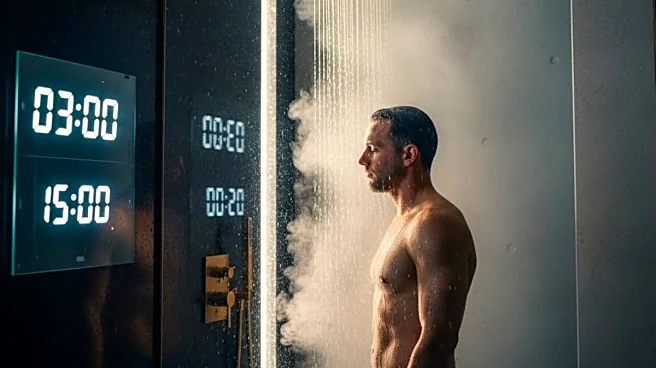




For some people, a shower is a five-minute pit stop. For others, it is where the day begins, stress disappears and a favourite song is played. But how long do you actually need to stay under running water to get clean?
Pablo Pereira-Doel, an environmental scientist at the University of Surrey in the UK, suggests three minutes is a sensible target for a body shower, with another two minutes if you are washing your hair. For people who turn off the water while using a soap, the active water-running time can be reduced even further.
The new study is striking because it is far shorter than the time many people spend in the shower. Data cited in the current analysis puts the average American shower at 16.1 minutes, while research has found that some
people can remain under the water for close to 40 minutes.
Three Minutes: The New Shower Rule
Pereira-Doel’s three-minute figure is not meant to be a universal medical rule or a stopwatch test for every person. It is a practical target based on the question of how much shower time is actually necessary for basic hygiene.
He suggests that around three minutes for washing the body and adding roughly two minutes when washing hair is enough to maintain hygiene. For someone focused primarily on reducing water consumption, switching off the tap while applying soap can bring the running-water time down to around a minute for a basic body rinse, two minutes with shampoo and three with conditioner.
The important point is that three minutes is a target for efficiency, not a claim that everyone must shower for exactly three minutes. And that distinction matters because showering is rarely just a mechanical cleaning exercise.
Why Do We Spend So Long In The Shower?
Think about what happens when you step into a warm shower after a long day. You may not be particularly dirty. You may simply want to stand there for a few extra minutes. That appears to be a major reason showers stretch well beyond the time required for hygiene.
Research suggests that more than four in 10 showers in the cited sample were taken for reasons unrelated to hygiene, including relaxation, self-care and warming up. Pereira-Doel has also pointed out that for many people, cleaning themselves is not the only reason they remain in the shower. That makes the shower an unusual household activity: part hygiene routine, part leisure.
So the real question may not be why people cannot shower in three minutes. It may be whether those additional minutes are being spent deliberately because someone wants to relax, or simply because nobody notices how much time has passed.
“As for why people linger… the answer is that for a large share of showers, getting clean isn’t the point,” said Pereira-Doel as quoted by New York Post. “Over four in 10 showers in our sample were taken for reasons unrelated to hygiene — relaxation, self–care, warming up on a cold morning,” he continued. “When a shower is doing that job, its length isn’t a decision anyone is consciously making.”
Does A Longer Shower Actually Make You Cleaner?
A shower’s basic job is to remove sweat, dirt, excess oil and other substances from the skin. Spending twice as long under running water does not necessarily mean you are twice as clean.
What matters is also how you shower: the temperature of the water, the cleanser being used, how much scrubbing is involved and whether hair is being washed.
That means someone who spends 15 minutes under very hot water is not necessarily following a better hygiene routine than someone who spends five minutes washing efficiently.
For people with dry or sensitive skin, the routine itself can also matter. Very hot water and excessive cleansing can be more relevant than the precise number of minutes spent in the bathroom.
In other words, there is no scientific magic switch that turns on at three minutes and off at five.
Your Shower Time May Depend On Your Water
One of the more interesting findings from Pereira-Doel’s research is that shower duration is influenced by circumstances that have little to do with how dirty someone is.
Water pressure can also affect behaviour: if the pressure is poor, people may stay under the shower longer because they do not feel properly rinsed. Time matters too, with leisure-period showers tending to be longer.
That is particularly relevant in India, where water pressure and water quality can vary significantly between homes, buildings and cities.
“What I can say is that cleaning in a shower is done by the product and the rinse, not by elapsed time. A product lifts dirt and oil from the skin; water carries it away. Once the product is fully rinsed off, additional minutes under the water aren’t removing anything more; it is just enjoyment. Our measurements put ‘fully rinsed’ at around four litres for a body wash; after that, the extra water isn’t doing any cleaning work,” Pereira-Doel told News18 over an email.
There is also an easily overlooked habit: shampooing twice. Research associated with Pereira-Doel’s work has examined how repeated shampooing can lengthen shower duration, while the scientist has suggested that many people do it out of habit rather than necessity.
“In a showering routine where the average conditioner needs 6.4 litres, that’s more than half the water. Across 10 shampoos, the spread was narrower, closer to a litre. So, yes, the product genuinely matters and choosing well could save more water than shortening your shower by a minute,” Pereira-Doel pointed out.
When asked specifically about the India context, the scientist said, “What we know is that water hardness genuinely does change how products behave. Standard shampoos rinse more easily in soft water; in hard water they clear less readily. Interestingly, in our German data, people in soft-water areas showered longer, not shorter, which suggests the effect on behaviour runs through comfort and sensory experience rather than through any real difference in rinsing need.”
How Much Water Are We Wasting?
Every additional minute means more water flowing through the showerhead. And when that minute is multiplied across millions of households, a seemingly insignificant personal habit becomes a significant environmental and resource issue.
Pereira-Doel’s research has also looked at whether people can actually be persuaded to shorten their showers. In a field experiment covering more than 17,500 showers across six accommodation sites in Denmark, Spain and the UK, researchers used real-time timers and persuasive messages. The intervention reduced water-running time by 25.79%.
That finding is important because it suggests that the solution may not simply be telling people to use less water. Giving people immediate feedback can actually change behaviour.
So, Should You Really Aim For Three Minutes?
“Yes, and in India the case is stronger than in most places. India has around 18% of the world’s population and roughly 4% of its freshwater. Per capita availability has fallen below the internationally used water-stress threshold, hundreds of millions of people live under high or extreme water stress and demand is projected to outstrip supply substantially within the decade. Bengaluru’s crisis in 2024 showed how quickly an urban supply can come under real strain. Against that, although a few minutes in the shower sounds trivial, showers and baths are the single largest share of indoor household water use, between a quarter and 45% depending on the country, so it’s the biggest lever available inside a home,” Pereira-Doel said.
For most people, the sensible takeaway is not to panic if a shower occasionally runs longer than three minutes. The more useful lesson is to separate hygiene from leisure.
If you are washing your body and hair, five minutes may be a reasonable efficiency target based on Pereira-Doel’s recommendation. If you want to spend another 10 minutes enjoying hot water after that, it is worth recognising that those minutes are serving a different purpose.






/images/ppid_59c68470-image-178888755854473949.webp)