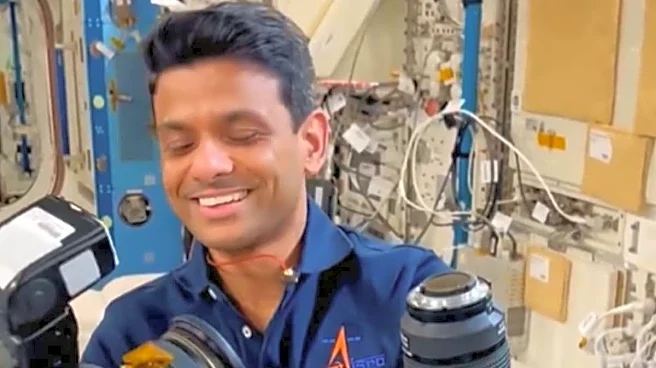




From being an astronaut to a scientist now, Group Captain Shubhanshu Shukla is all set for his new avatar. Shukla’s first peer-reviewed scientific research paper has been published in the US-based journal PLOS One.
His research did not originate from experiments conducted on the ISS, but rather from a laboratory on Earth, specifically at the Mechanical Engineering Department of the Indian Institute of Science (IISc) in Bengaluru, where he is pursuing a Master’s degree.
Can bacteria help humans build structures on Mars, despite the Red Planet’s toxic soil? — The study explores a futuristic option.
Since Scientists and even entrepreneurs like Elon Musk are already talking about having a permanent human outpost on Mars, if that were to happen, it
would be near impossible to carry construction material from Earth. So, what is the next best alternative?
“The idea is to use what’s already there,” Shukla said. “If we don’t have to carry construction material from Earth, and instead use resources available on Mars, it becomes much easier to support long-term missions.”
There are several challenges regarding the atmosphere of Mars and its soil hides a serious chemical issue. Several space missions have found perchlorate in Martian regolith, a chlorine-based compound that is toxic to most Earth life.
This poses a problem for scientists exploring the idea of “living construction” on Mars. Researchers at IISc decided to investigate whether such bacteria could survive perchlorate-rich soil and whether construction using these microbes was even possible.
Shubhanshu Shukla’S Achievement
For Shubhanshu Shukla, the publication hold great importance. PLOS One is among the world’s most respected open-access scientific journals, and getting a first paper accepted there is a significant achievement for any young researcher.
Shukla did seven basic scientific experiments when he was at the ISS on his 20-day Axiom-4. These were what his principal investigators asked him to do. Maybe now he will be able to conceive more meaningful micro-gravity experiments as part of India’s ambitious Gaganyaan.
“Mars is an alien environment,” Aloke Kumar, Associate Professor of Mechanical Engineering at IISc and the study’s corresponding author and Group Captain Shukla’s research advisor was quoted as saying by NDTV.
“Understanding how Earth organisms respond to such conditions is a very important scientific question we must answer.”




/images/ppid_59c68470-image-176968252980816605.webp)




/images/ppid_59c68470-image-176967253350933756.webp)
/images/ppid_a911dc6a-image-176959123163910986.webp)

/images/ppid_59c68470-image-176961253005571540.webp)