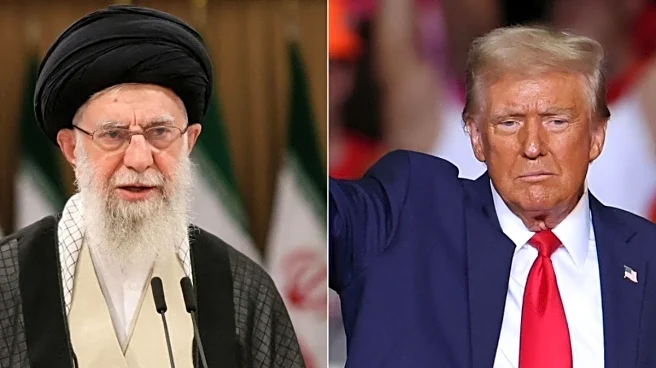

The Middle East is once again slipping into a dangerous familiar pattern — a rapid exchange of warnings, counter-warnings, and symbolic shows of force that are sending regional tensions sharply upward. A war of words between Tehran and Washington has pushed the mercury soaring. Statements meant to deter have instead hardened positions, narrowing diplomatic space and amplifying the risk of misinterpretation. Each declaration is now met with a counter-signal, each warning answered with another — creating an escalation dynamic driven as much by rhetoric as by troop movements.
Against this backdrop, senior Iranian officials issued stark cautions on January 28, warning that any attack on Iran would trigger retaliation not only against US forces but
also against Israel. Ali Shamkhani, a senior adviser to Iran’s Supreme Leader Ayatollah Ali Khamenei, spoke of an “immediate, unprecedented” response that could reach “the heart of Tel Aviv.”
IRAN’S MESSAGE — DETERRENCE THROUGH ESCALATION
Iran’s leadership is engaged in a familiar strategy: projecting readiness and resolve in order to prevent attack.
Foreign Minister Abbas Araghchi framed Iran’s military posture in blunt terms, saying the country’s armed forces had their “fingers on the trigger” and would respond “immediately and powerfully” to any aggression.
Such statements reflect more than bravado. Tehran has long believed that ambiguity invites vulnerability — that projecting maximal retaliation is the only credible shield against US power.
But this approach carries risk. The sharper the warning, the narrower the room for de-escalation.
WASHINGTON’S COUNTER-SIGNAL — THE ARMADA AND THE ULTIMATUM
The Iranian warnings come as the United States, under President Donald Trump, is once again pairing diplomacy with force. Trump has urged Tehran to “make a deal” over its nuclear program, warning that any further conflict would lead to consequences “far worse” than past strikes.
At the same time, Washington has deployed major naval assets toward the region, led by the aircraft carrier USS Abraham Lincoln.
The message is unmistakable: negotiation remains possible, but the shadow of military action is being deliberately widened.
This is coercive diplomacy in its purest form — an approach that has historically produced mixed outcomes, especially with Iran, which views talks under threat as humiliation rather than compromise.
Tehran’s rejection of negotiations “under intimidation” underscores this impasse.
ISRAEL AS THE CENTRAL PRESSURE POINT
What makes this escalation particularly volatile is that Iran is not threatening only US targets — it is explicitly implicating Israel. By warning that retaliation would strike Tel Aviv, Tehran is:
- signaling that Israel would bear costs even if America initiates conflict
- attempting to widen deterrence by threatening America’s closest regional ally
- drawing Israel directly into the narrative of escalation
This is critical because Israel has its own independent posture toward Iran’s nuclear program, one that often favors preemptive action.
If Tel Aviv becomes the declared battlefield of retaliation, the calculus for Israeli leadership becomes even more compressed, and the risk of rapid escalation multiplies.
THE NUCLEAR FILE AND THE DOMESTIC UNDERCURRENT
At the core of this crisis remains the unresolved nuclear question.
Trump is pressing for a deal that would prevent Iran from developing nuclear weapons, reviving the confrontational framework that followed his withdrawal from the 2015 agreement.
Iran, for its part, continues to insist on its right to peaceful nuclear technology — while refusing negotiations under coercion.
But beneath the strategic arguments lies another reality: domestic politics.
Both Washington and Tehran are speaking not only to each other, but to internal audiences:
- Trump projects strength through ultimatums and military presence
- Iran’s leadership asserts defiance to preserve legitimacy under pressure
- Israel watches for any weakening of deterrence on either side
- In this sense, escalation becomes performative as well as strategic.
THE DANGER OF MISCALCULATION
The greatest threat in moments like this is not necessarily intent — but miscalculation. History shows that wars in the Gulf often begin not with grand declarations, but through:
- misread signals
- retaliatory spirals
- accidents at sea
- proxy attacks blamed on state actors
With shipping disruptions already being reported in the Gulf, even economic arteries are beginning to tighten.
The more military assets converge, the smaller the margin for error becomes.
A REGION HELD HOSTAGE BY ABSOLUTES
The tragedy of the current moment is that the political language has become absolute:
- Iran says any strike means unprecedented retaliation
- Trump says refusal means the next attack will be “far worse”
- Israel stands implicitly inside the crosshairs of both
Diplomacy cannot survive indefinitely in a climate where every move must be maximal, every posture uncompromising. The region is being pulled once more toward the edge — not necessarily because war is inevitable, but because rhetoric, deployment, and distrust have created a machinery of escalation that is hard to stop once in motion.
THE QUESTION IS NOT POWER — BUT CONTROL
The United States has overwhelming military capability. Iran has asymmetric retaliation capacity. Israel has unmatched regional strike power.
But the real question is not who is stronger. The question is: who can still control the trajectory before deterrence collapses into catastrophe?
When leaders begin talking openly about striking “the heart of Tel Aviv,” and responding with an “armada,” the world is reminded that in the Middle East, words often arrive before fire.


/images/ppid_59c68470-image-177107504779557732.webp)

/images/ppid_59c68470-image-177107504945830607.webp)


/images/ppid_a911dc6a-image-177107322672112787.webp)
