

/images/ppid_a911dc6a-image-178505321972251036.webp)

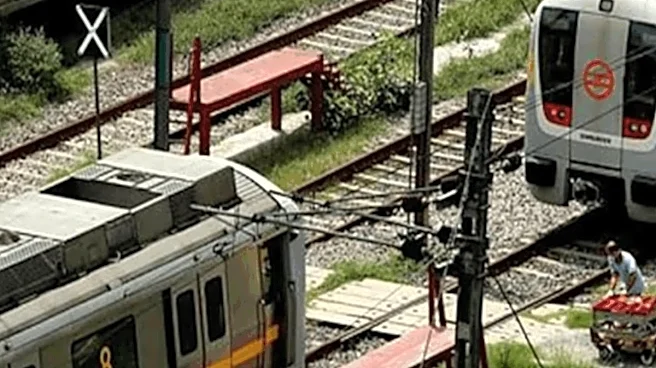
Delhi News: The Delhi Metro Rail Corporation (DMRC) has achieved a major construction milestone for the upcoming reversal facility at Noida Electronic City Metro Station after successfully installing a 58-metre steel span across National Highway-9 (NH-9) and the Delhi-Meerut Expressway (DME) without disrupting traffic movement.
The newly installed structure is part of a project designed to improve operational efficiency on the Blue Line, allowing trains to reverse direction after completing their trips at the terminal station. DMRC officials said the facility will help optimise train movement and improve service management on the corridor.
Steel Span Installed 14 Metres Above Highway
According to a report by Hindustan Times, the prefabricated steel span was launched from the Indirapuram
side and gradually pulled into position using specialised machinery before being placed between piers 384 and 385, officials said.
The massive structure has been installed at a height of around 14 metres above the highway and expressway, allowing traffic movement on NH-9 and the DME to continue without interruption.
DMRC officials said the installation was particularly challenging due to the location of the structure, which had to cross two busy road corridors while also passing beneath an energised high-tension overhead power line near pier 384.
To execute the work safely, steel trestles were erected at designated locations on the highway and expressway, following which support beams were placed to assist in launching and positioning the span. “The span was erected without disrupting traffic on the busy highway and expressway. The project was particularly challenging as the span also had to pass beneath an energised high-tension overhead power line near pier 384,” said Anuj Dayal, Principal Executive Director, DMRC.
Second Steel Span To Be Installed Later This Year
The reversal facility project involves the installation of two specially designed steel spans, one measuring 58 metres and another measuring 73 metres, both required to cross NH-9 and the Delhi-Meerut Expressway.
While the 58-metre span has already been installed, the longer 73-metre span is expected to be erected later this year, officials said.
DMRC added that this is the first instance of a Delhi Metro viaduct being constructed over an operational expressway without interrupting traffic movement, marking a significant engineering achievement for the corporation.
Civil Work Expected To Finish By Year-End
The civil construction work for the reversal facility is expected to be completed by the end of this year, after which activities such as track laying, electrification and installation of other operational systems will begin.
Once commissioned, the facility will enable trains arriving at Noida Electronic City to reverse direction more efficiently, improving operational flexibility and helping DMRC manage train services more effectively on the Blue Line.
DMRC’s Previous Complex Road Overpasses
DMRC has previously carried out challenging construction projects over busy road junctions, including works at the Moolchand intersection and the construction of Airport Line and Pink Line viaducts at Dhaula Kuan.
However, officials said the Noida Electronic City project stands out due to the complexity of constructing a Metro structure over an active expressway while ensuring uninterrupted traffic flow.
In May, construction work for a Metro pillar on the Indirapuram side of NH-9/DME had temporarily affected traffic, leading to the closure of the slip road connecting NH-9 to CISF Road, officials said.
The latest achievement is expected to pave the way for the completion of the reversal facility, further strengthening Metro connectivity and operational efficiency in the Noida-Ghaziabad region.





/images/ppid_a911dc6a-image-178505607680321261.webp)

/images/ppid_a911dc6a-image-178505602343388129.webp)
/images/ppid_a911dc6a-image-178505605030145821.webp)


/images/ppid_a911dc6a-image-178505442183443014.webp)