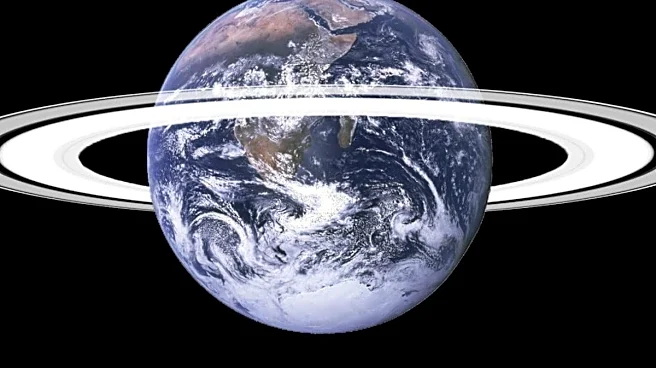




It sounds like something that belongs to another planet. It sounds unlikely, but some scientists think Earth may once have had rings, a bit like Saturn. The idea comes from looking at very old impact craters found in different parts of the world. These craters, which formed hundreds of millions of years ago, don’t seem to be spread out randomly. Instead, many of them appear to follow a pattern, almost as if they were part of something more organised. Instead of being spread evenly, many of them seem to line up along what would have been Earth’s equator at the time. That pattern has led researchers to consider a different explanation. One possibility is that Earth was once surrounded by a ring of debris, formed after a large asteroid or comet
broke apart under the planet’s gravity. Instead of hitting the surface all at once, fragments may have remained in orbit, gradually falling back over time. If that happened, the impacts wouldn’t be random. They would be concentrated along a band — much like the way material in a ring system orbits around a planet. Over time, those fragments would have re-entered Earth’s atmosphere, breaking apart and striking the surface in a more organised pattern than a typical asteroid shower. That’s where the crater alignment starts to make sense. The idea is still being studied, and not all scientists agree on it. Other explanations, including changes in Earth’s surface and plate tectonics over time, could also play a role in how these craters appear today. But the ring hypothesis offers a different way of looking at the evidence. It suggests that Earth, at least for a period of time, may have looked very different from what we see now — not just a blue planet, but one surrounded by a visible band of orbiting debris. Unlike Saturn’s rings, which are still intact, any such ring around Earth would have been temporary. Gravity, atmospheric drag, and collisions between particles would eventually have pulled it apart, sending debris back down to the surface. And that’s why, if it did exist, we don’t see it anymore. What might remain instead are the marks it left behind. A series of impacts that don’t just tell the story of objects hitting Earth, but possibly of something that once circled it. It’s not a confirmed chapter of Earth’s history yet. But it’s one that scientists are still trying to piece together — from clues that have been sitting in plain sight for millions of years.

/images/ppid_a911dc6a-image-177763252678091602.webp)

/images/ppid_a911dc6a-image-177763258844520712.webp)