

/images/ppid_a911dc6a-image-17760820798185364.webp)
/images/ppid_a911dc6a-image-177608215207222709.webp)
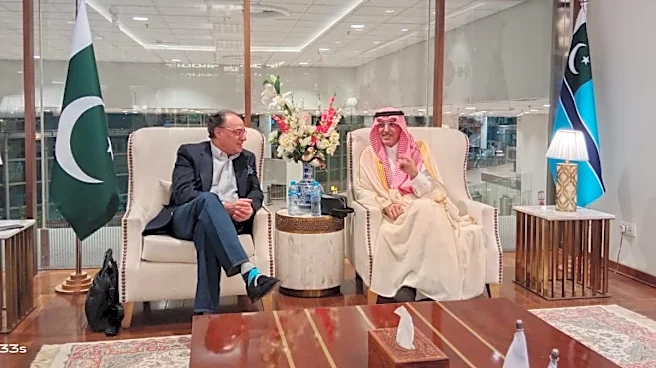
Saudi Arabia’s Finance Minister, Mohammed bin Abdullah Al-Jadaan, made a brief but significant one-day visit to Islamabad, offering Pakistan firm assurances of full financial backing at a time when its economy is under visible strain. The visit comes amid heightened tensions in the Middle East and uncertainty surrounding the US-Iran situation, factors that risk further pressuring Pakistan’s already fragile external position.
Financial Stress Driving Urgency
Pakistan is currently grappling with substantial external obligations, with nearly $5 billion in debt repayments due this month alone. This includes approximately $4.8 billion in total outflows, of which $3.5 billion is owed to the United Arab Emirates.
Without fresh financial support or rollover
arrangements, Pakistan’s foreign exchange reserves are projected to fall to around $11.5 billion, a level that would tighten liquidity and raise concerns over external stability.
Against this backdrop, Islamabad has been actively seeking assistance from Riyadh. This includes a request for a $5 billion loan, as well as a five-year extension of its existing oil financing facility, both seen as critical to easing immediate liquidity pressures.
No New Deal, Only Assurances
While no new loan amounts or financial packages were formally finalised during the meeting with Pakistan Prime Minister Shehbaz Sharif, sources indicate that Saudi Arabia conveyed a clear commitment to support Pakistan through its current economic challenges.
Officials familiar with the discussions described the engagement as part of ongoing financial coordination between the two longstanding allies, rather than an emergency bailout or policy shift.
The visit nonetheless underscores Pakistan’s continued dependence on Gulf partners, particularly Saudi Arabia, to manage recurring balance-of-payments stress.
Pakistan’s Mediation Role
Beyond economic assistance, the Saudi Finance Minister also reiterated Riyadh’s strong confidence in Pakistan’s ability to act as a mediator in the ongoing diplomatic efforts between the United States and Iran.
However, this positioning is as much about diplomatic optics as it is about actual leverage. While Pakistan maintains ties with both sides, its ability to shape outcomes in a high-stakes US-Iran equation remains limited.
Its involvement is better understood as a conduit for communication, rather than a decisive negotiating force.
Deepening Strategic Ties
Both sides emphasised the longstanding and “fraternal” nature of Saudi-Pakistan relations during the visit. Islamabad expressed gratitude for Riyadh’s continued economic support over the years, while reaffirming its commitment to strengthening cooperation across trade, investment, and regional stability.
For Saudi Arabia, the engagement underscores its broader strategic calculus in South Asia and the Middle East, balancing economic assistance with geopolitical alignment.
Continuity, Not A Shift
Sources indicate that while the assurances offered during the visit are significant, they align with Saudi Arabia’s long-standing pattern of stepping in during Pakistan’s financial stress cycles.
As Pakistan navigates a challenging economic phase, Saudi backing could prove crucial in maintaining market confidence and stabilising external accounts. But without structural economic fixes, Islamabad’s reliance on external support is unlikely to change anytime soon.