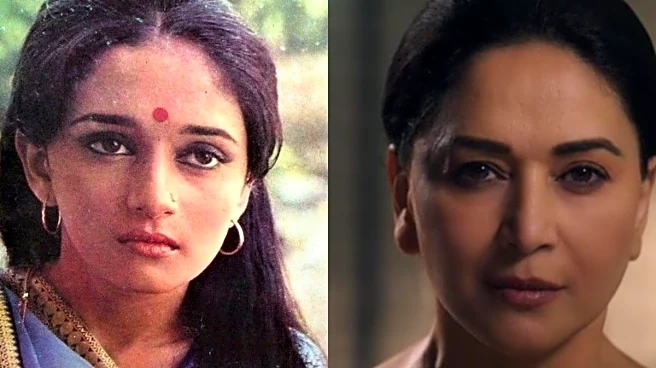



Four decades after she first stepped in front of the camera, Madhuri Dixit remains one of Hindi cinema’s most enduring stars, an actor who has not only survived changing eras but evolved with them. Reflecting on a journey that began with Abodh in 1984, the actor says the film industry she entered as a teenager bears little resemblance to the one she works in today.
In an interview with IANS, the ‘Dhak Dhak Girl’ spoke candidly about how filmmaking, direction and actor preparation have undergone a fundamental shift since the 1980s. Back then, she recalled, the industry functioned in a largely informal manner, with professionalism limited to a handful of banners. “In the 80s and 90s, only a few producers like Yash Chopra, BR Chopra, Subhash Ghai
and Rajshri Productions worked in a structured way. Otherwise, everything was quite unorganised,” she said.
Dixit noted that shoots in those years often began with little warning. Actors rarely had access to full scripts, rehearsals were uncommon, and scenes were frequently explained moments before the camera rolled. “You had to understand the scene on the spot and perform immediately,” she said, adding that there was hardly any time to prepare or develop a character in depth.
That approach, she believes, has changed dramatically. Today, actors receive bound scripts well in advance, participate in reading sessions, workshops and rehearsals, and are encouraged to explore the emotional and psychological layers of their characters before shooting begins. “You are much more prepared now, and that reflects in the performances,” Dixit observed.
She also pointed to the transformation in on-set working conditions. In her early years, basic comforts were often missing. Vanity vans were unheard of, and actors would wait under umbrellas between takes, even in harsh weather. “Now, the environment is far more professional. Every facility is available, and that allows actors to focus entirely on their work,” she said.
Equally significant, according to Dixit, is the heightened attention paid to character design in contemporary cinema, from costumes and styling to physical appearance and screen presence. Such detailing, she noted, was rare when she started out but is now an integral part of the filmmaking process.
Drawing a line from Abodh to her more recent work, including projects like Mrs Deshpande, Dixit said the evolution of direction and storytelling has been especially striking. Filmmakers today, she suggested, are more deliberate, more collaborative and more invested in telling nuanced stories, particularly those centred on women and complex emotional journeys.
/images/ppid_59c68470-image-17705300319411292.webp)


/images/ppid_a911dc6a-image-17705298299446085.webp)

/images/ppid_a911dc6a-image-177052962458453317.webp)

/images/ppid_a911dc6a-image-177052760877664283.webp)
/images/ppid_a911dc6a-image-1770527571863959.webp)
/images/ppid_a911dc6a-image-17705275376518005.webp)