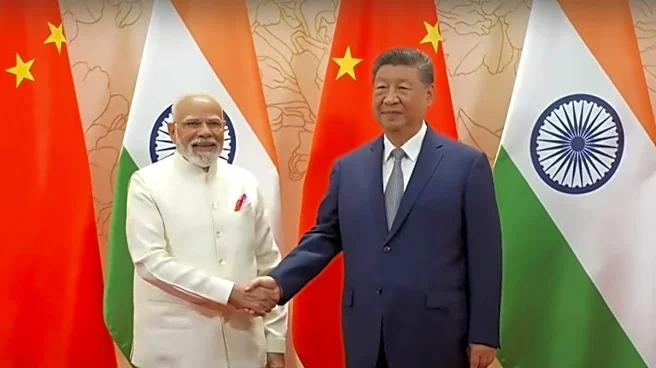



Chinese President Xi Jinping’s arrival in New Delhi marks a significant moment in India-China ties, bringing the leaders of the world’s two most populous nations together in the Indian capital for the first time in seven years. His visit for the 18th BRICS Summit comes at a time when New Delhi and Beijing have been steadily rebuilding engagement, reopening channels of communication and looking at ways to expand cooperation.
Xi’s meeting with Prime Minister Narendra Modi on the sidelines of the summit is expected to give further momentum to that process.
India-China relations went through one of their most difficult phases following the 2020 Galwan Valley clash. But the years since have also demonstrated that both countries have a strong interest
in restoring stability and moving the relationship forward.
Click here for LIVE updates on BRICS Summit 2026.
From border disengagement to the resumption of flights, from high-level diplomatic engagement to a renewed focus on trade and BRICS cooperation, several steps have brought Modi and Xi back to the table.
Here is how the relationship has travelled from Galwan to Delhi.
1. Galwan Was A Setback, But Dialogue Never Stopped
The June 2020 Galwan Valley clash dramatically disrupted India-China relations, with several Indian soldiers and four Chinese troops killed.
Yet even at the height of tensions, diplomatic and military channels remained open. Multiple rounds of commander-level talks were held as both sides worked towards disengagement at different friction points along the Line of Actual Control.
That sustained dialogue ultimately laid the groundwork for the next phase of the relationship.
For India, peace and tranquillity along the border remain fundamental to the broader relationship. China, too, has repeatedly stressed that the boundary question should be handled through dialogue while the two countries continue cooperation in other areas.
The importance of keeping the larger relationship moving was reflected in Chinese President Xi Jinping’s earlier call for the two countries to view their relationship from a strategic and long-term perspective.
2. Disengagement Created Space For Diplomacy
The progress on disengagement along parts of the LAC was an important confidence-building step. It reduced immediate military tensions and created greater room for diplomats and political leaders to look at the relationship beyond the border.
This is important because India and China have a relationship that extends far beyond their disputed boundary. They are major trading partners, members of BRICS, the Shanghai Cooperation Organisation and several other multilateral institutions.
As tensions eased, both sides began looking at ways to restore normal diplomatic and economic engagement.
3. Modi And Xi Began Rebuilding Engagement
A major breakthrough came in October 2024, when Modi and Xi held their first formal bilateral meeting in years on the sidelines of the BRICS Summit in Kazan, Russia.
The meeting marked an important political moment as the two leaders signalled a willingness to look at the broader picture.
It also underlined a reality that has become increasingly important in global geopolitics, that India and China can have differences while simultaneously cooperating on issues where their interests converge. This approach has become particularly relevant as the two countries work together within BRICS.
4. High-Level Contacts Have Gathered Momentum
The engagement since then has not been limited to the two leaders. Senior officials from India and China have remained in contact, with discussions covering border issues as well as broader bilateral ties.
In June, PM Modi met Chinese officials in New Delhi attending a BRICS national security advisers’ meeting and conveyed his greetings to Xi. He also stressed the importance of maintaining high-level exchanges, advancing practical cooperation and protecting the common interests of Global South countries.
The message from both sides has increasingly been one of engagement. Chinese Foreign Minister Wang Yi has called for India and China to view each other as partners rather than rivals and opportunities rather than threats.
This is a significant shift in tone from the difficult years immediately after Galwan.
5. Beijing’s Message: India And China Can Help Each Other Succeed
Ahead of Xi’s arrival in Delhi, China’s message has been particularly positive. Chinese officials have stressed that the two countries should strengthen cooperation, properly handle differences and look at the relationship from a longer-term strategic perspective.
Chinese Ambassador to India Xu Feihong has also spoken about the two countries being good neighbours and working together.
The broader Chinese position is that India and China should avoid allowing differences to overwhelm areas of common interest. This is closely aligned with the idea that the two Asian powers can contribute to each other’s economic development while also working together on larger global issues.
6. Economic Ties: The Next Big Pillar
Trade is another major area where the two countries have strong incentives to deepen engagement. India and China remain major trading partners, with bilateral trade running into hundreds of billions of dollars. China is an important source of machinery, electronics, chemicals, pharmaceutical inputs and other industrial goods for India.
At the same time, India wants greater market access for its exports and a more balanced trading relationship. As diplomatic ties improve, there is potential for greater cooperation in manufacturing, supply chains, investment and technology.
India is also looking to strengthen its position in global supply chains, while Chinese companies remain interested in one of the world’s fastest-growing major consumer markets.
A more stable political relationship could therefore create opportunities for both sides.
7. BRICS Gives India, China A Larger Common Purpose
The most important backdrop to Xi’s visit is BRICS itself. India is hosting the 18th BRICS Summit in New Delhi under the theme “Building for Resilience, Innovation, Cooperation and Sustainability.”
The expanded BRICS has become an increasingly important platform for the Global South, bringing together major economies from Asia, Africa, the Middle East and Latin America.
For India, the summit is an opportunity to strengthen its leadership role in the Global South. nFor China, BRICS is an important platform for advancing greater cooperation among emerging economies.
And for India and China, it offers an arena where the two countries can work together on issues such as trade, technology, energy security, food security, sustainable development and global financial reform.
The fact that Xi is travelling to India for the summit itself underlines the importance both countries attach to this platform.
8. From Managing Differences To Expanding Common Ground
The biggest change in India-China ties is perhaps the recognition that the relationship does not have to be defined by a single issue.
The border remains important and will inevitably feature in discussions between Modi and Xi. But there is now a much broader conversation taking place, involving trade, connectivity, investment, BRICS, the Global South and India’s and China’s roles in a rapidly changing world.
Beijing’s latest message reflects this approach. China has said the two countries should “handle differences” while helping each other succeed.
Xi’s arrival in Delhi is therefore more than a diplomatic visit or a BRICS obligation. It is an opportunity to put the India-China relationship on a more stable and constructive footing.
For PM Modi, the meeting offers a chance to reinforce India’s priorities on the border while also exploring new avenues for economic and multilateral cooperation.
For Xi, it provides an opportunity to strengthen China’s relationship with a major Asian power at a time when the global order is undergoing significant change.
For BRICS, the Modi-Xi engagement carries an even larger message.
India and China are two of the most influential members of the grouping. If they can cooperate on issues of common interest while managing their differences responsibly, it could strengthen BRICS as a platform for the wider Global South.
The journey from Galwan to Xi’s return to Delhi has not been an overnight transformation. It has been built through military talks, diplomatic engagement, political meetings and a gradual restoration of confidence.
Now, as Xi sits down with PM Modi in New Delhi, the opportunity is to take that process forward. The meeting may not resolve every outstanding issue. It does not need to.
Its larger significance could lie in demonstrating that India and China can manage differences, expand cooperation and contribute together to a more stable, multipolar world.

/images/ppid_59c68470-image-178913009910625659.webp)

/images/ppid_59c68470-image-178912505361262002.webp)

/images/ppid_59c68470-image-178914254024847217.webp)

/images/ppid_59c68470-image-178913753934419938.webp)
/images/ppid_59c68470-image-178913259614223338.webp)
/images/ppid_59c68470-image-178914503440362465.webp)