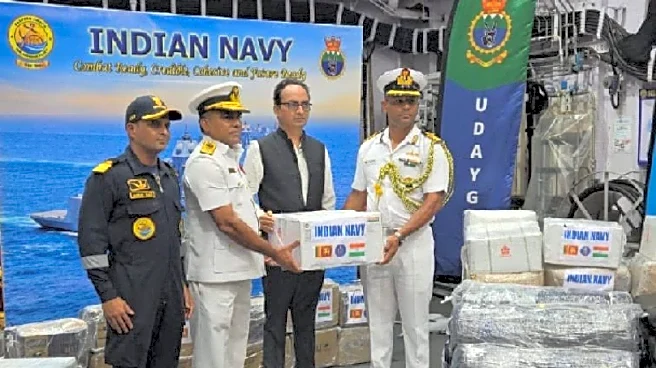

India on Monday said it has ramped up rescue and relief efforts in Sri Lanka under Operation Sagar Bandhu, launched on November 28 after Cyclone Ditwah triggered severe flooding, heavy casualties and large-scale
disruption across the island nation.
According to a statement from the Ministry of External Affairs (MEA), India moved quickly in coordination with Sri Lankan authorities, handing over 9.5 tons of emergency rations from two Indian Navy ships docked in Colombo.
Three Indian Air Force aircraft have also been deployed to airlift 31.5 tons of relief supplies, including tents, tarpaulins, blankets, hygiene kits, ready-to-eat meals, medicines, surgical equipment and two BHISHM medical cubes accompanied by a five-member training team.
In addition, 80 NDRF personnel have been flown in to support search-and-rescue operations. Another 12 tons of relief material was sent aboard INS Sukanya, taking the total assistance dispatched to 53 tons.
Working with the Sri Lankan Air Force, Chetak helicopters from INS Vikrant and IAF Mi-17s have carried out extensive rescue missions, airlifting stranded civilians — among them pregnant women, infants and critically injured people. The rescued include nationals of Sri Lanka, India, Germany, Slovenia, the UK, South Africa, Poland, Belarus, Iran, Australia, Pakistan and Bangladesh.
Over 150 people have been rescued so far, with operations continuing.
India has also evacuated over 2,000 citizens stranded in Sri Lanka via special IAF sorties and commercial flights.
The MEA said the operation reflects India’s Neighbourhood First and Vision MAHASAGAR approach, underscoring its role as the region’s “First Responder” in times of crisis.
Sri Lanka has appealed for international assistance after Cyclone Ditwah caused catastrophic flooding and landslides. Officials said at least 355 people have died and 366 remain missing.
Floodwaters in Colombo peaked overnight, with the capital beginning to see limited reopening as rainfall subsided. Many residents said the speed of the inundation caught them off guard.
“It is not just the amount of water, but how quickly everything went under,” delivery driver Dinusha Sanjaya, 37, told AFP.
Authorities said the full extent of destruction in central Sri Lanka is only now emerging as crews clear uprooted trees and mudslide-hit roads.
President Anura Kumara Dissanayake, who has declared a state of emergency, called it the “largest and most challenging natural disaster” in the country’s history.
Officials say the devastation is the worst Sri Lanka has seen since the 2004 Indian Ocean tsunami, which killed more than 31,000 people and displaced over a million.
/images/ppid_59c68470-image-1770987582774322.webp)

/images/ppid_59c68470-image-177098761981591595.webp)
/images/ppid_59c68470-image-1770987529810585.webp)
/images/ppid_59c68470-image-177098766350256772.webp)

/images/ppid_59c68470-image-177098756909942437.webp)
/images/ppid_59c68470-image-177098752880979418.webp)