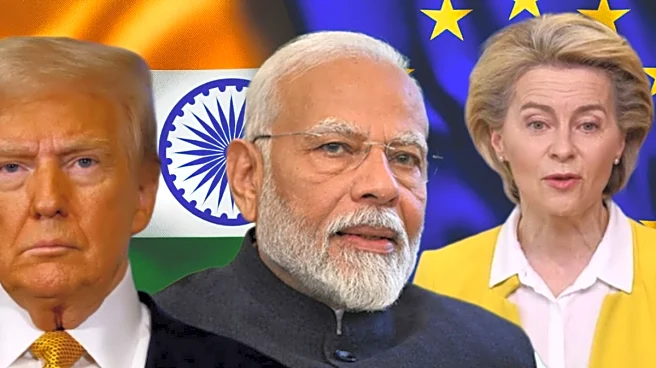

German Chancellor Friedrich Merz, standing on Indian soil, declared that India is a partner of choice and an EU–India free trade agreement is imminent. French President Emmanuel Macron, in a sweeping speech
on Europe’s future, argued that Europe must work closely with India and that it will not be anyone’s vassal. And India’s External Affairs Minister S Jaishankar stated plainly that 2026 will mark a decisive upswing in India–Europe ties. Taken together, these aren’t just diplomatic niceties but reflect a larger pattern indicative of how Europe is turning to India in a big way. At the heart of this shift is the Trump shock. But that’s not the only reason.
India and the European Union are closing in on a major free trade agreement which could be finalised as early as the end of this month. Reports say that January 27th could be the day of signing, while the final deal may exclude agriculture. EU Commission President Ursula von der Leyen, and EU Council President Antonio Costa are visiting India as the chief guests on Republic Day. German Chancellor Friedrick Merz was in India this week to push the trade deal. Being the largest EU member, Germany is at the core of this trade deal, and the Germans say yes to it. But this was not always the case. The EU–India free trade agreement is among the longest-running unfinished projects in global trade diplomacy. Negotiations began in 2007, stalled in 2013, languished for nearly a decade, and were formally revived only in 2022. For almost 18 years, the deal was paralysed by disagreements over tariffs on automobiles and alcohol, intellectual property protections, labour and environmental clauses, and market access for services.
It is striking the speed with which things began to move in 2025. The EU is infamous for being a divided house that drags its feet more often than not. But in 2025, negotiations were accelerated at a pace previously thought impossible. Technical chapters were closed in rapid succession. Political resistance softened. And timelines emerged where none had existed before.
This did not happen because Europe and India resolved old differences overnight. The fast-changing global strategic environment has forced Europe to act. From the Russia-Ukraine war, to Trump’s cold shoulder to China’s growing dominance, Europe has met a rude awakening. It needs to step up its game. As Trump upends alliances, weaponises tariffs, and treats decades-old partnerships as transactional inconveniences, Europe needs to prepare for a world where America is no longer a dependable anchor. And in that world, India looks indispensable — a rare window of opportunity that cannot be missed.
Trump has openly undermined NATO’s credibility, questioned security guarantees to allies, weaponised tariffs against friends and foes alike, and even floated the use of force to acquire Greenland despite Denmark being a NATO member. His 2025 National Security Strategy makes clear that Europe is no longer the centre of American strategic attention, nor the beneficiary of automatic solidarity. For Europe, this is existential.
The European project was built on a transatlantic bargain: American security guarantees in exchange for political alignment and economic openness. That bargain is now conditional, transactional, and volatile. Europe is discovering what India has long known, that dependency masquerading as partnership eventually becomes vulnerability. The EU-India trade deal is, therefore, not a repudiation of America, but one of the key ways to hedge against American unpredictability.
India is a promising great power– 4th largest in the world today, registering the fastest GDP growth rates, with a burgeoning consumer market, a young population and a growing defence budget. India offers scale in manufacturing and skilled workers. India has already done a trade deal with the UK, and the EU does not want to be left behind
Meanwhile, for India, which is facing 50 per cent tariffs from the United States and political perils of an elusive trade deal, the EU, which is technically the second largest economy in the world, is an economic superpower on its own and therefore, a major opportunity. It is India’s largest trading partner, accounting for 17 per cent of India’s total exports. India has roughly a $20 billion trade surplus here, and there is extreme potential for a better deal.
China is often cited as the reason Europe needs India and that is partly true. There’s no such deal between them, and the one they negotiated collapsed in five months in 2021 and has been in the freezer since then. But China dominates trade, with a surplus well over $300 billion favouring Beijing. Europe’s overdependence on China has exposed deep vulnerabilities, especially for Germany. But China is a structural problem; Trump is an immediate one. For Europe, India becomes attractive precisely because it is not America and not China.
India offers Europe diversification. And that is why Merz calls India a partner of choice. At a deeper level, Europe and India are converging on a shared worldview: that the future cannot belong to one power, one alliance, or one axis.
Macron’s calls to resist “spheres of influence” echo Jaishankar’s insistence on strategic autonomy.France’s flirtations forums like BRICS, once dismissed as peripheral, reflects a recognition that global power is dispersing, not consolidating.
India’s leadership role in the Global South, its presidency of major multilateral forums, and its ability to engage Washington, Moscow, Beijing and Brussels without becoming captive to any of them, is increasingly attractive to a Europe seeking relevance in a post-American-centric order.
Can Europe learn to live with India’s strategic autonomy? That’s an ongoing debate. There are differences, mainly on Russia, Ukraine, energy sourcing, and regulation. But under Trump’s shadow, these differences are being managed, not magnified. The question now is, will this alignment grow and outlast Trump?
By making a deal, both India and Europe elevate their negotiating powers. Europe needs it to cap vulnerability against the US and China, while providing a boost to its economy. Meanwhile, India seeks to increase capability — not merely to sell more goods, but to upgrade its economic architecture by pulling in European capital, technology, standards, forcing domestic firms to move up the value chain, improving competitiveness in high-regulation markets, and converting trade access into industrial strength.
All in all, the EU–India free trade deal is set to come to fruition with Trump’s aggression playing the catalyst. But China remains the long-term backdrop in this scheme. And India, increasingly, is Europe’s safe bet in an unsafe world.




/images/ppid_59c68470-image-177105753591587522.webp)