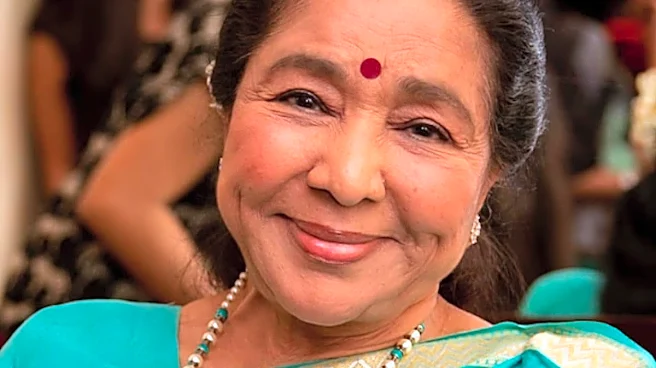




There’s something almost poetic about how legends begin… quietly, nervously, without the world even realising what it is witnessing. Long before her voice became the sound of desire, heartbreak, rebellion and joy, Asha Bhosle was just a little girl standing in front of a microphone, unsure but curious. It’s a memory that now feels heavier, more emotional, in the wake of her passing.
The legendary singer passed away on Sunday, April 12, after being admitted to Mumbai’s Breach Candy Hospital a day earlier due to a chest infection. She was later shifted to the ICU. Her death marks the end of an era in Indian music, a voice that shaped generations, now falling silent.
But decades before the fame, the awards, and the timeless songs, there was a 10-year-old
Asha recording her first track. The year was 1943, and the song was Chala Chala Nav Bala for the Marathi film Majha Bala. It wasn’t a grand studio setup or a polished environment. It was raw, uncertain, and deeply human, much like the young girl stepping into it.
Looking back at that moment years later, she had recalled just how overwhelming it felt. “When I recorded my first song, I was 10 years old. I had to sing this song standing in front of the mic and I was trembling at that time, because I did not know anything then. My father had recorded his songs. Then when I sang the first song, I felt that I can sing. Didi does not only sing, I can also sing.” It was a simple realisation, but one that would go on to change Indian music forever.
The conditions she worked in during those early years were far from what artists experience today. Technology was limited, and recording itself was a test of patience and resilience. In a conversation with Republic Media Network, she once described how unpredictable those sessions could be. “Andheri mein inside the Mohan Studio, sets were not as empty and the shooting was going on everywhere in Mumbai. The recording was set up in a way that I was standing in the open, with a mic hanging from a tree. Inside the orchestra and the musicians had set up in the studio. We recorded the song till 4 am in the morning.”
Nature, too, seemed to have a role in those recordings. “The crows came and cawed and the recording was interrupted. Soon after, the vehicles started to ply and that interrupted the session. The train also began to roll… When the train used to pass through, we used to pause and then begin back the entire recording process. That is how we managed. It was a tough time.” It paints a picture of a very different era — one where music was carved out of chaos, patience, and sheer passion.
From those humble, challenging beginnings emerged a voice that would go on to define multiple moods and generations. Whether it was the playful allure of Piya Tu Ab To Aaja, the quiet romance of Jaiye Aap Kahan Jayenge, the youthful energy of Rangeela Re, or the modern flair of Sharara Sharara, Asha Bhosle refused to be limited to one sound. She moved effortlessly between genres, from peppy dance numbers to deeply soulful ghazals like Dil Cheez Kya Hai and classical compositions such as Tora Man Darpan Kehlaye.
Her journey was not just about versatility but endurance. Even in her later years, she remained deeply connected to music. In 2023, as she turned 90, she chose to celebrate not with a quiet gathering but with a full-fledged concert in Dubai. Speaking to PTI before the performance, she had said, “At 90, standing on stage for three hours belting out songs. I’m thrilled I can still do it.” It was not just a statement of pride, but of love — for an art she never walked away from.
That connection ran deeper than just performance. As she once shared, “Humari saans nahin hoti hai toh aadmi mar jata hai. Mere liye music meri saans hai (If we stop breathing, we die. For me, music is my breath). I’ve lived by that, given everything to music, survived tough times when I thought I couldn’t go on-and here I am.” It was a philosophy she lived by, through every phase of her life.
Even in recent years, she continued to surprise audiences, embracing newer sounds and trends. In 2024, she caught widespread attention for performing Tauba Tauba at a Dubai concert, even recreating a viral dance step, proving yet again that her spirit remained as lively as ever.
Across her career, she earned numerous accolades, including two National Film Awards, the Dadasaheb Phalke Award in 2000, and the Padma Vibhushan in 2008. But beyond the honours, it is the memory of her voice — fearless, versatile, and deeply expressive — that will endure.
Today, when we look back at that 10-year-old girl trembling before a microphone, it feels almost impossible to connect her to the legend she became.