
/images/ppid_59c68470-image-178913506932268890.webp)


China and Russia dominate the conversation around India’s trade deficit within BRICS. But the UAE is another important, and less obvious, piece of the puzzle. India’s trade deficit with the UAE stood at $26.53 billion in FY26, making it the country’s third-largest BRICS trade deficit after China and Russia.
Yet the UAE’s importance to India goes well beyond the trade gap. The Gulf country is a major trading partner, energy supplier, investment hub and logistics gateway connecting India with markets across West Asia, Africa and beyond.
A Big Trade Deficit, But A Bigger Relationship
India’s exports to the UAE have grown 124% since FY21, while bilateral non-oil trade has crossed $76 billion. The India-UAE Comprehensive Economic Partnership Agreement (CEPA) has also removed tariffs on several
goods, making it easier for Indian businesses to access the UAE market.
But trade growth has not translated into a balanced trade equation. India exported goods worth $37.36 billion to the UAE in FY26, while imports stood at $63.89 billion, resulting in a $26.53-billion deficit.
The composition of those imports is also important. India imported gold worth $15.4 billion from the UAE in FY2025-26, according to data cited by the Directorate General of Foreign Trade (DGFT). Gold and other commodities therefore form an important part of the import equation, making the headline trade deficit more nuanced than a simple measure of the strength of the overall relationship.
Also Read: PM Modi’s BRICS Balancing Act: Can India Bridge The Iran-UAE Divide Amid West Asia War?
UAE Is More Than A Trading Partner
The UAE’s importance to India also comes from its position as a major energy producer, financial centre, investor and logistics hub connecting Asia, Europe and Africa.
Its location helps India access wider markets across the Gulf, West Asia and Africa, while its logistics network facilitates the movement of goods towards Central Asia, the Middle East and parts of South Asia.
The UAE is also a major re-export hub. This means bilateral trade figures can reflect wider international supply chains, with goods moving through the UAE before reaching other markets.
Energy is another key pillar. India and the UAE have ties covering oil reserves, LNG and clean-energy projects, adding an important supply-chain and energy-security dimension to the relationship.
Why BRICS Adds Another Layer
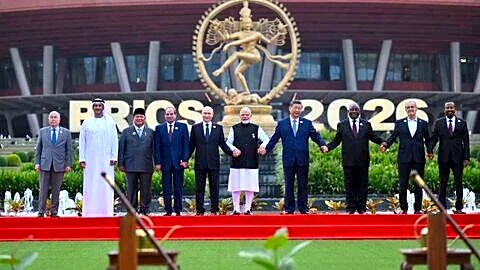
The UAE joined BRICS in 2024 as part of the grouping’s first major expansion. For India, its membership provides another platform to deepen an economic relationship that is already substantial.
Also Read: Iran, UAE At BRICS 2026: India Has A Diplomatic Tightrope To Walk
The UAE’s non-oil foreign trade with BRICS countries crossed $312 billion in 2025, up from $243 billion in 2024. BRICS members accounted for around 31% of the UAE’s total non-oil foreign trade that year.
The India-UAE Trade Paradox
India is among the UAE’s leading trading partners within the grouping. The UAE’s non-oil trade with India reached Dh107.5 billion in the first half of 2026, supported by the India-UAE CEPA.
For India, therefore, the UAE presents a trade paradox. It is a significant source of imports and one of the country’s largest BRICS trade deficits, but it is also a gateway for Indian exports, energy, investment and wider market access.
That makes the UAE an important piece of India’s BRICS trade story – not simply because of the $26.53-billion deficit, but because of what the UAE can offer India beyond the bilateral trade balance.