
Taapsee Pannu has opened up about the ripple effect Alpha’s box office failure had on other female-led films, claiming that investors became hesitant about backing projects headlined by women after the Alia Bhatt and Sharvari-starrer failed to deliver commercially.
The actor, currently promoting her Netflix film Gandhari, argued that one expensive female-led film failing can affect an entire crop of projects. According to Taapsee, male stars and their big-budget films are afforded considerably more room for failure, while women-led films are expected to justify every rupee spent on them.
Alpha, the first female-led film in the YRF Spy Universe, was reportedly made on a budget of Rs 130 crore and earned Rs 100 crore worldwide.
Taapsee Pannu Says
Alpha’s Failure Changed Investor Conversations
During an interview with Zoom TV, Taapsee was asked whether she personally experienced the fallout after Alpha failed at the box office. She responded, “Yes. Every year it happens.”
Explaining the conversations that follow such failures, she said, “The conversations are like, ‘These days, female-driven films are not working. If such a big superstar’s film is not working, then what will happen to the rest? That’s why we won’t make them now. Women-driven cinema is not popular now.’”
According to Taapsee, the consequences can extend to projects that have no connection with the film that underperformed.
“So, if you are talking about four or five films in the market, one or two of them get shelved because someone else’s film flopped. That’s the kind of impact,” she added.
‘Our Scope Of Error Is In Minus’
Taapsee also questioned why big-budget films led by women are expected to meet a different creative benchmark.
“One thing I’ve noticed, and people have been asking me this lately, is that when you put money into a film or mount an action film on a female actor, which is not a conventional genre for a woman, people ask, ‘Why doesn’t it work?’ If you put money into it, make it a big film, and it doesn’t work, then how will anyone invest money again? I have only one question,” she said.
She then compared this scrutiny with the expectations surrounding male-led spectacles. “The big, male-driven film that money is invested in, does it always have an impeccable storyline? Does it always have layers and nuances? Isn’t it sometimes just about glamorisation and wow action sequences?”
Taapsee argued that audiences and investors give male-led commercial films greater latitude. “If there is a male-driven action film, or any kind of big-budget film, and the story is 15 or 20, let’s say 19 or 20, even if it is 15 or 20, it will work. But our measuring yard is different.”
She continued, “If so much money is invested in a female-driven film, there is an expectation that, forget 19 or 20, you have to deliver 21. You cannot go wrong. So, the bandwidth we have for going wrong, the scope of error we have, our delta, that is in minus.”
Taapsee Says One Flop Can Affect ‘Entire Community’
Taapsee also stressed that what is labelled a “big budget” for a woman-led movie remains relatively modest compared with major male-led spectacles.
“If one female-driven film, especially a relatively higher-budget film, flops, and I say ‘relative’ because the budget is not as high as you would expect. If you compare it with the budget of Dhurandhar, it is just a fraction of that, but if there is a flop, the entire community gets affected.”
She added, “All of our leading actresses who want to do films where we lead the story, it impacts all of us. All of our films get shelved. I can tell you from my own experience: if there is a big female-driven flop in a particular year, then the conversations I have with investors change. Investors back out.”
A Hit Can Have The Opposite Effect
Taapsee said the same industry tendency can work in their favour when a female-led film succeeds. A successful film, she explained, can suddenly make producers interested in similar genres.
“There is also a positive side. When someone else’s film becomes popular, suddenly there are new phone calls. People say, ‘Let’s attempt this genre. This is working.’”
Citing horror as an example, she added, “Suddenly, if a horror movie is doing well and it is driven by a female actor, they call and say, ‘With a female, we can make horror. That has worked.’”
“So, it becomes positive for us. Our films get made if that continues. So, we are all together. We are all in the same boat,” Taapsee concluded.
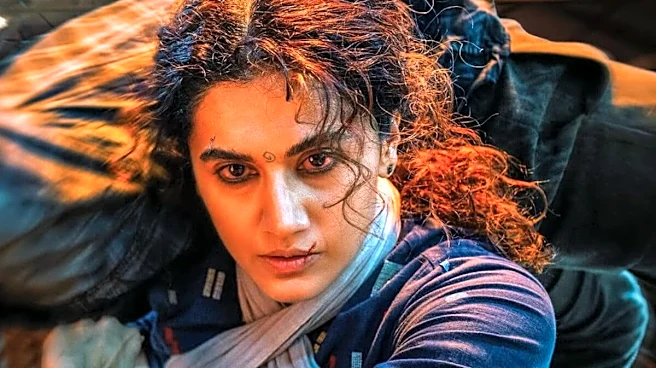
Meanwhile, Taapsee is currently seen in Gandhari, directed by Devashish Makhija and written and produced by Kanika Dhillon. Co-starring Ishwak Singh, the film is streaming on Netflix.