
/images/ppid_59c68470-image-178913753934419938.webp)
/images/ppid_59c68470-image-178914753606414027.webp)

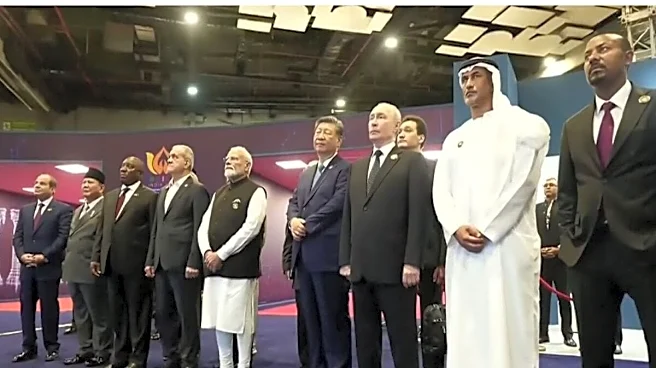
Marking two decades of the bloc’s existence, the XVIII BRICS Summit in New Delhi culminated in the unanimous adoption of the landmark New Delhi Declaration on 12 September 2026. Hosted under India’s Chairship with the theme “Building for Resilience, Innovation, Cooperation and Sustainability”, the declaration outlines a comprehensive blueprint for reformed multilateralism, economic integration, counter-terrorism, and inclusive global governance.
Comprehensive Security and Counter-Terrorism Framework
A central pillar of the New Delhi Declaration is a zero-tolerance stance against security threats:
- Counter-Terrorism & Accountability: In a direct reflection of India’s security imperatives, BRICS leaders condemned in the strongest terms the terrorist attack in Jammu and Kashmir on April 22, 2025, which claimed 26 lives. The bloc explicitly called for accountability for terrorist acts, zero tolerance, and an end to double standards, reiterating that terrorism must not be linked to any religion, nationality, or civilisation.
- Global Norms: Leaders urged the swift finalisation and adoption of the UN Comprehensive Convention on International Terrorism (CCIT) and concerted action against UN-designated entities.
- International Peace & Geopolitics: The declaration expressed grave concern over global polarisation and military spending, calling for peaceful dispute resolution through dialogue, diplomacy, and conflict prevention. On West Asia, members urged maximum restraint, ceasefire compliance in Gaza and Lebanon, protection of civilians, and a two-state solution for Palestine within 1967 borders.
Reforming Global Governance and the UN System
Celebrating the 20th anniversary of BRICS, member states issued an unequivocal call to overhaul current international institutions to reflect contemporary multipolar realities:
- UN Security Council Reform: The declaration reiterates support for comprehensive UN reform, including a structural update of the UN Security Council (UNSC) to amplify the representation of developing nations across Africa, Asia, and Latin America.
- Support for Emerging Nations: Permanent members China and Russia reaffirmed their explicit support for India and Brazil’s aspirations to play greater roles within the UN and its Security Council.
- Institutional Equity: The document called for equitable geographical representation across UN leadership and noted the historical absence of a female UN Secretary-General.
India-Centric Economic and Technological Initiatives
India’s leadership left a distinct
footprint on the document’s economic, financial, and technological outcomes:
- Financial Systems and Infrastructure: The summit endorsed technical progress under the BRICS Payment Task Force to explore fast, low-cost cross-border payment mechanisms and local currency trade settlements. Members welcomed India’s proposal to host a BRICS Risk Lab at the GIFT City International Financial Services Centre (IFSC) in Gujarat to strengthen the regional reinsurance framework. Additionally, the India Centre for BRICS Industrial Competencies (ICBIC) was formally established.
- Digital Public Infrastructure (DPI) & AI: Building on India’s technological leadership, the declaration recognised the transformative role of DPI and Digital Public Goods for equitable growth. It noted proposals for a BRICS DPI repository and commended India for hosting the AI Impact Summit in February 2026.
- Micro, Small, and Medium Enterprises (MSMEs): The declaration celebrated the inaugural BRICS SME Forum held in Agra and welcomed the Jaipur Consensus to study an Invoice Discounting Mechanism to unlock working capital for export-oriented MSMEs.
Health, Environment, and Social Development
The declaration embedded several Indian healthcare and environmental models into the international framework:
- Mental Health and TCIM: NIMHANS (Bengaluru) was designated as the coordinating Centre of Excellence for the newly established BRICS Training Hub Network for mental well-being. The document also established an Expert Working Group on Traditional, Complementary and Integrative Medicine (TCIM).
- Disaster Management & Environment: BRICS members acknowledged India’s leadership in creating the Coalition for Disaster Resilient Infrastructure (CDRI) and welcomed the Guwahati Declaration on anti-drug cooperation.
- Biodiversity Conservation: The bloc took note of India’s initiative to establish the International Big Cats Alliance (IBCA).
The New Delhi Declaration reinforces the expanded BRICS grouping as a decisive voice for the Global South, bridging consensus across diverse economies to drive equitable development and global policy reform.


/images/ppid_59c68470-image-178914503440362465.webp)

/images/ppid_59c68470-image-178921753537169740.webp)



