
Daldal sets out with a strikingly dark promise, one that peers into the decaying margins of Mumbai’s underbelly and asks an unsettling question: what makes a serial killer a killer? The series isn’t interested
in jump scares or surface-level shocks alone; it wants to explore the psychology behind violence, the trauma that festers long before blood is spilled, and the past that almost always precedes monstrosity.
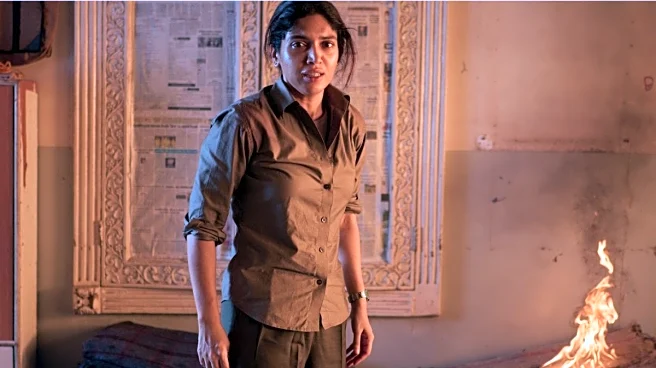
The show opens on a chilling note with the murder of an animal rights activist, found dead with his wrists slit and chunks of raw meat stuffed into his mouth. It’s a brutal, symbolic crime and a statement of intent and Daldal does not shy away from cold-blooded violence. Tasked with solving the case is Rita Ferreira, Mumbai Crime Branch’s youngest DCP, newly appointed and already fighting battles on multiple fronts.
Played by Bhumi Satish Pednekar, Rita is stoic to the point of emotional isolation. She rarely smiles, barely emotes, and moves through the narrative like someone carrying a lifetime of unresolved grief. Her personal demons —– a fractured childhood, an absent father and a strained relationship with her mother — are slowly unpacked as the investigation progresses. Rita isn’t just hunting a killer, she’s fighting her own impostor syndrome while navigating a deeply patriarchal police force that questions her authority at every turn.
One of the show’s unusual choices is revealing the killer’s identity very early on. This changes the nature of Daldal completely. Instead of building suspense around who committed the crime, the series turns into a psychological drama. The focus shifts to why the crime happened and what led the killer to this point. The story tries to explore the emotional and mental damage behind the violence, suggesting that serial killers are shaped by their past. Again and again, the show points to abuse, neglect, and trauma as forces that create the person we see in the present.
However, this is also where Daldal begins to struggle. In trying to explore the psyche of a serial killer, the series also attempts to tackle sexism in the workplace, childhood abuse, drug addiction, prostitution, human trafficking, media ethics and systemic failure — all within the same narrative framework. While each theme is relevant and timely, the sheer volume works against the show. Instead of converging into a powerful whole, these threads often feel scattered, diluting the emotional and narrative impact.
Bhumi Pednekar’s performance mirrors this inconsistency. Her restrained approach works well in a few emotional scenes, where her vulnerability briefly breaks through the stoicism. In those moments, she reminds you why she is regarded as a formidable actress. But for much of the series, the monotony of the performance weighs the character down. With limited dialogue and heavy reliance on body language, the portrayal doesn’t always land as intended.
Aditya Rawal is a clear standout as Sajid, a young drug addict caught between self-destruction and survival. His performance is raw and largely unsettling. Samara Tijori also impresses as journalist Anita, a character with a bleak past and secrets of her own. Her character doesn’t demand attention immediately, but as the series progresses, her presence begins to matter more and more.
Another performance that deserves special mention is Geeta Sharma as Indu Mhatre, the sub-inspector who becomes one of the emotional anchors of the series. Sharma is fantastic in the role, bringing lived-in realism to a character constantly juggling professional integrity and personal vulnerability. Indu’s struggle to balance the demands of police work with motherhood — particularly in scenes involving her son. Some of Daldal’s most effective moments unfold in her interactions with Bhumi Pednekar’s Rita Ferreira, where the show briefly pauses its grim momentum to explore empathy, resilience and solidarity between two women navigating a hostile system.
Ultimately, Daldal is a series brimming with ambition and intent. It wants to be a psychological study, a social commentary and a crime drama all at once. While the promise is undeniable, the execution remains uneven. By revealing its killer early and overloading its thematic canvas, the show drifts into a slow-burning drama rather than the gripping thriller it initially suggests. It’s absorbing in parts, flawed in structure— and leaves you thinking more than it leaves you breathless.
At times, when one thread is given space to stand out, the others are left underdeveloped or abruptly pushed aside. There are moments where this balancing act works, but just as often, the narrative feels scattered and uneven. As a result, Daldal becomes something of a mishmash — part crime drama, part psychological study, part social commentary — without fully committing to any one form. It’s watchable and occasionally effective, but rarely gripping.



/images/ppid_a911dc6a-image-176972903382680791.webp)