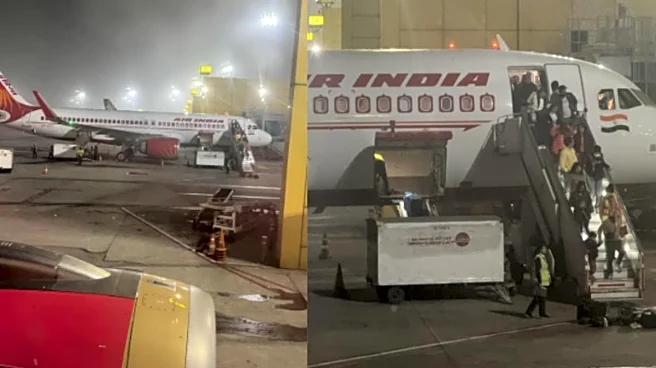



Jog your memory: When was the last time you or someone you know deboarded an airplane from the right side? If your answer is never, you are possibly in the majority. A passenger at New Delhi’s Indira Gandhi International Airport (IGI) recently witnessed an unusual sight: passengers on an Air India flight disembarking down the airstairs from the right side of the aircraft after it had landed and taxied to the apron. Sensing that this wasn’t something they had not seen before, the curious passenger quickly snapped a photograph, took to the Internet, and posed a question: “Its not that common or is it ? (sic)”
Additionally, the Reddit user, on the r/AirIndiaTravel Subreddit, provided the location: “Just saw this at IGI T3 now 18:40 06/01/2026.”
Was this a one-time occurrence or a common operation at airports?
The passenger, who posed the question, received swift responses from the Reddit community and the most upvoted response answered the query.
“Shared Route”
As it turns out, the Air India airplane you see in the post attached below operates on both domestic and international routes. In this specific case, the Air India flight had operated the Bangkok-Delhi route. After completing the journey, the aircraft was parked on the domestic side of T3 (international) terminal in Delhi for its outbound flight to Bengaluru.
The passengers had completed an international trip, meaning they had to proceed to the immigration area. They were deplaned via airstairs to hop on the Air India bus heading towards the international side of the terminal. In short, if the passengers had exited via the aerobridge, they would have ended up at the domestic section of T3.
De boarding from the right side
byu/mrbadheart inAirTravelIndia
“VT-RTT, after operating the flight BKK-DEL, is parked on the domestic side of T3 for its next flight DEL-BLR. If the pax are made to exit via aerobridge, they’ll end up in the domestic terminal. Therefore, they’re made to exit via stairs and will be taken to the international side on a bus. This happens quite frequently when aircrafts are used for both international and domestic routes,” the Reddit user (u/amflyinhigh) explained in their response.
What’s VT-RTT?
“VT-RTT” denotes the registration number or is a unique identifier of an aircraft. The suffix on this Air India bird, “VT”, indicates its country of origin, India (G for the United Kingdom, N for the United States). According to flightradar24.com, the plane we see in the photo uploaded by the user is a gorgeous Airbus A320neo (Airbus A320-251N).
Airbus A320neo
Air India, on its official website, flaunts the amenities, curated onboard service, and seat layouts of its Airbus A320neo fleet. The type is in service by Air India for both domestic and short-haul international routes.
Air India has currently deployed Airbus A320neo for the following short-haul international routes:
Hyderabad-Dubai
Dubai-Hyderabad
Delhi-Yangon
Delhi-Doha
Doha-Delhi
Mumbai-Dammam
Bangkok-Delhi
Delhi-Bangkok
Bangkok-Mumbai
Mumbai-Bangkok
Mumbai-Dhaka
Dhaka-Mumbai
Yangon-Delhi
Doha-Mumbai
Dammam-Mumbai
Mumbai-Doha
No Boarding From The Right
While deplaning from the right may not be a common sight, the boarding of passengers is strictly restricted to the left side of the airplane.
Ground Crew
Airlines strive for quick turnaround times. When the cabin crew is preparing for the outbound flight, the ground crew is tasked with baggage loading, refuelling the jet, and several other crucial tasks. Boarding passengers and cabin crew from the left side of the aircraft ensures a swift, efficient, and uninterrupted workflow for the ground crew.
Age-old Tradition
According to a writeup published on mondortiz.com, boarding on the left side of the plane is tied to the nautical legacy.
“In seafaring terms, the left side of a ship is known as ‘port, while the right side is ‘starboard.’ This nomenclature can be traced back to a time when ships were guided by a steering oar, typically located on the right side or the ‘steerboard’ due to the right-hand dominance of most individuals. To avoid interference with the steering oar, embarking and disembarking were usually conducted from the left side of the ship – the port side,” the blog noted.
Additionally, the captain occupies the left seat in the cockpit. In the early days of aviation, airports were designed to accommodate boarding and deboarding on the left side, allowing pilots to better judge wingtip clearance while taxiing and parking on the apron, thereby preventing structural damage to the aircraft, the blog further explained.







/images/ppid_a911dc6a-image-177073402422810189.webp)
